
Human/Mouse CTLA-4 Antibody
R&D Systems, part of Bio-Techne | Catalog # MAB386


Scientific images may be resized, cropped, or adjusted for brightness or contrast for presentation purposes. These updates are limited to presentation and do not affect the underlying scientific interpretation of the data. Where available, additional source data may be provided upon request.
Conjugate
Catalog #
Key Product Details
Species Reactivity
Human, Mouse
Applications
Western Blot, Agonist Activity
Label
Unconjugated
Antibody Source
Monoclonal Mouse IgG1 Clone # 1003705
Product Specifications
Immunogen
Chinese Hamster Ovary cell line, CHO-derived human CTLA-4
Ala37-Phe162
Accession # P16410
Ala37-Phe162
Accession # P16410
Specificity
Detects human CTLA-4 in direct ELISAs. Detects human and moue CTLA-4 in Western blots.
Clonality
Monoclonal
Host
Mouse
Isotype
IgG1
Scientific Data Images for Human/Mouse CTLA-4 Antibody
Detection of Human and Mouse CTLA‑4 by Western Blot.
Western blot shows lysates of NS0 mouse myeloma cell line transfected with with Human CTLA-4 and mouse lymph node tissue. PVDF membrane was probed with 2 µg/mL of Mouse Anti-Human/Mouse CTLA-4 Monoclonal Antibody (Catalog # MAB386) followed by HRP-conjugated Anti-Mouse IgG Secondary Antibody (Catalog # HAF018). A specific band was detected for CTLA-4 at approximately 52 kDa (as indicated). This experiment was conducted under reducing conditions and using Immunoblot Buffer Group 1.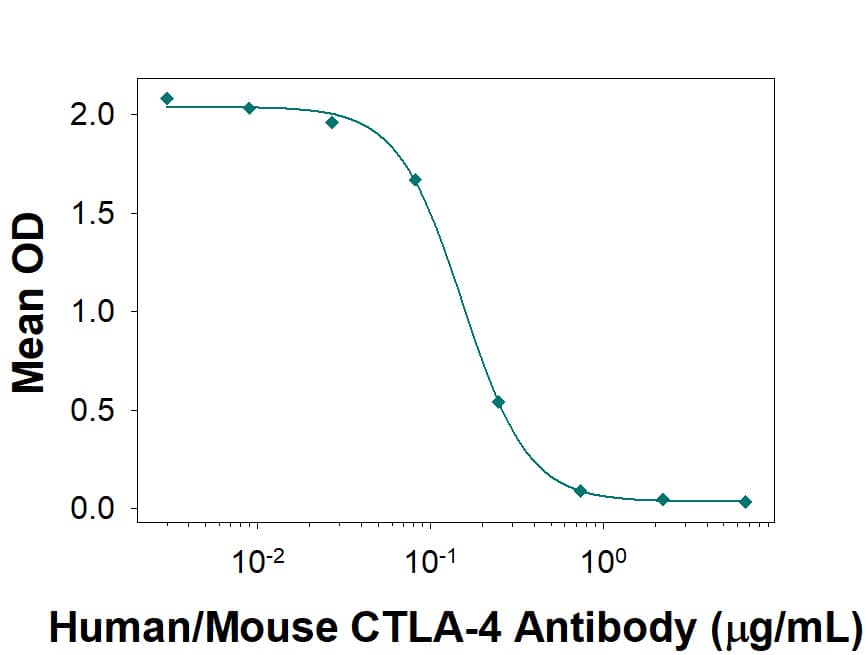
Inhibition of Anti-CD3 Induced IFN-gamma Secretion by Human/Mouse CTLA‑4 Antibody.
Anti-Human/Mouse CTLA-4 Monoclonal Antibody (Catalog # MAB386) inhibits IFN-gamma secretion in human peripheral blood mononuclear cells (PBMC) induced by immobilized Mouse Anti-Human CD3e Monoclonal Antibody (Catalog # MAB100) coated at 1 µg/mL (100 µL/well) in a dose-dependent manner (green line) as measured by the Human IFN-gamma Quantikine ELISA Kit (Catalog # DIF50C). The ED50 is typically 0.05-0.4 µg/mL.Applications for Human/Mouse CTLA-4 Antibody
Application
Recommended Usage
Agonist Activity
Measured
by its ability to to inhibit anti-CD3 antibody induced IFN-gamma
secretion by human peripheral blood mononuclear cells (PBMC). The ED50 for
this effect is 0.05-0.4 μg/mL.
Western Blot
2 µg/mL
Sample: NS0 mouse myeloma cell line transfected with with Human CTLA‑4 and Mouse lymph node tissue
Sample: NS0 mouse myeloma cell line transfected with with Human CTLA‑4 and Mouse lymph node tissue
Formulation, Preparation, and Storage
Purification
Protein A or G purified from hybridoma culture supernatant
Reconstitution
Reconstitute at 0.5 mg/mL in sterile PBS. For liquid material, refer to CoA for concentration.
Formulation
Lyophilized from a 0.2 μm filtered solution in PBS with Trehalose. *Small pack size (SP) is supplied either lyophilized or as a 0.2 µm filtered solution in PBS.
Shipping
Lyophilized product is shipped at ambient temperature. Liquid small pack size (-SP) is shipped with polar packs. Upon receipt, store immediately at the temperature recommended below.
Stability & Storage
Use a manual defrost freezer and avoid repeated freeze-thaw cycles.
- 12 months from date of receipt, -20 to -70 °C as supplied.
- 1 month, 2 to 8 °C under sterile conditions after reconstitution.
- 6 months, -20 to -70 °C under sterile conditions after reconstitution.
Background: CTLA-4
CTLA-4 (Cytotoxic T-lymphocyte Associated protein‑4, designated CD152), is a type I transmembrane T cell inhibitory molecule that is a member of the Ig superfamily (1, 2). Human or mouse CTLA-4 cDNA encodes 223 amino acids (aa) including a 35 aa signal sequence, a 126 aa extracellular domain (ECD) with one Ig-like V-type domain, a 21 aa transmembrane (TM) sequence, and a 41 aa cytoplasmic sequence. It is found as a covalent homodimer of 41-43 kDa (2) Within the ECD, human CTLA-4 shares 68%, 71% and 83‑86% aa sequence identity with mouse, rat and porcine/bovine/rabbit/feline/canine CTLA-4, respectively. A 174 aa form that lacks TM and cytoplasmic sequences (sCTLA-4) is possibly secreted (3-5). Isoforms of 56-79 aa that mainly contain parts of the cytoplasmic domain are reported. In mouse, an isoform lacking the Ig-like domain has ligand-independent inhibitory activity and is termed liCTLA-4 (6). CD28, which is structurally related to CTLA-4, is constitutively expressed on naïve T cells and promotes T cell activation when engaged by B7-2 on antigen-presenting cells (APC) within the immunological synapse (IS) (1, 7, 8). In contrast, CTLA-4 is recruited from intracellular vesicles to the IS beginning 1-2 days after T cell activation (2, 7, 8). It forms a linear lattice with B7-1 on APC, inducing negative regulatory signals and ending T cell activation (9). Abatacept, a therapeutic human CTLA-4-Ig fusion protein (trade name Orencia), competes with CD28 for B7-1 and B7-2 binding and has been used to antagonize T cell activation in autoimmune conditions and to enhance transplant survival (10). Mice deleted for CTLA-4 show no abnormalities until after birth, but then develop lethal autoimmune reactions due to continued T cell activation and poor control by regulatory T cells, which constitutively express CTLA-4 in wild-type mice and humans (11-13).
References
- Harper, K. et al. (1991) J. Immunol. 147:1037.
- Teft, W.A. et al. (2006) Annu. Rev. Immunol. 24:65.
- Magistrelli, G. et al. (1999) Eur. J. Immunol. 29:3596.
- Tector, M. et al. (2009) BMC Immunol. 10:51.
- Oaks, M.K. and K.M. Hallett (2000) J. Immunol. 164:5015.
- Vijayakrishnan, L. et al. (2004) Immunity 20:563.
- Pentcheva-Hoang, T. et al. (2004) Immunity 21:401.
- Jansson, A. et al. (2005) J. Immunol 175:1575.
- Darlington, P.J. et al. (2005) J. Immunol. 175:996.
- Platt, A.M. et al. (2010) J. Immunol. 185:1558.
- Wing, K. et al. (2008) Science 322:271.
- Friedline, R.H. et al. (2009) J. Exp. Med. 206:421.
- Jain, N. et al. (2010) Proc. Natl. Acad. Sci. USA 107:1524.
Long Name
Cytotoxic T-lymphocyte-associated Molecule 4
Alternate Names
CD152, CTLA4
Gene Symbol
CTLA4
UniProt
Additional CTLA-4 Products
Product Documents for Human/Mouse CTLA-4 Antibody
Product Specific Notices for Human/Mouse CTLA-4 Antibody
For research use only
Loading...
Loading...
Loading...
Loading...
Loading...