
Recombinant Human FGF-10 Protein Best Seller
R&D Systems, part of Bio-Techne | Catalog # 345-FG

Key Product Details
- R&D Systems E. coli-derived Recombinant Human FGF-10 Protein (345-FG)
- Quality control testing to verify active proteins with lot specific assays by in-house scientists
- All R&D Systems proteins are covered with a 100% guarantee
Product Specifications
Source
E. coli-derived human FGF-10 protein
Cys37-Ser208 & Gly41-Ser208
Cys37-Ser208 & Gly41-Ser208
Purity
>97%, by SDS-PAGE visualized with Silver Staining and quantitative densitometry by Coomassie® Blue Staining.
Endotoxin Level
<0.10 EU per 1 μg of the protein by the LAL method.
N-terminal Sequence Analysis
Cys37 & Gly41
Predicted Molecular Mass
19.5 kDa
SDS-PAGE
19-22 kDa, reducing conditions
Activity
Measured in a cell proliferation assay using 4MBr-5 rhesus monkey epithelial cells. Rubin, J.S. et al. (1989) Proc. Natl. Acad. Sci. USA 86:802.
The ED50 for this effect is 20-100 ng/mL.
The ED50 for this effect is 20-100 ng/mL.
Reviewed Applications
Read 1 review rated 5 using 345-FG in the following applications:
Scientific Data Images for Recombinant Human FGF-10 Protein

Recombinant Human FGF-10 Protein Bioactivity
Recombinant Human FGF-10 (Catalog # 345-FG) stimulates cell proliferation of the 4MBr‑5 rhesus monkey epithelial cell line. The ED50 for this effect is 20-100 ng/mL.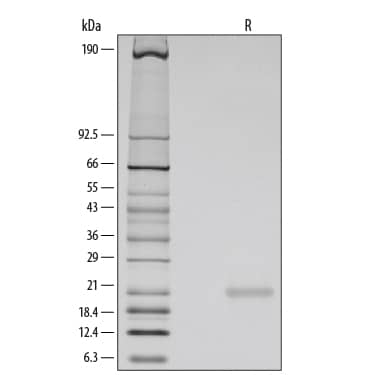
Recombinant Human FGF-10 Protein SDS-PAGE
1 μg/lane of Recombinant Human FGF-10 was resolved with SDS-PAGE under reducing (R) conditions and visualized by silver staining, showing a single band at 21 kDa.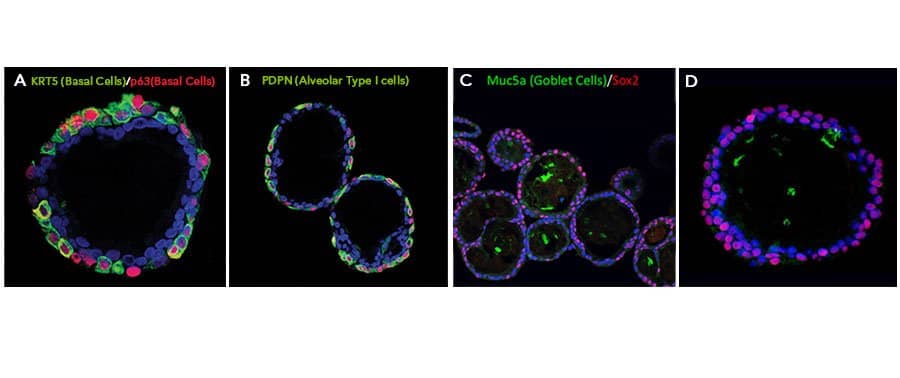
Adult stem cell-derived Lung Organoids Cultured using Recombinant Human FGF-10 Protein.
Adult stem cells isolated from human lung biopsy tissue were embedded in Cultrex UltiMatrix RGF Basement Membrane Extract (BME001-05) and cultured for 20-60 days in lung organoid expansion medium, which includes Recombinant Human FGF-10 (Catalog # 345-FG), Recombinant Human KGF/FGF-7 (251-KG), Recombinant Human Noggin (6057-NG), and Recombinant Human R-Spondin 1 (4645-RS), along with the other reagents listed in the lung organoid expansion medium recipe in the lung organoid culture protocol. Lung organoids were able to differentiate and exhibit markers for various cell types of the lung. Lung organoids were stained with (A) a Rabbit Anti-Human Cytokeratin 5 (KRT5) Monoclonal Antibody (Novus Biologicals, Catalog # NB110-56916; green) and a Goat Anti-Human p63/TP73L Polyclonal Antibody (AF1916; red) to visualize basal cells, (B) a Hamster Anti-Mouse Podoplanin (PDPN) Monoclonal Antibody (Novus Biologicals, Catalog # NB600-1015; green) to visualize alveolar type I cells and a Goat Anti-Human p63/TP73L Polyclonal Antibody (AF1916; red) to visualize basal cells, and (C, D) a Mouse Anti-MUC5AC Monoclonal Antibody (Novus Biologicals, Catalog # NBP2-15196; green) to visualize Goblet cells and a Mouse Anti-Human/Mouse/Rat SOX2 Monoclonal Antibody (MAB2018; red). All samples were counterstained with DAPI (5748; blue).Formulation, Preparation and Storage
Carrier Free
What does CF mean?CF stands for Carrier Free (CF). We typically add Bovine Serum Albumin (BSA) as a carrier protein to our recombinant proteins. Adding a carrier protein enhances protein stability, increases shelf-life, and allows the recombinant protein to be stored at a more dilute concentration. The carrier free version does not contain BSA.
What formulation is right for me?In general, we advise purchasing the recombinant protein with BSA for use in cell or tissue culture, or as an ELISA standard. In contrast, the carrier free protein is recommended for applications, in which the presence of BSA could interfere.
Carrier: 345-FG
| Formulation | Lyophilized from a 0.2 μm filtered solution in MOPS, Na2SO4, EDTA and DTT with BSA as a carrier protein. |
| Reconstitution | Reconstitute at 100 μg/mL in sterile PBS containing at least 0.1% human or bovine serum albumin. |
| Shipping | The product is shipped at ambient temperature. Upon receipt, store it immediately at the temperature recommended below. |
| Stability & Storage | Use a manual defrost freezer and avoid repeated freeze-thaw cycles.
|
Carrier Free: 345-FG/CF
| Formulation | Lyophilized from a 0.2 μm filtered solution in MOPS, Na2SO4, EDTA and DTT. |
| Reconstitution | Reconstitute at 100 μg/mL in sterile PBS. |
| Shipping | The product is shipped at ambient temperature. Upon receipt, store it immediately at the temperature recommended below. |
| Stability & Storage | Use a manual defrost freezer and avoid repeated freeze-thaw cycles.
|
Background: FGF-10
References
- Beenken, A. and M. Mohammadi (2009) Nat. Rev. Drug Discov. 8:235.
- Igarashi, M. et al. (1998) J. Biol. Chem. 273:13230.
- Emoto, H. et al. (1997) J. Biol. Chem. 272:23191.
- Beer, H.-D. et al. (2005) Oncogene 24:5269.
- Zhang, X. et al. (2006) J. Biol. Chem. 281:15694.
- Min, H. et al. (1998) Genes Dev. 12:3156.
- Rice, R. et al. (2004) J. Clin. Invest. 113:1692.
- Bellusci, S. et al. (1997) Development 124:4867.
- Weaver, M. et al. (2000) Development 127:2695.
- Pirvola, U. et al. (2000) J. Neurosci. 20:6125.
- Sakaue, H. et al. (2002) Genes Dev. 16:908.
- Donjacour, A.A. et al. (2003) Dev. Biol. 261:39.
- Mailleux, A.A. et al. (2002) Development 129:53.
- Makarenkova, H.P. et al. (2000) Development 127:2563.
- Jaskoll, T. et al. (2005) BMC Dev. Biol. 5:11.
- Nomura, S. et al. (2008) Br. J. Cancer 99:305.
Long Name
Fibroblast Growth Factor 10
Alternate Names
FGF10, KGF-2, KGF2
Gene Symbol
FGF10
UniProt
Additional FGF-10 Products
Product Documents for Recombinant Human FGF-10 Protein
Product Specific Notices for Recombinant Human FGF-10 Protein
For research use only
Loading...
Loading...
Loading...
Loading...