
Human TRAILR4/TNFRSF10D PE-conjugated Antibody
R&D Systems, part of Bio-Techne | Catalog # FAB633P

Conjugate
Catalog #
Key Product Details
Species Reactivity
Validated:
Human
Cited:
Human, Rat
Applications
Validated:
Flow Cytometry
Cited:
Western Blot, Flow Cytometry
Label
Phycoerythrin (Excitation = 488 nm, Emission = 565-605 nm)
Antibody Source
Monoclonal Mouse IgG1 Clone # 104918
Product Specifications
Immunogen
Mouse myeloma cell line NS0-derived recombinant human TRAIL R4/TNFRSF10D
Ala56-His211
Accession # Q9UBN6
Ala56-His211
Accession # Q9UBN6
Specificity
Detects human TRAIL R4/TNFRSF10D in ELISAs and Western blots. In sandwich immunoassays, less than 5% cross-reactivity with recombinant human (rh) TRAIL R1, rhTRAIL R2, TRAIL R3, rhTRAIL, rhTNF‑ alpha, and rhTNF-beta is observed.
Clonality
Monoclonal
Host
Mouse
Isotype
IgG1
Scientific Data Images for Human TRAILR4/TNFRSF10D PE-conjugated Antibody
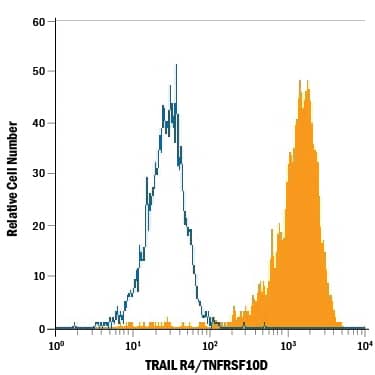
Detection of TRAIL R4/TNFRSF10D in Human Blood Granulocytes by Flow Cytometry.
Human peripheral blood granulocytes were stained with Mouse Anti-Human TRAIL R4/TNFRSF10D PE-conjugated Monoclonal Antibody (Catalog # FAB633P, filled histogram) or isotype control antibody (Catalog # IC002P, open histogram). View our protocol for Staining Membrane-associated Proteins.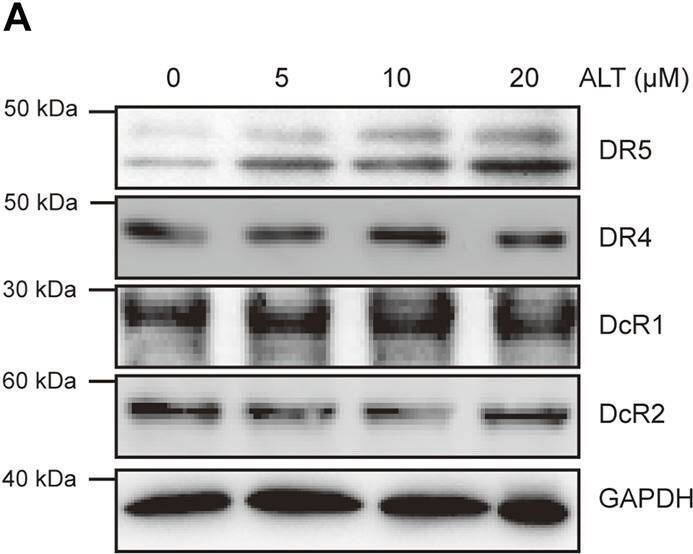
Detection of TRAILR4/TNFRSF10D by Western Blot
Alternol induces expression of DR5. (A) Caki-1 cells were treated with various doses of alternol (ALT) for 24 h. Total cellular extracts were then prepared and analyzed for DR4, DR5, DcR1, and DcR2 by western blot. (B) Caki-1 cells were treated with various doses of alternol (ALT) for 24 h. DR5, DR4, DcR1, and DcR2 mRNA levels were analyzed by qRT-PCR. (C) Cellular surface levels of DR5, DR4, DcR1, and DcR2 were analyzed by flow cytometry staining using PE-conjugated specific antibodies for each receptor. IgG isotype controls (gray histogram), DMSO (gray line), and alternol (red line) are presented. (D) Caki-1 cells were treated with various doses of alternol for 24 h or treated with 20 μM alternol for different times. Then, cellular lysates were analyzed with indicated antibodies. HCT116 wt and HCT116 p53−/− cells were treated with various doses of alternol for 24 h, and DR5 protein and mRNA levels were analyzed by western blot (E) and qRT-PCR (F), respectively. (G) Various types of carcinoma cells were treated with 20 μM alternol for 24 h, after which whole-cell extracts were analyzed by western blot assay. The same blots were stripped and re-incubated with actin antibody to confirm equal protein loading. Data are the mean ± SD of three independent experiments. *p < 0.05; **p < 0.01; ***p < 0.001, compared with 0 μM ALT. Image collected and cropped by CiteAb from the following open publication (https://pubmed.ncbi.nlm.nih.gov/33841136), licensed under a CC-BY license. Not internally tested by R&D Systems.Applications for Human TRAILR4/TNFRSF10D PE-conjugated Antibody
Application
Recommended Usage
Flow Cytometry
10 µL/106 cells
Sample: Human peripheral blood granulocytes
Sample: Human peripheral blood granulocytes
Formulation, Preparation, and Storage
Purification
Protein A or G purified from ascites
Formulation
Supplied in a saline solution containing BSA and Sodium Azide.
Shipping
The product is shipped with polar packs. Upon receipt, store it immediately at the temperature recommended below.
Stability & Storage
Protect from light. Do not freeze.
- 12 months from date of receipt, 2 to 8 °C as supplied.
Background: TRAILR4/TNFRSF10D
Human TRAIL R4, also called Decoy Receptor 2 (DcR2) and TRUNND (TRAIL Receptor with a Truncated Death Domain), is a type I, TNF R family transmembrane protein, which is a receptor for TRAIL (APO2 Ligand). In the TNF superfamily nomenclature, TRAIL R4 is designated as TNFRSF10D. TRAIL R4 is unique among the TRAIL receptors in that its cytoplasmic domain contains a truncated consensus death domain motif. Binding of TRAIL R4 does not result in an apoptotic signal. Overexpression of TRAIL R4 can protect cells bearing TRAIL R1 and/or TRAIL R2 from TRAIL-mediated apoptosis. The human soluble TRAIL R4/Fc chimera neutralizes the ability of TRAIL to induce apoptosis.
References
- Griffith, T.S. et al. (1998) Curr. Opin. Immunol. 10:559.
- Pan, G. et al. (1998) FEBS lett 424:41.
- Marsters, S.A. et al. (1997) Cur. Biol. 7:1003.
- Degli-Esposti, M.A. et al. (1997) Immunity 7:813.
Long Name
TRAIL Receptor 4
Alternate Names
CD264, DcR2, TNFRSF10D, TRAIL R4
Entrez Gene IDs
8793 (Human)
Gene Symbol
TNFRSF10D
UniProt
Additional TRAILR4/TNFRSF10D Products
Product Documents for Human TRAILR4/TNFRSF10D PE-conjugated Antibody
Product Specific Notices for Human TRAILR4/TNFRSF10D PE-conjugated Antibody
For research use only
Loading...
Loading...
Loading...
Loading...
Loading...
Loading...