
Human MMP-14/MT1-MMP Antibody
R&D Systems, part of Bio-Techne | Catalog # MAB9181


Scientific images may be resized, cropped, or adjusted for brightness or contrast for presentation purposes. These updates are limited to presentation and do not affect the underlying scientific interpretation of the data. Where available, additional source data may be provided upon request.
Conjugate
Catalog #
Key Product Details
Species Reactivity
Validated:
Human
Cited:
Human
Applications
Validated:
Immunohistochemistry, Western Blot, Flow Cytometry, Immunoprecipitation, CyTOF-ready
Cited:
Immunohistochemistry, Immunohistochemistry-Frozen, Western Blot, Flow Cytometry, Immunocytochemistry, CyTof
Label
Unconjugated
Antibody Source
Monoclonal Mouse IgG2B Clone # 128527
Product Specifications
Immunogen
Mouse myeloma cell line NS0-derived recombinant human MMP‑14/MT1‑MMP
Tyr112-Ala541 (predicted)
Accession # P50281
Tyr112-Ala541 (predicted)
Accession # P50281
Specificity
Detects human MMP‑14/MT1‑MMP in direct ELISAs and Western blots. Does not detect E. coli-expressed recombinant human MMP-14 catalytic domain (aa 112-284).
Clonality
Monoclonal
Host
Mouse
Isotype
IgG2B
Scientific Data Images for Human MMP-14/MT1-MMP Antibody
Detection of MMP-14/MT1-MMP in MDA‑MB‑231 Human Cell Line by Flow Cytometry.
MDA-MB-231 human breast cancer cell line was stained with Mouse Anti-Human MMP-14/MT1-MMP Monoclonal Antibody (Catalog # MAB9181, filled histogram) or isotype control antibody (Catalog # MAB0041, open histogram), followed by Allophycocyanin-conjugated Anti-Mouse IgG Secondary Antibody (Catalog # F0101B).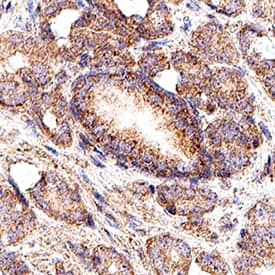
Detection of MMP-14/MT1-MMP in Human Prostate Cancer.
MMP-14/MT1-MMP was detected in immersion fixed paraffin-embedded sections of Human Prostate Cancer using Mouse Anti-Human MMP-14/MT1-MMP Monoclonal Antibody (Catalog # MAB9181) at 15 µg/mL for 1 hour at room temperature followed by incubation with the Anti-Mouse IgG VisUCyte™ HRP Polymer Antibody (Catalog # VC001). Before incubation with the primary antibody, tissue was subjected to heat-induced epitope retrieval using VisUCyte Antigen Retrieval Reagent-Basic (Catalog # VCTS021). Tissue was stained using DAB (brown) and counterstained with hematoxylin (blue). Specific staining was localized to cytoplasm in epithelial cells. View our protocol for IHC Staining with VisUCyte HRP Polymer Detection Reagents.Applications for Human MMP-14/MT1-MMP Antibody
Application
Recommended Usage
CyTOF-ready
Ready to be labeled using established conjugation methods. No BSA or other carrier proteins that could interfere with conjugation.
Flow Cytometry
0.25 µg/106 cells
Sample: MDA‑MB‑231 human breast cancer cell line
Sample: MDA‑MB‑231 human breast cancer cell line
Immunohistochemistry
8-25 µg/mL
Sample: Immersion fixed paraffin-embedded sections of Human Prostate Cancer.
Sample: Immersion fixed paraffin-embedded sections of Human Prostate Cancer.
Immunoprecipitation
25 µg/mL
Sample: Conditioned cell culture medium spiked with Recombinant Human MMP‑14 (Catalog # 918‑MP), see our available Western blot detection antibodies
Sample: Conditioned cell culture medium spiked with Recombinant Human MMP‑14 (Catalog # 918‑MP), see our available Western blot detection antibodies
Western Blot
1 µg/mL
Sample: Recombinant Human MMP-14 (Catalog # 918-MP)
Sample: Recombinant Human MMP-14 (Catalog # 918-MP)
Formulation, Preparation, and Storage
Purification
Protein A or G purified from hybridoma culture supernatant
Reconstitution
Reconstitute at 0.5 mg/mL in sterile PBS. For liquid material, refer to CoA for concentration.
Formulation
Lyophilized from a 0.2 μm filtered solution in PBS with Trehalose. *Small pack size (SP) is supplied either lyophilized or as a 0.2 µm filtered solution in PBS.
Shipping
Lyophilized product is shipped at ambient temperature. Liquid small pack size (-SP) is shipped with polar packs. Upon receipt, store immediately at the temperature recommended below.
Stability & Storage
Use a manual defrost freezer and avoid repeated freeze-thaw cycles.
- 12 months from date of receipt, -20 to -70 °C as supplied.
- 1 month, 2 to 8 °C under sterile conditions after reconstitution.
- 6 months, -20 to -70 °C under sterile conditions after reconstitution.
Background: MMP-14/MT1-MMP
As the first member of membrane type (MT) MMPs, MMP-14, also known as MT1-MMP, plays an important role in extracellular matrix (ECM) remodeling by being able to degrade type I collagen, activate pro-MMP-2 and process cell adhesion molecules such as CD44 and integrin alphaV (1). MMP-14 is therefore a key enzyme in many physiological and pathological processes such as angiogenesis and tumor invasion. Structurally, MMP-14 consists of the following domains: a pro domain containing the furin cleavage site, a catalytic domain containing the zinc-binding site, a hinge region, a hemopexin-like domain, a transmembrane domain, and a cytoplasmic tail (2).
References
- Seike, M. (2003) Cancer Lett. 194:1.
- Sato, H. et al. (1994) Nature 370:61.
Long Name
Matrix Metalloproteinase 14/Membrane Type 1 MMP
Alternate Names
MMP-X1, MMP14, MT-MMP1, MT1-MMP
Entrez Gene IDs
4323 (Human)
Gene Symbol
MMP14
UniProt
Additional MMP-14/MT1-MMP Products
Product Documents for Human MMP-14/MT1-MMP Antibody
Product Specific Notices for Human MMP-14/MT1-MMP Antibody
For research use only
Loading...
Loading...
Loading...
Loading...
Loading...
Loading...