
Human Flt-3/Flk-2 Antibody
R&D Systems, part of Bio-Techne | Catalog # MAB812

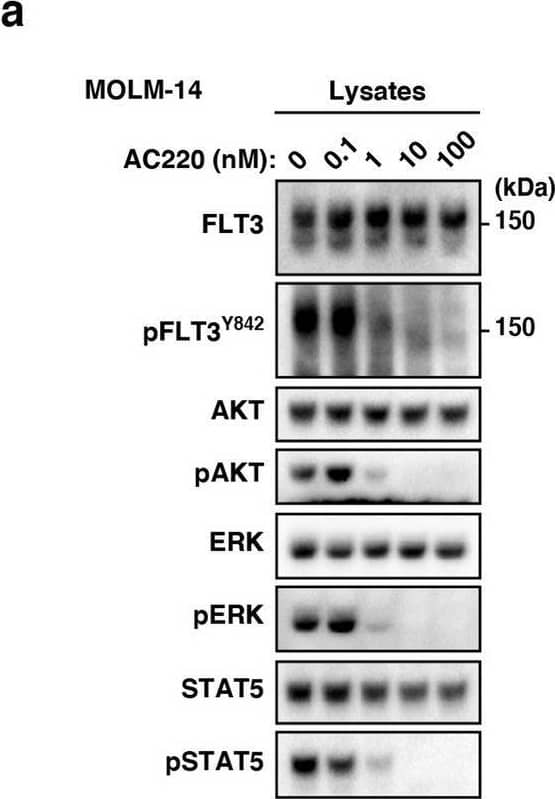
Scientific images may be resized, cropped, or adjusted for brightness or contrast for presentation purposes. These updates are limited to presentation and do not affect the underlying scientific interpretation of the data. Where available, additional source data may be provided upon request.
Conjugate
Catalog #
Key Product Details
Species Reactivity
Validated:
Human
Cited:
Human, Mouse
Applications
Validated:
Flow Cytometry, CyTOF-ready
Cited:
Western Blot, Immunocytochemistry, Immunoprecipitation
Label
Unconjugated
Antibody Source
Monoclonal Mouse IgG1 Clone # 66903
Product Specifications
Immunogen
Mouse myeloma cell line NS0-derived recombinant human Flt‑3/Flk‑2
Asn27-Asn541
Accession # AAA18947
Asn27-Asn541
Accession # AAA18947
Specificity
Detect human Flt‑3/Flk‑2 in direct ELISAs. In direct ELISAs, no cross-reactivity with recombinant mouse Flt-3, recombinant human (rh) SCF R, rhPDGF R alpha, or rhPDGF R beta is observed.
Clonality
Monoclonal
Host
Mouse
Isotype
IgG1
Scientific Data Images for Human Flt-3/Flk-2 Antibody
Detection of Flt-3/Flk-2 in THP-1 cells by Flow Cytometry.
THP-1 cells were stained with Mouse Anti-Human Flt-3/Flk-2 Monoclonal Antibody (Catalog # MAB812, filled histogram) or isotype control antibody (Catalog # MAB002, open histogram), followed by Phycoerythrin-conjugated Anti-Mouse IgG Secondary Antibody (Catalog # F0102B). View our protocol for Staining Membrane-associated Proteins.
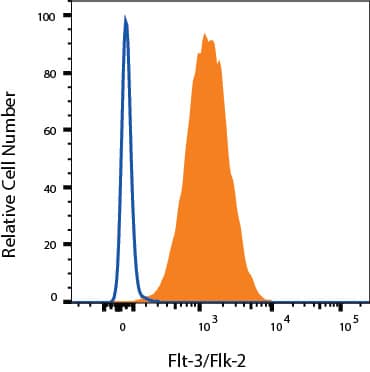
Detection of Flt-3/Flk-2 in PBMC monocytes by Flow Cytometry.
PBMC monocytes were stained with Mouse Anti-Human Flt-3/Flk-2 Monoclonal Antibody (Catalog # MAB812, filled histogram) or isotype control antibody (Catalog # MAB002, open histogram), followed by Phycoerythrin-conjugated Anti-Mouse IgG Secondary Antibody (Catalog # F0102B). View our protocol for Staining Membrane-associated Proteins.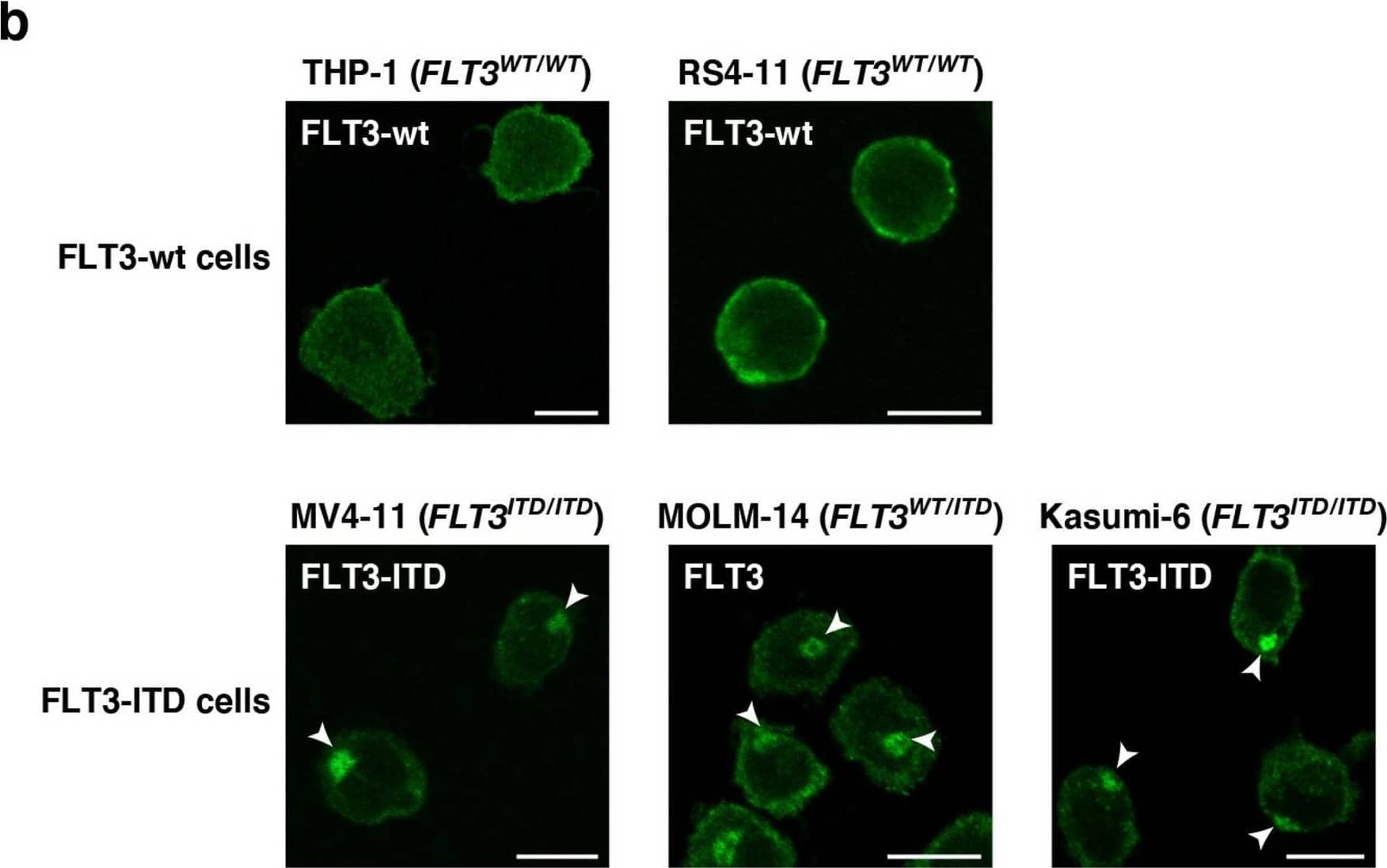
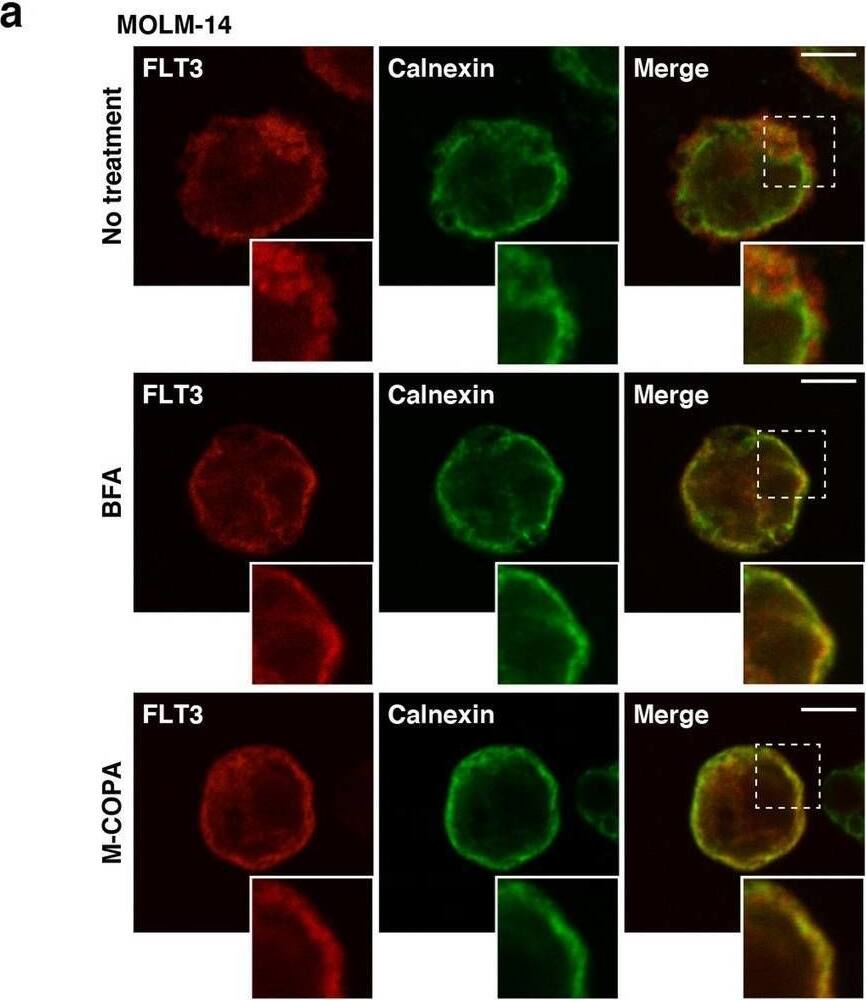
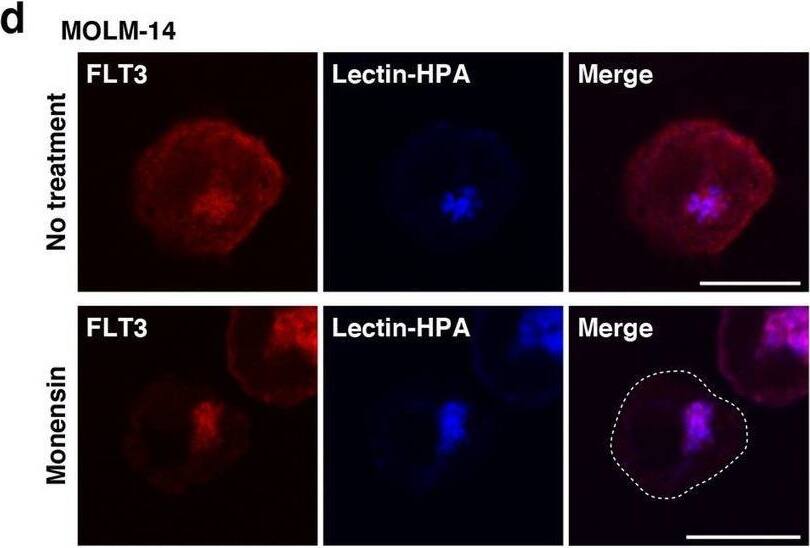
Detection of Human Flt-3/Flk-2 by Immunocytochemistry/ Immunofluorescence
FLT3-ITD mislocalizes to the perinuclear region in AML cells. (a) Schematic representations of wild-type FLT3 (FLT3-wt) and an FLT3 internal tandem duplication (FLT3-ITD) mutant showing the extracellular domain (ECD, blue), the transmembrane domain (TM, yellow), the kinase domain (pink), and the ITD (green). (b) Fixed THP-1, RS4-11, MV4-11, MOLM-14, or Kasumi-6 cells were permeabilized and subsequently immunostained with anti-FLT3 ECD antibody. Arrowheads indicate the perinuclear region. Bars, 10 µm. Note that FLT3-wt localized to the plasma membrane, whereas FLT3-ITD accumulated in the perinuclear region. Image collected and cropped by CiteAb from the following open publication (https://pubmed.ncbi.nlm.nih.gov/34811450), licensed under a CC-BY license. Not internally tested by R&D Systems.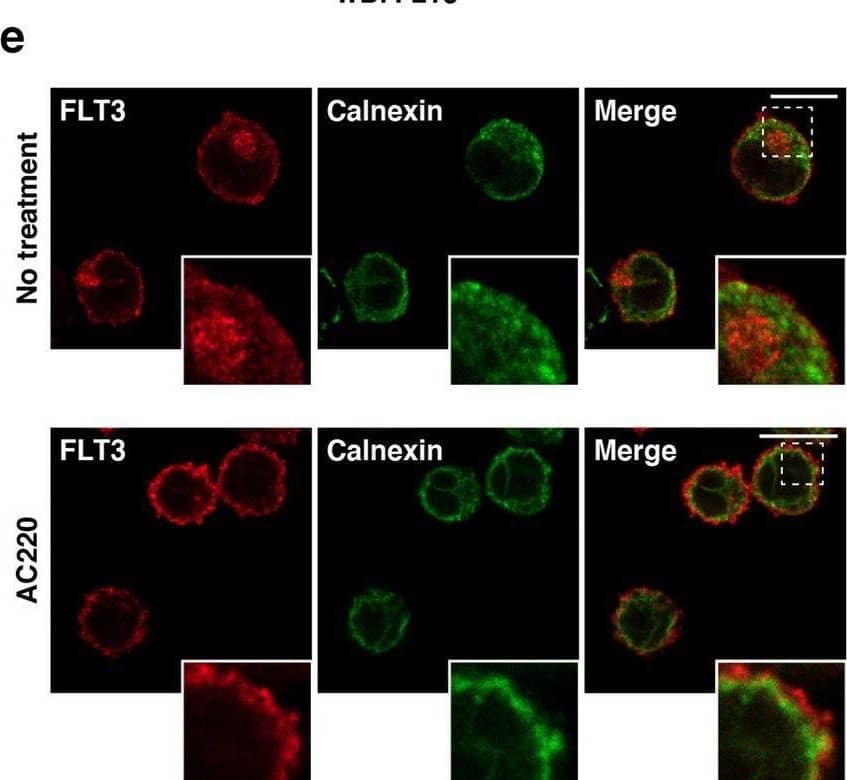
Applications for Human Flt-3/Flk-2 Antibody
Application
Recommended Usage
CyTOF-ready
Ready to be labeled using established conjugation methods. No BSA or other carrier proteins that could interfere with conjugation.
Flow Cytometry
0.25 µg/106 cells
Sample: THP-1 and PBMC monocytes
Sample: THP-1 and PBMC monocytes
Formulation, Preparation, and Storage
Purification
Protein A or G purified from ascites
Reconstitution
Reconstitute at 0.5 mg/mL in sterile PBS. For liquid material, refer to CoA for concentration.
Formulation
Lyophilized from a 0.2 μm filtered solution in PBS with Trehalose. *Small pack size (SP) is supplied either lyophilized or as a 0.2 µm filtered solution in PBS.
Shipping
Lyophilized product is shipped at ambient temperature. Liquid small pack size (-SP) is shipped with polar packs. Upon receipt, store immediately at the temperature recommended below.
Stability & Storage
Use a manual defrost freezer and avoid repeated freeze-thaw cycles.
- 12 months from date of receipt, -20 to -70 °C as supplied.
- 1 month, 2 to 8 °C under sterile conditions after reconstitution.
- 6 months, -20 to -70 °C under sterile conditions after reconstitution.
Background: Flt-3/Flk-2
The Flt-3 (fms-like tyrosine kinase) receptor, also named Flk-2 (fetal liver kinase) and Stk-1(stem cell tyrosine kinase) is a member of the class III subfamily of receptor tyrosine kinases that also includes KIT, the receptor for SCF and FMS, the receptor for M-CSF. The extracellular region of these receptors contains five immunoglobulin-like domains and the intracellular region contains a split kinase domain. Human Flt-3 cDNA encodes a 993 amino acid (aa) residue type I membrane protein with a 26 aa residue signal peptide, a 515 aa extracellular domain with 10 potential N-linked glycosylation sites, a 21 aa residue transmembrane domain and a 431 aa residue cytoplasmic domain. Mouse Flt-3 has also been cloned and shown to share 85% amino acid sequence identity with human Flt-3. Flt-3 expression has been detected in various tissues, including placenta, gonads, and tissues of nervous and hematopoietic origin. Among hematopoietic cells, the expression of Flt-3 was found to be restricted to the highly enriched stem/progenitor cell populations. The ligand for Flt-3 (FL) has been identified to be a transmembrane protein with structural homology to M-CSF and SCF. Recombinant soluble Flt-3/Fc chimeric protein has been shown to bind FL with high affinity and is a potent FL antagonist.
References
- Rosnet, O. et al. (1996) Acta. Haemato. 95:218.
- Drexler, H.G. (1996) Leukemia 10:588.
Long Name
fms-like Tyrosine Kinase 3
Alternate Names
CD135, Flk-2, Flt3, STK-1
Gene Symbol
FLT3
UniProt
Additional Flt-3/Flk-2 Products
Product Documents for Human Flt-3/Flk-2 Antibody
Product Specific Notices for Human Flt-3/Flk-2 Antibody
For research use only
Loading...
Loading...
Loading...
Loading...
Loading...
Loading...