
Human 4-1BB/TNFRSF9/CD137 Biotinylated Antibody
R&D Systems, part of Bio-Techne | Catalog # BAF838



Scientific images may be resized, cropped, or adjusted for brightness or contrast for presentation purposes. These updates are limited to presentation and do not affect the underlying scientific interpretation of the data. Where available, additional source data may be provided upon request.
Conjugate
Catalog #
Key Product Details
Validated by
Biological Validation
Species Reactivity
Validated:
Human
Cited:
Human
Applications
Validated:
Western Blot, ELISA Detection (Matched Antibody Pair), Flow Cytometry, Immunocytochemistry
Cited:
Immunohistochemistry, Immunocytochemistry
Label
Biotin
Antibody Source
Polyclonal Goat IgG
Product Specifications
Immunogen
Mouse myeloma cell line NS0-derived recombinant human 4-1BB
Leu24-Gln186
Accession # Q07011
Leu24-Gln186
Accession # Q07011
Specificity
Detects human 4‑1BB/TNFRSF9/CD137 in ELISAs and Western blots. In sandwich ELISAs, less than 0.1% cross-reactivity with recombinant mouse 4-1BB, recombinant human (rh) NGF R, rhTNF RI and rhTNF RII is observed.
Clonality
Polyclonal
Host
Goat
Isotype
IgG
Scientific Data Images for Human 4-1BB/TNFRSF9/CD137 Biotinylated Antibody
Detection of 4‑1BB/TNFRSF9/ CD137 in PHA-treated Human T Cells by Flow Cytometry.
Human T cells were treated for 48 hours with 5 µg/mL PHA then stained with Human 4-1BB/TNFRSF9/CD137 Biotinylated Antigen Affinity-purified Polyclonal Antibody (Catalog # BAF838, filled histogram) or control antibody (Catalog # BAF108, open histogram), followed by Streptavidin-Allophycocyanin (Catalog # F0050).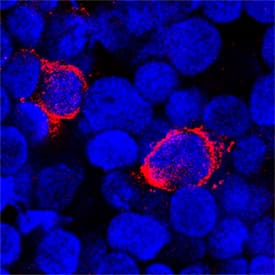
4‑1BB/TNFRSF9/CD137 in Human PBMCs.
4-1BB/TNFRSF9/CD137 was detected in immersion fixed human peripheral blood mononuclear cells (PBMCs) using Goat Anti-Human 4-1BB/TNFRSF9/CD137 Biotinylated Antigen Affinity-purified Polyclonal Antibody (Catalog # BAF838) at 15 µg/mL for 3 hours at room temperature. Cells were stained using the NorthernLights™ 557-conjugated Streptavidin (red ; Catalog # NL999) and counterstained with DAPI (blue). Specific staining was localized to plasma membrane and cytoplasm. View our protocol for Fluorescent ICC Staining of Cells on Coverslips.
Detection of 4-1BB/TNFRSF9/CD137 in Human Peripheral Blood Mononuclear Cells Stimulated With PHA and Monensin.
4-1BB/TNFRSF9/CD137 was detected in fixed Human Peripheral Blood Mononuclear Cells stimulated with PHA and Monensin cells using Goat Anti-Human 4-1BB/TNFRSF9/CD137 Biotinylated Antigen Affinity-purified Polyclonal Antibody (Catalog # BAF838) at 15 µg/ml for 3 hours at room temperature. Cells were stained using the NorthernLights™ 557-conjugated Anti-Mouse IgG Secondary Antibody (red; Catalog # NL007) and counterstained with DAPI (blue). Specific staining was localized to the cytoplasm. View our protocol for Fluorescent ICC Staining of Non-adherent Cells.Applications for Human 4-1BB/TNFRSF9/CD137 Biotinylated Antibody
Application
Recommended Usage
Flow Cytometry
2.5 µg/106 cells
Sample: PHA-treated Human T cells
Sample: PHA-treated Human T cells
Immunocytochemistry
5-15 µg/mL
Sample: Immersion fixed human peripheral blood mononuclear cells (PBMCs) stimulated with PHA and monensin
Sample: Immersion fixed human peripheral blood mononuclear cells (PBMCs) stimulated with PHA and monensin
Western Blot
0.1 µg/mL
Sample: Recombinant Human 4-1BB/TNFRSF9/CD137 Fc Chimera (Catalog # 838-4B)
Sample: Recombinant Human 4-1BB/TNFRSF9/CD137 Fc Chimera (Catalog # 838-4B)
Human 4-1BB/TNFRSF9/CD137 Sandwich Immunoassay
Please Note: Optimal dilutions of this antibody should be experimentally determined.
Formulation, Preparation, and Storage
Purification
Antigen Affinity-purified
Reconstitution
Reconstitute at 0.2 mg/mL in sterile PBS.
Formulation
Lyophilized from a 0.2 μm filtered solution in PBS with BSA as a carrier protein.
Shipping
The product is shipped at ambient temperature. Upon receipt, store it immediately at the temperature recommended below.
Stability & Storage
Use a manual defrost freezer and avoid repeated freeze-thaw cycles.
- 12 months from date of receipt, -20 to -70 °C as supplied.
- 1 month, 2 to 8 °C under sterile conditions after reconstitution.
- 6 months, -20 to -70 °C under sterile conditions after reconstitution.
Background: 4-1BB/TNFRSF9/CD137
4-1BB is an inducible T cell surface protein belonging to the TNF receptor superfamily. It is alternatively known as TNFRSF9, CD137, and ILA. The 255 amino acid human 4-1BB is a type I transmembrane protein having in its extracellular domain four of the cysteine-rich motifs that are characteristic of the TNF receptor superfamily. The 30 KD glycoprotein exists both as a monomer and as a dimer on T cells. The human and mouse proteins share 60% amino acid identity. 4-1BB is absent from naive T cells, but it is upregulated and continually expressed following T cell activation. The natural ligand, 4-1BBL, is a member of the TNF superfamily and is expressed on activated antigen presenting cells including dendritic cells, macrophages, and B cells. Cross-linking of 4-1BB by 4-1BBL or by agonistic antibodies transmits a potent co-stimulatory signal that enhances the effect of other activating signals such as PHA or anti-CD3 antibodies. 4-1BB signals through the TFAF2‑NIK pathway resulting in activation of NF-kappa B and ultimately promoting proliferation and survival of T cells.
References
- Vinay, D. and B. Kwon (1998) Semin. Immunol. 10:481.
- Sica, G. and L. Chen (2000) Adv. Exp. Med. Biol. 465:355.
Alternate Names
41BB, CD137, ILA, TNFRSF9
Gene Symbol
TNFRSF9
UniProt
Additional 4-1BB/TNFRSF9/CD137 Products
Product Documents for Human 4-1BB/TNFRSF9/CD137 Biotinylated Antibody
Product Specific Notices for Human 4-1BB/TNFRSF9/CD137 Biotinylated Antibody
For research use only
Loading...
Loading...
Loading...
Loading...
Loading...
Loading...