
Proteome Profiler Human Pluripotent Stem Cell Array Kit
R&D Systems, part of Bio-Techne | Catalog # ARY010
Contains 8 membranes - each spotted in duplicate with 15 different stem cell marker antibodies

Key Product Details
Species
Human
Product Summary for Proteome Profiler Human Pluripotent Stem Cell Array Kit
Kit Summary
A membrane-based antibody array for the simultaneous detection of 15 established stem cell markers.
Troubleshooting GuideKey Benefits
- Verifies stem cell identity
- Detects 15 stem cell markers simultaneously
- Easier to perform than a Western blot
- Requires no specialized equipment
- The array protocol can now be performed with a smaller sample size! Save more of your valuable stem cell cultures by simultaneously detecting pluripotency and germ layer markers using lysate from only 1 well of a 24-well plate.
Why Use an Antibody Array to Detect Multiple Stem Cell Markers in Parallel?
Examining the expression profile of stem cells can be expensive, time-consuming, and can require specialized equipment. For example, microarrays are expensive and require specialized equipment. Similar expression analyses can be achieved by performing multiple immunoprecipitaions and Western blots, although these techniques are also time-consuming.
To address this need, R&D Systems offers the Proteome Profiler Human Pluripotent Stem Cell Antibody Array Kit. This rapid, sensitive, and economical multiplex assay allows users to determine if their cells express markers of pluripotency consistent with undifferentiated cells or if the cells express markers consistent with differentiation towards lineages such as the trophectoderm, ectoderm, mesoderm, and endoderm. No specialized equipment is needed as data are obtained by chemiluminescence.
The Proteome Profiler Human Pluripotent Stem Cell Antibody Array Kit:
- Is a sensitive multiplex tool to verify stem cell identity using 15 stem cell markers.
- Has a protocol that can be completed with just 5.5 hours of hands-on time.
- Is more efficient than other techniques used to establish pluripotency.
- Does not require specialized equipment.
Kit Contents
Each kit contains eight nitrocellulose membranes spotted with 15 different antibodies printed in duplicate to detect stem cell markers. Buffers, biotinylated detection antibodies, streptavidin-HRP, and chemiluminescent reagents are included to enable the detection of stem cell markers from cell lysates.
- 8-well Rectangular Multi-dish
- Human Pluripotent Stem Cell Array - 8 nitrocellulose membranes each spotted with 15 different antibodies to stem cell markers printed in duplicate
- Array Buffer 1
- Array Buffer 2 Concentrate (5X)
- Array Buffer 3
- Chemi Reagent 1
- Chemi Reagent 2
- Detection Antibody Cocktail, Human Pluripotent Stem Cell Array
- Lysis Buffer 16
- Streptavidin-HRP
- Transparency Overlay Template
- Wash Buffer Concentrate (25X)
Analytes Detected by this kit:
- Oct-3/4
- Nanog
- SOX2
- E-Cadherin
- Alpha-Fetoprotein (AFP)
- GATA-4
- HNF-3 beta/FoxA2
- PDX-1/IPF1
- SOX17
- Otx2
- TP63/TP73L
- Goosecoid (Gsc)
- Snail
- VEGF R2/KDR/Flk-1
- HCG
Stability and Storage
Store the unopened kit at 2 °C to 8 °C. Do not use past kit expiration date.
Scientific Data Images for Proteome Profiler Human Pluripotent Stem Cell Array Kit

siRNA-mediated Knockdown of PDGF R alpha, PDGF R beta, and cAbl Upregulates Expression of Pluripotent, Mesoderm, and Endoderm Markers.
Small interfering RNAs (siRNAs) were transfected into mesenchymal stem cells by electroporation. Knockdown was verified by RT-PCR and Western blot analysis (data not shown here). Cell lysates from siRNA-treated cells were used in the Proteome Profiler Human Pluripotent Stem Cell Antibody Array (Catalog # ARY010) to examine relative expression levels of mesoderm, endoderm, and pluripotent markers. The images represent nitrocellulose membranes following chemiluminescent detection of bound analytes. Each of the array markers has duplicate spots, which are boxed to highlight their identity. A. Scrambled (Scr) siRNA-treated mesenchymal stem cells. B. Knockdown of PDGF R alpha upregulated pluripotent markers (Oct-3/4, Nanog, SOX2, and E-Cadherin) as well as markers of the mesoderm and endoderm compared to Scr. C. Knockdown of PDGF R beta upregulated expression of Snail, SOX17, VEGF R2, Oct-3/4, and Nanog compared to both Scr and PDGF R alpha knockdowns. D. Knockdown of cAbl upregulated pluripotent markers (Nanog, Oct-3/4, E-Cadherin, and SOX2) compared to Scr in addition to markers of the endoderm and mesoderm.Adapted from Ball, S.G. et al. (2012) Stem Cells 30:548.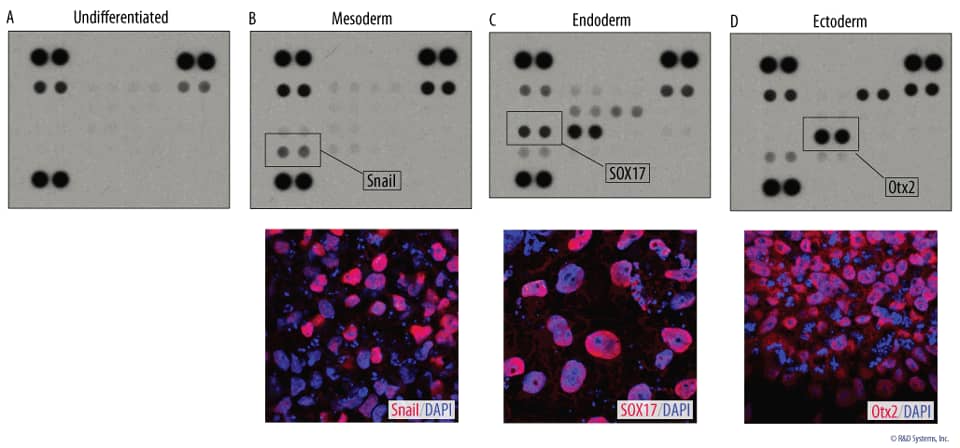
Small Sample Lysate Volume Used to Detect Germ Layer Markers in Differentiated Human Pluripotent Stem Cells.
BG01V human embryonic stem cells were differentiated into mesoderm, endoderm, and ectoderm using the differentiation supplements included in the Human Pluripotent Stem Cell Functional Identification Kit (Catalog # SC027B). Following differentiation in a 24-well plate, a single well of confluent cells was lysed in 100 µL of lysis buffer and analyzed using the Proteome Profiler Human Pluripotent Stem Cell Antibody Array (Catalog # ARY010). The differentiation supplements upregulated expression of the germ layer markers (A) Snail, (B) Sox17, and (C) Otx2 compared to undifferentiated cells. Immunocytochemistry for the same markers (Snail, Catalog # AF3639; Sox17, Catalog # AF1924; and Otx2, Catalog # AF1979; red) followed by staining with the appropriate NorthernLights™-conjugated Secondary Antibodies and counterstaining with DAPI (blue) is consistent with data obtained by array analysis.Formulation, Preparation, and Storage
Shipping
The product is shipped with polar packs. Upon receipt, store it immediately at the temperature recommended below.
Storage
Store the unopened product at 2 - 8 °C. Do not use past expiration date.
Background: Pluripotent Stem Cells
Embryonic stem (ES) cells are pluripotent stem cells derived from the inner cell mass of pre-implantation embryos. Induced pluripotent stem (iPS) cells can be generated by somatic cell reprogramming following the exogenous expression of specific transcription factors (Oct-3/4, KLF4, SOX2, and c-Myc). These cell types are capable of unlimited, undifferentiated proliferation in vitro and still maintain the capacity to differentiate into a wide variety of somatic cells. In this capacity, pluripotent stem cells have widespread clinical potential for the treatments of heart disease, diabetes, spinal cord injury, and a variety of neurodegenerative disorders.
R&D Systems offers a wide range of products to support pluripotent stem cell culture and differentiation. Mouse embryonic fibroblasts may be used to maintain and expand pluripotent stem cells in an undifferentiated state. We also offer defined culture media, which are specifically optimized for use with human or rodent pluripotent stem cells. In addition, R&D Systems offers a variety of products to assess differentiation status and identify specific stem cell types of interest, including panels of marker antibodies, primer pairs, multi-color flow cytometry kits, and specialized verification kits.
Additional Pluripotent Stem Cells Products
Product Documents for Proteome Profiler Human Pluripotent Stem Cell Array Kit
Product Specific Notices for Proteome Profiler Human Pluripotent Stem Cell Array Kit
For research use only
Loading...
Loading...
Loading...
Loading...