
TIM-3 Antibody (2C12) [DyLight 755]
Novus Biologicals, part of Bio-Techne | Catalog # NBP3-11989IR
Recombinant Monoclonal Antibody

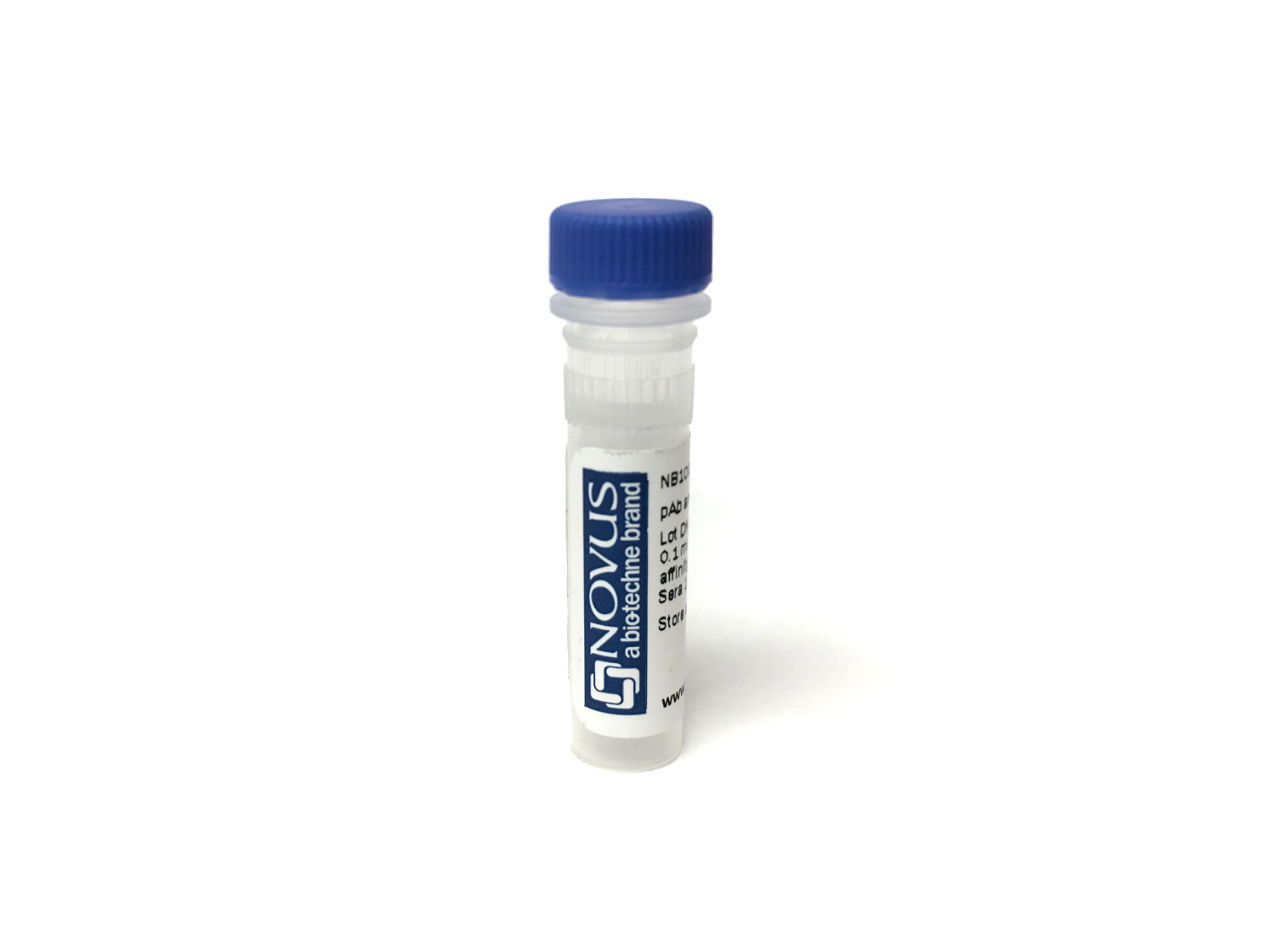
Conjugate
Catalog #
Forumulation
Catalog #
Key Product Details
Species Reactivity
Mouse
Applications
Immunohistochemistry, Block/Neutralize, Flow Cytometry, Immunocytochemistry/ Immunofluorescence
Label
DyLight 755 (Excitation = 754 nm, Emission = 776 nm)
Antibody Source
Monoclonal Rabbit IgG Kappa Clone # 2C12
Concentration
Please see the vial label for concentration. If unlisted please contact technical services.
Product Specifications
Immunogen
This antibody was raised by immunising rats with TIM-3:Ig fusion protein emulsified in complete Freund's adjuvant.
Specificity
This antibody is specific for murine TIM-3, a Th1-specific cell surface protein. TIM-3 is a type I transmembrane protein and contains an immunoglobulin and a mucin-like domain in its extracellular portion and a tyrosine phosphorylation motif in its cytoplasmic portion. This antibody binds to the BALB/c allele of TIM-3 while reactivity to the C57Bl/6 allele is significantly weaker.
Clonality
Monoclonal
Host
Rabbit
Isotype
IgG Kappa
Description
This conjugate is made on demand and is not held in inventory. Each order represents a unique lot. All conjugates are generated using validated conjugation protocols and meet strict degree of labeling (F/P) specifications; additional information is available upon request. The antibody concentration is provided on the individual product label.
For specialized conjugation needs, like large quantities, specific concentrations, and defined F/P ratios, bulk and custom antibody conjugation services are available.
For specialized conjugation needs, like large quantities, specific concentrations, and defined F/P ratios, bulk and custom antibody conjugation services are available.
Applications for TIM-3 Antibody (2C12) [DyLight 755]
Application
Recommended Usage
Block/Neutralize
Optimal dilutions of this antibody should be experimentally determined.
Flow Cytometry
Optimal dilutions of this antibody should be experimentally determined.
Immunocytochemistry/ Immunofluorescence
Optimal dilutions of this antibody should be experimentally determined.
Immunohistochemistry
Optimal dilutions of this antibody should be experimentally determined.
Application Notes
Recommended applications are based on validated applications from the unconjugated base product NBP3-11989. This conjugated antibody is not kept in inventory and is made to order using validated conjugation protocols.
Spectra Viewer
Plan Your Experiments
Use our spectra viewer to interactively plan your experiments, assessing multiplexing options. View the excitation and emission spectra for our fluorescent dye range and other commonly used dyes.
Spectra Viewer
Formulation, Preparation, and Storage
Purification
Protein A purified
Formulation
50mM Sodium Borate
Preservative
0.05% Sodium Azide
Concentration
Please see the vial label for concentration. If unlisted please contact technical services.
Shipping
The product is shipped with polar packs. Upon receipt, store it immediately at the temperature recommended below.
Stability & Storage
Store at 4C in the dark.
Background: TIM-3
Dysregulation of TIM-3 expression is associated with autoimmune diseases as shown by studies where inhibition of TIM-3 using blocking antibodies worsened disease progression in experimental autoimmune encephalomyelitis (EAE) models of multiple sclerosis (MS) (2,3,5). Conversely, high levels of TIM-3 have been shown during viral infection as well as in many cancer types where its increased expression may be an indicator of poor prognosis (2,3,5). TIM-3 has emerged as a potential cancer immunotherapy target as preclinical studies blocking TIM-3 results in increased anti-tumor immunity and prevents tumor growth (3,5). Studies have suggested combination therapy of TIM-3 blockade with blockade of other checkpoint inhibitors such as programmed death 1 (PD-1) or lymphocyte activation gene 3 (LAG-3) is more effective than TIM-3 blockade alone (3,5).
References
1. Acharya N, Sabatos-Peyton C, Anderson AC. Tim-3 finds its place in the cancer immunotherapy landscape. J Immunother Cancer. 2020; 8(1):e000911. https://doi.org/10.1136/jitc-2020-000911
2. Das M, Zhu C, Kuchroo VK. Tim-3 and its role in regulating anti-tumor immunity. Immunol Rev. 2017; 276(1):97-111. https://doi.org/10.1111/imr.12520
3. Joller N, Kuchroo VK. Tim-3, Lag-3, and TIGIT. Curr Top Microbiol Immunol. 2017; 410:127-156. https://doi.org/10.1007/82_2017_62
4. Uniprot (Q8TDQ0)
5. Wolf Y, Anderson AC, Kuchroo VK. TIM3 comes of age as an inhibitory receptor. Nat Rev Immunol. 2020; 20(3):173-185. https://doi.org/10.1038/s41577-019-0224-6
Long Name
T Cell Immunoglobulin Mucin-3
Alternate Names
CD366, HAVcr-2, HAVCR2, KIM-3, SPTCL, TIM3, TIMD3
Gene Symbol
HAVCR2
Additional TIM-3 Products
Product Documents for TIM-3 Antibody (2C12) [DyLight 755]
Product Specific Notices for TIM-3 Antibody (2C12) [DyLight 755]
DyLight (R) is a trademark of Thermo Fisher Scientific Inc. and its subsidiaries.
This product is for research use only and is not approved for use in humans or in clinical diagnosis. Primary Antibodies are guaranteed for 1 year from date of receipt.
Loading...
Loading...
Loading...
Loading...
Loading...