
Human PARP Antibody
R&D Systems, part of Bio-Techne | Catalog # MAB8095


Conjugate
Catalog #
Key Product Details
Validated by
Knockout/Knockdown
Species Reactivity
Validated:
Human
Cited:
Human
Applications
Validated:
Knockout Validated, Immunohistochemistry, Western Blot, Simple Western
Cited:
Western Blot, Immunocytochemistry
Label
Unconjugated
Antibody Source
Monoclonal Mouse IgG1 Clone # 839120
Product Specifications
Immunogen
E. coli-derived recombinant human PARP
Thr373-Glu540
Accession # P09874
Thr373-Glu540
Accession # P09874
Specificity
Detects human PARP in ELISAs and Western blots.
Clonality
Monoclonal
Host
Mouse
Isotype
IgG1
Scientific Data Images for Human PARP Antibody
Detection of Human PARP by Western Blot.
Western blot shows lysates of HeLa human cervical epithelial carcinoma cell line. PVDF membrane was probed with 1 µg/mL of Mouse Anti-Human PARP Monoclonal Antibody (Catalog # MAB8095) followed by HRP-conjugated Anti-Mouse IgG Secondary Antibody (Catalog # HAF018). A specific band was detected for PARP at approximately 110 kDa (as indicated). This experiment was conducted under reducing conditions and using Immunoblot Buffer Group 1.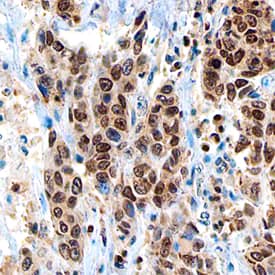
PARP in Human Breast.
PARP was detected in immersion fixed paraffin-embedded sections of human breast using Mouse Anti-Human PARP Monoclonal Antibody (Catalog # MAB8095) at 15 µg/mL overnight at 4 °C. Before incubation with the primary antibody, tissue was subjected to heat-induced epitope retrieval using Antigen Retrieval Reagent-Basic (Catalog # CTS013). Tissue was stained using the Anti-Mouse HRP-DAB Cell & Tissue Staining Kit (brown; Catalog # CTS002) and counterstained with hematoxylin (blue). Specific staining was localized to the nuclei of epithelial cells. View our protocol for Chromogenic IHC Staining of Paraffin-embedded Tissue Sections.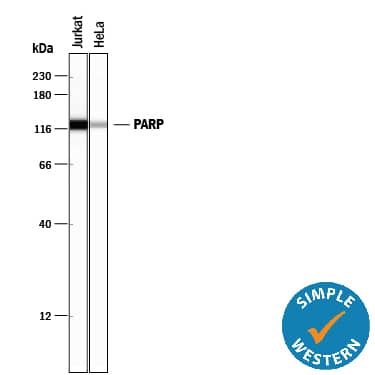
Detection of Human PARP by Simple WesternTM.
Simple Western lane view shows lysates of Jurkat human acute T cell leukemia cell line and HeLa human cervical epithelial carcinoma cell line, loaded at 0.5 mg/mL. A specific band was detected for PARP at approximately 125 kDa (as indicated) using 10 µg/mL of Mouse Anti-Human PARP Monoclonal Antibody (Catalog # MAB8095). This experiment was conducted under reducing conditions and using the 12-230 kDa separation system.Applications for Human PARP Antibody
Application
Recommended Usage
Immunohistochemistry
8-25 µg/mL
Sample: Immersion fixed paraffin-embedded sections of human breast
Sample: Immersion fixed paraffin-embedded sections of human breast
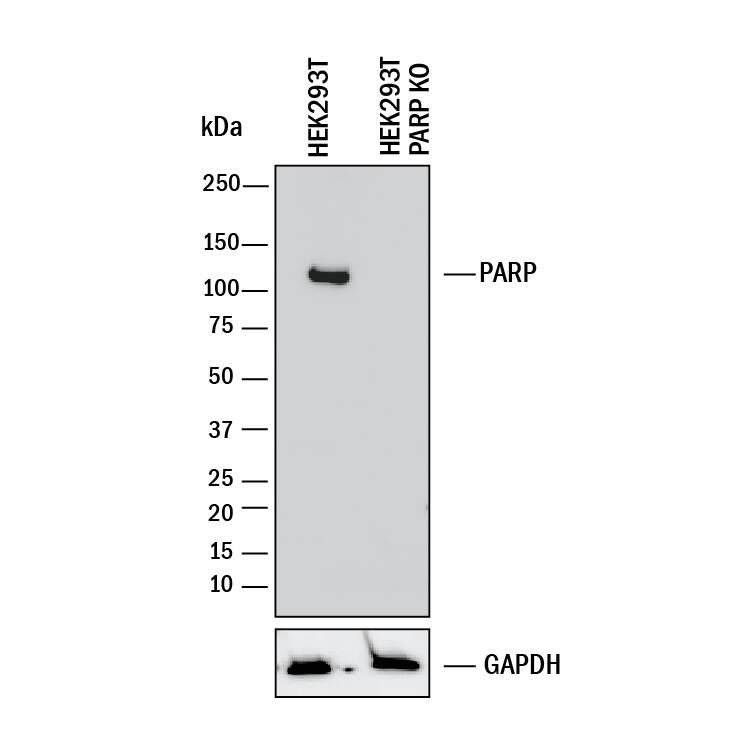
Knockout Validated
PARP
is specifically detected in HEK293T human embryonic kidney parental cell line but is not detectable in
PARP knockout HEK293T cell line.
Simple Western
10 µg/mL
Sample: Jurkat human acute T cell leukemia cell line and HeLa human cervical epithelial carcinoma cell line
Sample: Jurkat human acute T cell leukemia cell line and HeLa human cervical epithelial carcinoma cell line
Western Blot
1 µg/mL
Sample: HeLa human cervical epithelial carcinoma cell line
Sample: HeLa human cervical epithelial carcinoma cell line
Reviewed Applications
Read 1 review rated 5 using MAB8095 in the following applications:
Formulation, Preparation, and Storage
Purification
Protein A or G purified from hybridoma culture supernatant
Reconstitution
Reconstitute at 0.5 mg/mL in sterile PBS. For liquid material, refer to CoA for concentration.
Formulation
Lyophilized from a 0.2 μm filtered solution in PBS with Trehalose. *Small pack size (SP) is supplied either lyophilized or as a 0.2 µm filtered solution in PBS.
Shipping
Lyophilized product is shipped at ambient temperature. Liquid small pack size (-SP) is shipped with polar packs. Upon receipt, store immediately at the temperature recommended below.
Stability & Storage
Use a manual defrost freezer and avoid repeated freeze-thaw cycles.
- 12 months from date of receipt, -20 to -70 °C as supplied.
- 1 month, 2 to 8 °C under sterile conditions after reconstitution.
- 6 months, -20 to -70 °C under sterile conditions after reconstitution.
Background: PARP
PARP, Poly [ADP-ribose] polymerase 1 (PARP1), is a widely expressed component of a base excision repair (BER) complex, containing at least XRCC1, PARP2, POLB and LRIG3. PARP expression is correlated with proliferation, with higher levels occurring during early fetal development and organogenesis and in the highly proliferative cell compartments of adult. PARP is upregulated in B cells that have been induced to switch to various Ig isotypes. PARP interacts with the DNA polymerase alpha catalytic subunit POLA1; this interaction functions as part of the control of replication fork progression.
Long Name
Poly [ADP-ribose] Polymerase
Alternate Names
ADPRT, PARP1, PPOL
Gene Symbol
PARP1
UniProt
Additional PARP Products
Product Documents for Human PARP Antibody
Product Specific Notices for Human PARP Antibody
For research use only
Loading...
Loading...
Loading...
Loading...
Loading...