
Human/Mouse/Rat 14-3-3 gamma Antibody
R&D Systems, part of Bio-Techne | Catalog # MAB5700


Conjugate
Catalog #
Key Product Details
Species Reactivity
Human, Mouse, Rat
Applications
Western Blot
Label
Unconjugated
Antibody Source
Monoclonal Mouse IgG2B Clone # 505810
Product Specifications
Immunogen
E. coli-derived recombinant human 14-3-3 gamma
Met1-Asn247
Accession # P61981
Met1-Asn247
Accession # P61981
Specificity
Detects human, mouse, and rat 14-3-3 gamma in Western blots.
Clonality
Monoclonal
Host
Mouse
Isotype
IgG2B
Scientific Data Images for Human/Mouse/Rat 14-3-3 gamma Antibody
Detection of Human, Mouse, and Rat 14‑3‑3 gamma by Western Blot.
Western blot shows lysates of HeLa human cervical epithelial carcinoma cell line, NIH-3T3 mouse embryonic fibroblast cell line, and L6 rat myoblast cell line. PVDF membrane was probed with 1 µg/mL Mouse Anti-Human/Mouse/Rat 14-3-3 gamma Monoclonal Antibody (Catalog # MAB5700) followed by HRP-conjugated Anti-Mouse IgG Secondary Antibody (Catalog # HAF007). A specific band for 14-3-3 gamma was detected at approximately 30 kDa (as indicated). This experiment was conducted under reducing conditions and using Immunoblot Buffer Group 1.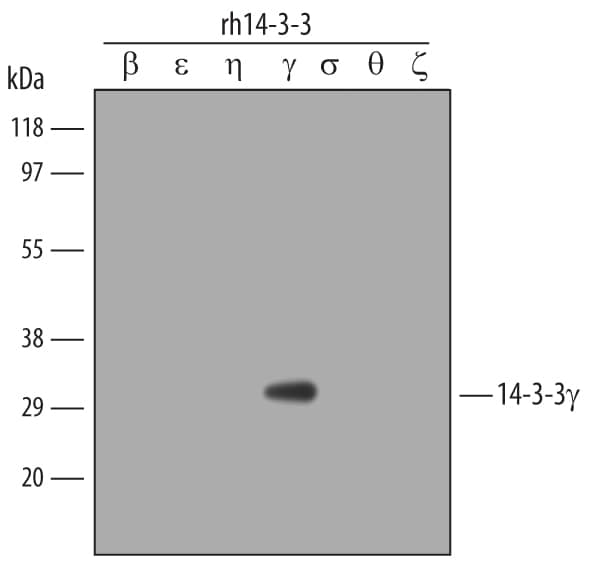
Detection of Human 14-3-3 gamma by Western Blot.
Western blot shows recombinant human 14-3-3 beta, epsilon, eta, gamma, sigma, theta, and zeta (5 ng/lane. PVDF membrane was probed with 1 µg/mL Mouse Anti-Human/Mouse/Rat 14-3-3 gamma Monoclonal Antibody (Catalog # MAB5700) followed by HRP-conjugated Anti-Mouse IgG Secondary Antibody (Catalog # HAF007). A specific band for 14-3-3 gamma was detected at approximately 30 kDa (as indicated). This experiment was conducted under reducing conditions and using Immunoblot Buffer Group 1.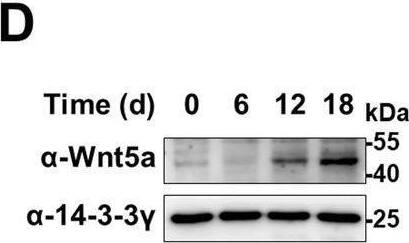
Detection of Mouse 14-3-3 gamma by Western Blot
Effects of adipocyte hypertrophy on Wnt5a expression. A Mature adipocytes were further cultured for 6 or 12 days & then harvested at the indicated times after induction. B Confocal microscopic images of F-actin (green), lipid vacuoles (white), & nuclei (blue) visualized by staining with Phalloidin-Alexa555, BODIPY 493/503, or Hoechst 33258, respectively (left panel). Sizes of lipid vacuoles & were measured in BODIPY stained areas & F-actin covered areas, respectively, using ImageJ. 58~74 were observed at each time point. Scale bars indicate 20 μm. C qRT-PCR analyses results of Wnt5a mRNA levels expressed as means ± SEs. All experiments were repeated independently at least twice. **p < 0.01, & ***p < 0.001 by a Student’s t-test. D–F WB of Wnt5a, beta-actin, YAP, & TAZ for whole lysates of adipocytes cultured & harvested as described in Fig. 3A. 14-3-3 gamma was used as the loading control. G WB analyses of YAP & TAZ in nuclear fraction of mature adipocytes obtained as shown Fig. 3A. Lamin A/C was used as the loading control for the nuclear fraction. H qRT-PCR of Ctgf, Ankrd1 & Cyr61 mRNA levels. I–K Mature adipocytes were treated at 18 days after adipogenic induction with Verteporfin (VP; 5 μM) for 4 h & harvested. I qRT-PCR of Wnt5a mRNA (J) WB analyses of Wnt5a protein, (K) qRT-PCR of Ctgf & Cyr61 mRNA levels (normalized versus 18 S rRNA levels). L qRT-PCR of Wnt5a, Yap, Taz, Ctgf, & Cyr61 (M) WB analyses of Wnt5a, YAP, TAZ proteins in 3T3-L1 preadipocytes transfected with control siRNA or siRNAs against YAP & TAZ. qRT-PCR results are presented as means ± SEs. Experiments were conducted independently at least twice. The significances of differences were determined using a two-tailed paired Student’s t-test. *p < 0.05, **p < 0.01, ***p < 0.001; ns, not significant. Image collected & cropped by CiteAb from the following open publication (https://pubmed.ncbi.nlm.nih.gov/35478181), licensed under a CC-BY license. Not internally tested by R&D Systems.Applications for Human/Mouse/Rat 14-3-3 gamma Antibody
Application
Recommended Usage
Western Blot
1 µg/mL
Sample: HeLa human cervical epithelial carcinoma cell line, NIH-3T3 mouse embryonic fibroblast cell line, and L6 rat myoblast cell line
Sample: HeLa human cervical epithelial carcinoma cell line, NIH-3T3 mouse embryonic fibroblast cell line, and L6 rat myoblast cell line
Formulation, Preparation, and Storage
Purification
Protein A or G purified from hybridoma culture supernatant
Reconstitution
Reconstitute at 0.5 mg/mL in sterile PBS. For liquid material, refer to CoA for concentration.
Formulation
Lyophilized from a 0.2 μm filtered solution in PBS with Trehalose. *Small pack size (SP) is supplied either lyophilized or as a 0.2 µm filtered solution in PBS.
Shipping
Lyophilized product is shipped at ambient temperature. Liquid small pack size (-SP) is shipped with polar packs. Upon receipt, store immediately at the temperature recommended below.
Stability & Storage
Use a manual defrost freezer and avoid repeated freeze-thaw cycles.
- 12 months from date of receipt, -20 to -70 °C as supplied.
- 1 month, 2 to 8 °C under sterile conditions after reconstitution.
- 6 months, -20 to -70 °C under sterile conditions after reconstitution.
Background: 14-3-3 gamma
Alternate Names
1433 gamma, YWHAG
Gene Symbol
YWHAG
UniProt
Additional 14-3-3 gamma Products
Product Documents for Human/Mouse/Rat 14-3-3 gamma Antibody
Product Specific Notices for Human/Mouse/Rat 14-3-3 gamma Antibody
For research use only
Loading...
Loading...
Loading...
Loading...
Loading...