
Human IL-22 Antibody
R&D Systems, part of Bio-Techne | Catalog # AF782


Scientific images may be resized, cropped, or adjusted for brightness or contrast for presentation purposes. These updates are limited to presentation and do not affect the underlying scientific interpretation of the data. Where available, additional source data may be provided upon request.
Conjugate
Catalog #
Key Product Details
Validated by
Biological Validation
Species Reactivity
Validated:
Human
Cited:
Human
Applications
Validated:
Western Blot, Neutralization, Immunocytochemistry
Cited:
Immunohistochemistry, Immunohistochemistry-Paraffin, Immunohistochemistry-Frozen, Neutralization
Label
Unconjugated
Antibody Source
Polyclonal Goat IgG
Product Specifications
Immunogen
E. coli-derived recombinant human IL-22
Ala34-Ile179
Accession # Q9GZX6
Ala34-Ile179
Accession # Q9GZX6
Specificity
Detects human, recombinant mouse, and recombinant rat IL-22 in direct ELISAs and Western blots. In direct ELISAs and Western blots, less than 1% cross-reactivity with recombinant human IL-10 is observed.
Clonality
Polyclonal
Host
Goat
Isotype
IgG
Endotoxin Level
<0.10 EU per 1 μg of the antibody by the LAL method.
Scientific Data Images for Human IL-22 Antibody
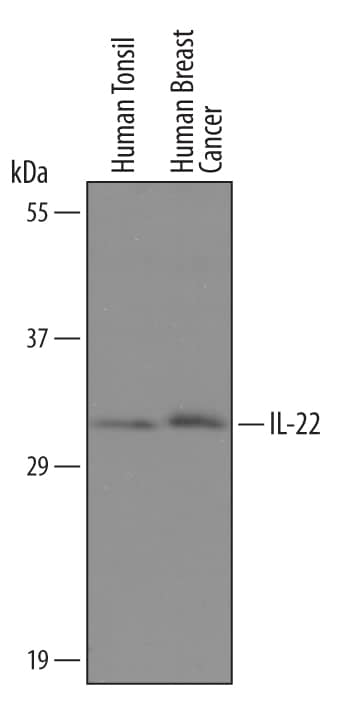
Detection of Human IL‑22 by Western Blot.
Western blot shows lysates of human tonsil tissue and human breast cancer tissue. PVDF Membrane was probed with 1 µg/mL of Goat Anti-Human IL-22 Antigen Affinity-purified Polyclonal Antibody (Catalog # AF782) followed by HRP-conjugated Anti-Goat IgG Secondary Antibody (Catalog # HAF019). A specific band was detected for IL-22 at approximately 32 kDa (as indicated). This experiment was conducted under reducing conditions and using Immunoblot Buffer Group 1.
IL-22 in Human PBMCs.
IL-22 was detected in immersion fixed human peripheral blood mononuclear cells (PBMCs) treated with lipopolysaccharide (LPS) using 10 µg/mL Goat Anti-Human IL-22 Antigen Affinity-purified Polyclonal Antibody (Catalog # AF782) for 3 hours at room temperature. Cells were stained with the NorthernLights™ 557-conjugated Anti-Goat IgG Secondary Antibody (red; Catalog # NL001) and counterstained with DAPI (blue). View our protocol for Fluorescent ICC Staining of Non-adherent Cells.
IL‑10 Secretion Induced by IL‑22 and Neutralization by Human IL‑22 Antibody.
Recombinant Human IL-22 (Catalog # 782-IL) stimulates IL-10 secretion in the COLO 205 human colorectal adeno-carcinoma cell line in a dose-dependent manner (orange line), as measured by the Human IL-10 DuoSet ELISA Development Kit (Catalog # DY217B). IL-10 secretion elicited by Recombinant Human IL-22 (1 ng/mL) is neutralized (green line) by increasing concentrations of Goat Anti-Human IL-22 Antigen Affinity-purified Polyclonal Antibody (Catalog # AF782). The ND50 is typically 0.5-2.5 µg/mL.

Applications for Human IL-22 Antibody
Application
Recommended Usage
Immunocytochemistry
5-15 µg/mL
Sample: Immersion fixed human peripheral blood mononuclear cells (PBMCs) treated with lipopolysaccharide (LPS)
Sample: Immersion fixed human peripheral blood mononuclear cells (PBMCs) treated with lipopolysaccharide (LPS)
Western Blot
1 µg/mL
Sample: Human tonsil tissue and human breast cancer tissue
Sample: Human tonsil tissue and human breast cancer tissue
Neutralization
Measured by its ability to neutralize IL‑22-induced IL‑10 secretion in the COLO 205 human colorectal adenocarcinoma cell line [Marehalli, L. et al. (2004) Intl. Immunopharmacol. 4:679]. The Neutralization Dose (ND50) is typically 0.5-2.5 µg/mL in the presence of 1 ng/mL Recombinant Human IL‑22.
Formulation, Preparation, and Storage
Purification
Antigen Affinity-purified
Reconstitution
Reconstitute at 0.2 mg/mL in sterile PBS. For liquid material, refer to CoA for concentration.
Formulation
Lyophilized from a 0.2 μm filtered solution in PBS with Trehalose. *Small pack size (SP) is supplied either lyophilized or as a 0.2 µm filtered solution in PBS.
Shipping
Lyophilized product is shipped at ambient temperature. Liquid small pack size (-SP) is shipped with polar packs. Upon receipt, store immediately at the temperature recommended below.
Stability & Storage
Use a manual defrost freezer and avoid repeated freeze-thaw cycles.
- 12 months from date of receipt, -20 to -70 °C as supplied.
- 1 month, 2 to 8 °C under sterile conditions after reconstitution.
- 6 months, -20 to -70 °C under sterile conditions after reconstitution.
Background: IL-22
Interleukin-22 (IL-22), also known as IL-10-related T cell-derived inducible factor (IL-TIF) was initially identified as a gene induced by IL-9 in mouse T cells and mast cells. Human IL-22 cDNA encodes a 179 amino acid (aa) residue protein with a putative 33 aa signal peptide that is cleaved to generate a 147 aa mature protein that shares approximately 79% and 22% aa sequence identity with mouse IL-22 and human IL-10, respectively. The human IL-22 gene is localized to chromosome 12q15. Although it exists as a single copy gene in human and in many mouse strains, the mouse IL-22 gene is duplicated in some mouse strains including C57B1/6, FVB and 129. The two mouse genes designated IL-TIF alpha and IL-TIF beta, share greater than 98% sequence homology in their coding region. IL-22 has been shown to activate STAT1 and STAT3 in several hepatoma cell lines and upregulate the production of acute phase proteins. IL-22 is produced by normal T cells upon anti-CD3 stimulation in humans. Mouse IL-22 expression is also induced in various organs upon lipopolysaccharide injection, suggesting that IL-22 may be involved in inflammatory responses. The functional IL-22 receptor complex consists of two receptor subunits, IL-22 R (previously an orphan receptor named CRF2-9) and IL-10 R beta (previously known as CRF2-4), belonging to the class II cytokine receptor family.
References
- Dumoutier, L. et al. (2000) J. Immunol. 164:1814.
- Xie, M-H. et al. (2000) J. Biol. Chem. 275:31335.
- Dumoutier, L. et al. (2000) Proc. Natl. Acad. Sci. USA 97:10144.
- Kotenko, S.V. et al. (2001) J. Biol. Chem. 276:2725.
Long Name
Interleukin 22
Alternate Names
IL-TIF, IL22
Gene Symbol
IL22
UniProt
Additional IL-22 Products
Product Documents for Human IL-22 Antibody
Product Specific Notices for Human IL-22 Antibody
For research use only
Loading...
Loading...
Loading...
Loading...
Loading...