
Human BAFF/BLyS/TNFSF13B Antibody
R&D Systems, part of Bio-Techne | Catalog # MAB124


Scientific images may be resized, cropped, or adjusted for brightness or contrast for presentation purposes. These updates are limited to presentation and do not affect the underlying scientific interpretation of the data. Where available, additional source data may be provided upon request.
Conjugate
Catalog #
Key Product Details
Species Reactivity
Validated:
Human
Cited:
Human
Applications
Validated:
Neutralization
Cited:
Neutralization, Flow Cytometry, Immunocytochemistry
Label
Unconjugated
Antibody Source
Monoclonal Mouse IgG2B Clone # 148725
Product Specifications
Immunogen
Mouse myeloma cell line NS0-derived recombinant human BAFF
Ala134-Leu285
Accession # Q9Y275
Ala134-Leu285
Accession # Q9Y275
Specificity
Detects human BAFF in direct ELISAs.
Clonality
Monoclonal
Host
Mouse
Isotype
IgG2B
Endotoxin Level
<0.10 EU per 1 μg of the antibody by the LAL method.
Scientific Data Images for Human BAFF/BLyS/TNFSF13B Antibody
Cell Proliferation Induced by BAFF/BLyS/TNFSF13B and Neutralization by Human BAFF/BLyS/TNFSF13B Antibody.
Recombinant Human BAFF/BLyS/TNFSF13B (Catalog # 2149-BF) stimulates proliferation in mouse B cells in a dose-dependent manner (orange line). Proliferation elicited by Recombinant Human BAFF/BLyS/TNFSF13B (5 ng/mL) is neutralized (green line) by increasing concentrations of Mouse Anti-Human BAFF/BLyS/TNFSF13B Monoclonal Antibody (Catalog # MAB124). At 20 µg/mL, this anti-BAFF/BLyS/TNFSF13B antibody will neutralize >60% of Recombinant Human BAFF/BLyS/TNFSF13B-induced proliferation of mouse B cells.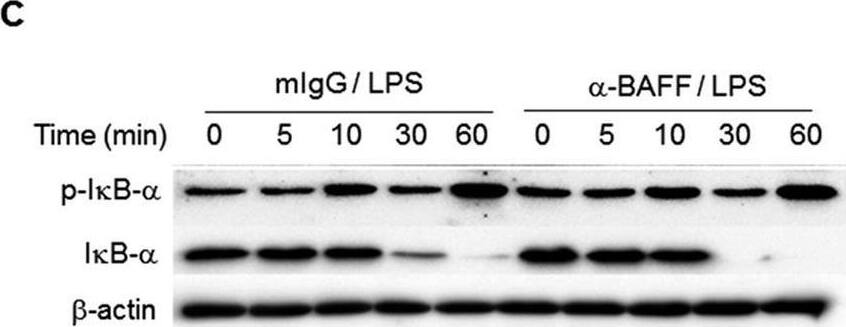
Detection of BAFF/BLyS/TNFSF13B by Western Blot
BAFF-mediated signaling synergizes with LPS for NF-kappa B activation without affecting I kappaB degradation or NF-kappa B nuclear translocation.(A and B) HEK 293 T cells were transfected with an NF-kappa B luciferase construct, reference reporter construct, and BAFF expression vector in combination with CD4-TLR4, death domain (DD) of MyD88, or wild type TRIF-expressing vectors for 24 h. Relative luciferase activity (RLA) was then measured. ***p < 0.001 when compared with the negative control. #p < 0.05, ## < 0.01 and ### < 0.001 (n = 6). (C) THP-1 cells were pre-treated with 1 μg/ml of anti-BAFF mAb or mIgG and then stimulated with 100 ng/ml of LPS for the indicated time periods and total cell lysates were obtained. The Western blot was performed using antibodies specific for phospho-I kappaB-alpha, I kappaB-alpha or beta-actin. (D) Cells were pretreated as in C and stimulated with 1 μg/ml of LPS. After 30 min, the location of p65 was analyzed using immunocytochemistry and the proportion of cells with nuclear p65 was determined (n = 3). Image collected and cropped by CiteAb from the following open publication (https://pubmed.ncbi.nlm.nih.gov/28374824), licensed under a CC-BY license. Not internally tested by R&D Systems.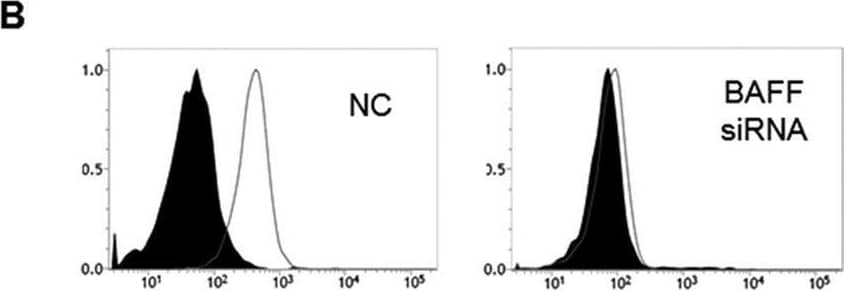
Detection of BAFF/BLyS/TNFSF13B by Flow Cytometry
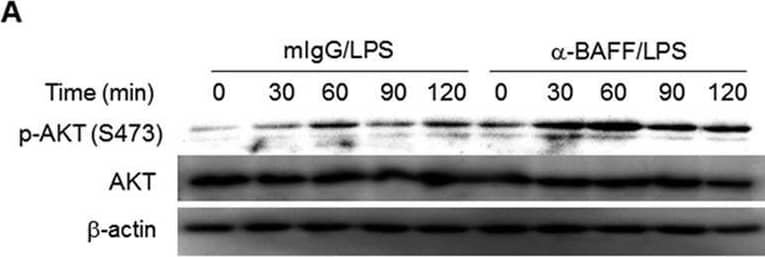
The enhancing effect of mAb is BAFF specific and starts at relatively early time points after LPS stimulation.(A) THP-1 cells were transiently transfected with 10 nM scramble siRNA (NC) or BAFF-specific siRNA. After 24 h, RT-PCR analysis was performed to evaluate the expression levels of BAFF mRNA. (B) Cells were transfected as in (A) and collected at 48 h. BAFF expression levels were then measured by flow cytometry using BAFF specific mAb (empty area) or mIgG (filled area). (C) Cells were transfected as in (A). After 48 h, cells were pre-treated with 1 μg/ml mIgG or anti-BAFF mAb for 30 min and then the cells were stimulated with 100 ng/ml LPS for 24 h. Cultured supernatants were then collected to evaluate levels of secreted IL-8. Values represent IL-8 levels relative to those of the positive control (set to 100%). *p < 0.05 (n = 3). (D) THP-1 cells were pretreated as in (C) and stimulated with 1 μg/ml of LPS. Culture supernatants were collected at the indicated time points and IL-8 levels were measured using ELISA. Control samples were treated with 1 μg/ml anti-BAFF or mIgG for 24 h in the absence of LPS treatment. Image collected and cropped by CiteAb from the following open publication (https://pubmed.ncbi.nlm.nih.gov/28374824), licensed under a CC-BY license. Not internally tested by R&D Systems.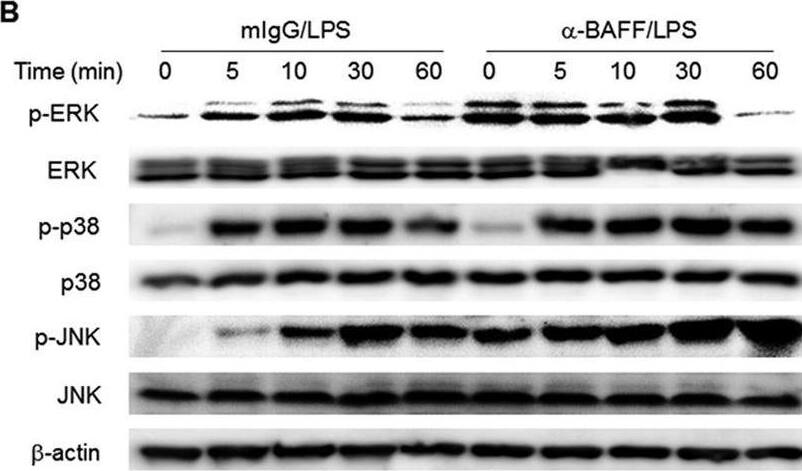
Applications for Human BAFF/BLyS/TNFSF13B Antibody
Application
Recommended Usage
Neutralization
Measured by its ability to neutralize BAFF/BLyS/TNFSF13B-induced proliferation in mouse B cells. At 20 µg/mL, this anti-BAFF/BLyS/TNFSF13B antibody will neutralize > 60% of 5 ng/mL Recombinant Human BAFF/BLyS/TNFSF13B-induced proliferation of mouse B cells.
Formulation, Preparation, and Storage
Purification
Protein A or G purified from hybridoma culture supernatant
Reconstitution
Reconstitute at 0.5 mg/mL in sterile PBS. For liquid material, refer to CoA for concentration.
Formulation
Lyophilized from a 0.2 μm filtered solution in PBS with Trehalose. *Small pack size (SP) is supplied either lyophilized or as a 0.2 µm filtered solution in PBS.
Shipping
Lyophilized product is shipped at ambient temperature. Liquid small pack size (-SP) is shipped with polar packs. Upon receipt, store immediately at the temperature recommended below.
Stability & Storage
Use a manual defrost freezer and avoid repeated freeze-thaw cycles.
- 12 months from date of receipt, -20 to -70 °C as supplied.
- 1 month, 2 to 8 °C under sterile conditions after reconstitution.
- 6 months, -20 to -70 °C under sterile conditions after reconstitution.
Background: BAFF/BLyS/TNFSF13B
Long Name
B cell Activating Factor
Alternate Names
BLyS, CD257, TALL1, THANK, TNFSF13B, ZTNF4
Gene Symbol
TNFSF13B
UniProt
Additional BAFF/BLyS/TNFSF13B Products
Product Documents for Human BAFF/BLyS/TNFSF13B Antibody
Product Specific Notices for Human BAFF/BLyS/TNFSF13B Antibody
For research use only
Loading...
Loading...
Loading...
Loading...