
Recombinant Human p53 His-tag Protein, CF

R&D Systems, part of Bio-Techne | Catalog # 11816-TP

Catalog #
Availability
Size / Price
Qty
Loading...
11816-TP-050

Key Product Details

Source

E. coli

Accession #

Conjugate

Unconjugated

Applications

Bioactivity

Product Specifications

Source

E. coli-derived human p53 protein
Glu2-Asp393, with an N-termina 6-His SUMO tag

Purity

>85%, by SDS-PAGE visualized with Silver Staining and quantitative densitometry by Coomassie® Blue Staining.

Endotoxin Level

<1.0 EU per 1 μg of the protein by the LAL method.

N-terminal Sequence Analysis

Met-His tag

Predicted Molecular Mass

55.7 kDa

SDS-PAGE

66-73 kDa, under reducing conditions.

Activity

Measured by its binding ability in a functional ELISA.
Recombinant Human p53 His-tag binds to Recombinant Human MDM2/HDM2 GST-tag (Catalog # 11802-DM) with an ED50 of 12.50-125.0 ng/mL

Scientific Data Images for Recombinant Human p53 His-tag Protein, CF
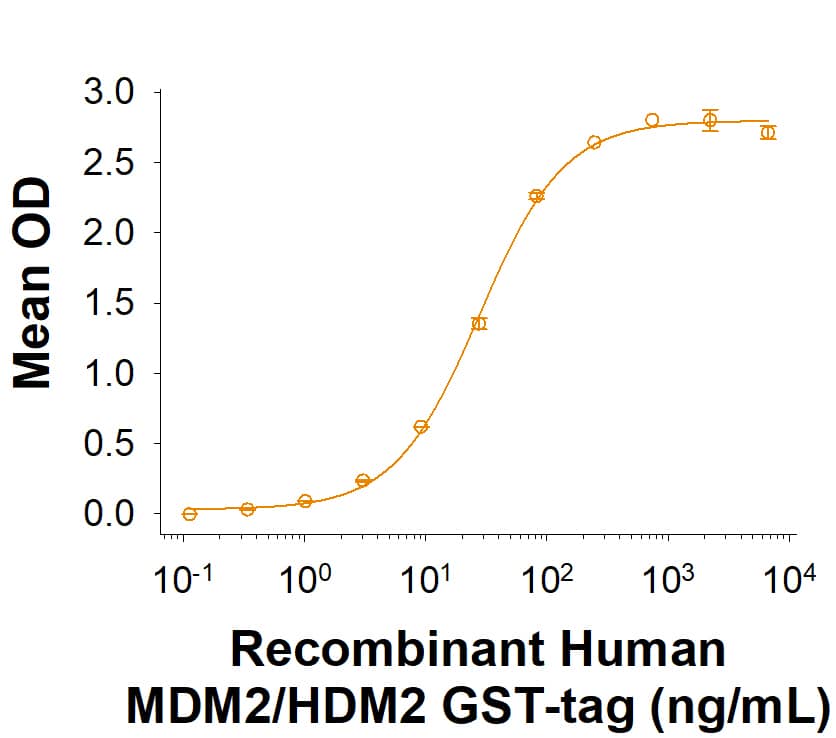
Recombinant Human p53 His-tag Protein Binding Activity.

Measured by its binding ability in a functional ELISA. Recombinant Human p53 His-tag Protein (Catalog # 11816-TP) binds to Recombinant Human MDM2/HDM2 GST-tag (11802-DM) with an ED50 of 12.50-125.0 ng/mL.
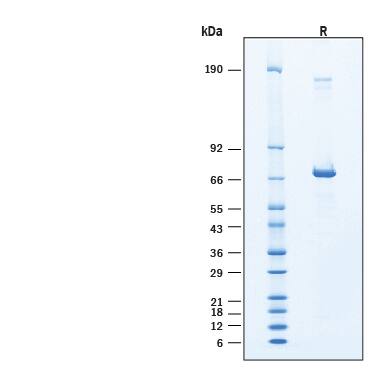
Recombinant Human p53 His-tag Protein SDS-PAGE.

2 μg/lane of Recombinant Human p53 His-tag Protein (Catalog # 11816-TP) was resolved with SDS-PAGE under reducing (R) condition and visualized by Coomassie® Blue staining, showing bands at 66-73 kDa.

Formulation, Preparation and Storage

11816-TP
Formulation Supplied as a 0.2 μm filtered solution in HEPES, NaCl, TCEP, ZnCl2 and Glycerol with Trehalose.
Shipping The product is shipped with dry ice or equivalent. Upon receipt, store it immediately at the temperature recommended below.
Stability & Storage Use a manual defrost freezer and avoid repeated freeze-thaw cycles.
  • 6 months from date of receipt, -20 to -70 °C as supplied.
  • 3 months, -20 to -70 °C under sterile conditions after opening.

Background: p53

The tumor suppressor protein p53 is a sequence‑specific transcription factor that plays a central role in maintaining genomic integrity by coordinating cellular responses to DNA damage, oncogenic stress, hypoxia, and metabolic imbalance. p53 is encoded by the TP53 gene, which is the most frequently altered gene in human cancer (1). Under physiological, non‑stress conditions, p53 protein levels are kept low through continuous ubiquitin‑mediated degradation, primarily controlled by the E3 ubiquitin ligase MDM‑2 (2). Human p53 is a ~53 kDa protein composed of an N‑terminal transactivation domain, a proline‑rich region, a central DNA‑binding domain, an oligomerization domain, and a C‑terminal regulatory domain (3). Upon cellular stress, post‑translational modifications such as phosphorylation and acetylation disrupt p53–MDM‑2 interactions, leading to rapid stabilization and activation of p53 (2, 4). Activated p53 induces transcriptional programs that promote cell‑cycle arrest, DNA repair, senescence, ferroptosis, or apoptosis, depending on cellular context and damage severity (1, 3). In addition to its canonical transcription‑dependent roles, p53 also exerts transcription‑independent functions in the cytoplasm and mitochondria, where it directly influences apoptotic signaling, mitochondrial metabolism, and redox homeostasis (4, 5). These diverse activities position p53 as a master regulator of cell fate decisions and stress adaptation. p53 function is tightly modulated by an extensive network of cofactors, ubiquitin ligases, deubiquitinases, chromatin regulators, and metabolic enzymes, allowing for fine‑tuned and context‑specific signaling outputs (3, 5). Loss of p53 function through mutation, deletion, or functional inactivation enables tumor initiation and progression by allowing survival and proliferation of genetically unstable cells. While many cancers harbor missense mutations within the p53 DNA‑binding domain, a substantial fraction of tumors retain wild‑type p53 but suppress its activity through overexpression of negative regulators such as MDM‑2 and MDM‑X (2, 6). As a result, restoration of p53 signaling has emerged as a major therapeutic strategy, driving the development of small‑molecule MDM‑2 inhibitors, mutant‑p53 reactivators, and p53‑based combination therapies (6, 7). Recombinant human p53 is therefore an essential research reagent for studies of tumor suppressor biology, transcriptional regulation, protein–protein interactions, ubiquitin‑proteasome pathways, stress signaling, and anticancer drug discovery.

References

  1. Kastenhuber, E.R. and Lowe, S.W. (2017) Cell 170:1062.
  2. Kung, C.‑P. and Weber, J.D. (2022) Front. Cell Dev. Biol. 10:818744.
  3. Liu, Y. et al. (2024) Cancer Cell 42:946.
  4. Hafner, A. et al. (2019) Nat. Rev. Mol. Cell Biol. 20:199.
  5. Bykov, V.J.N. et al. (2018) Nat. Rev. Cancer 18:89.
  6. Munisamy, M. et al. (2021) Am. J. Cancer Res. 11:5762
  7. Sabapathy, K. and Lane, D.P. (2020) Nat. Rev. Clin. Oncol. 17:471.

Alternate Names

BCC7, LFS1, TP53, TRP53

Entrez Gene IDs

7157 (Human); 22059 (Mouse); 24842 (Rat)

Gene Symbol

TP53

UniProt

Additional p53 Products

Product Documents for Recombinant Human p53 His-tag Protein, CF

Certificate of Analysis

To download a Certificate of Analysis, please enter a lot number in the search box below.

Note: Certificate of Analysis not available for kit components.

Product Specific Notices for Recombinant Human p53 His-tag Protein, CF

For research use only

Loading...
Loading...
Loading...