
Recombinant Human MDM2/HDM2 GST-tag Protein, CF

R&D Systems, part of Bio-Techne | Catalog # 11802-DM

Catalog #
Availability
Size / Price
Qty
Loading...
11802-DM-025

Key Product Details

Source

E. coli

Conjugate

Unconjugated

Applications

Bioactivity

Product Specifications

Source

E. coli-derived human MDM2/HDM2 protein
GST LEVLFQGP Human MDM-2
(Met1-Pro491)
Accession # Q00987.1
N-terminus C-terminus

Purity

>80%, by SDS-PAGE visualized with Silver Staining and quantitative densitometry by Coomassie® Blue Staining.

N-terminal Sequence Analysis

Met1, Ser2, and Pro3 of GST tag

Predicted Molecular Mass

82 kDa

SDS-PAGE

105-120 kDa, under reducing conditions.

Activity

Measured by its binding ability in a functional ELISA.
Recombinant Human MDM2/HDM2 GST-tag binds to Recombinant Human p53 His-tag (Catalog # 11816-TP) with an ED50 of 15.00-150.0 ng/mL.

Scientific Data Images for Recombinant Human MDM2/HDM2 GST-tag Protein, CF
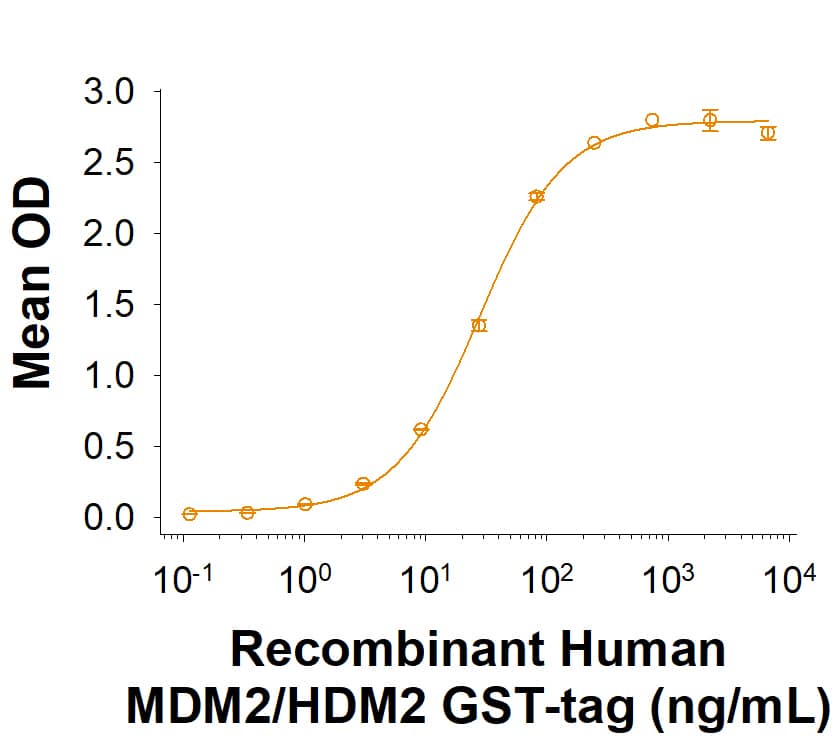
Recombinant Human MDM2/HDM2 GST-tag Protein Binding Activity.

Measured by its binding ability in a functional ELISA. Recombinant Human MDM2/HDM2 GST-tag Protein (Catalog # 11802-DM) binds to Recombinant Human p53 His-tag (11816-TP) with an ED50 of 15.00-150.0 ng/mL.
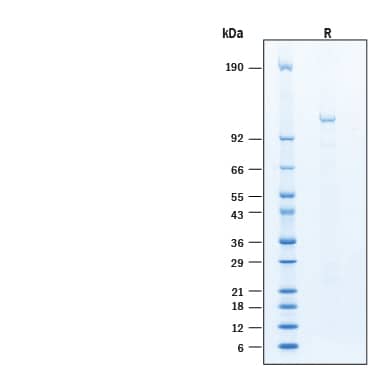
Recombinant Human MDM2/HDM2 GST-tag Protein SDS-PAGE.

2 μg/lane of Recombinant Human MDM2/HDM2 GST-tag Protein (Catalog # 11802-DM) was resolved with SDS-PAGE under reducing (R) condition and visualized by Coomassie® Blue staining, showing bands at 105-120 kDa.

Formulation, Preparation and Storage

11802-DM
Formulation Supplied as a 0.2 μm filtered solution in Tris, NaCl, Glycerol and TCEP with Trehalose.
Reconstitution
Shipping The product is shipped with dry ice or equivalent. Upon receipt, store it immediately at the temperature recommended below.
Stability & Storage Use a manual defrost freezer and avoid repeated freeze-thaw cycles.
  • 6 months from date of receipt, -20 to -70 °C as supplied.
  • 3 months, -20 to -70 °C under sterile conditions after opening.

Background: MDM2/HDM2

Mouse double minute 2 homolog (MDM‑2) is a ubiquitously expressed nuclear and cytoplasmic protein that functions as a central negative regulator of the tumor suppressor p53. MDM‑2 is an E3 ubiquitin ligase that controls p53 protein stability and transcriptional activity through direct binding and ubiquitination, thereby maintaining low basal levels of p53 under non‑stress conditions (1, 2). Human MDM‑2 is a ~55 kDa protein consisting of an N‑terminal p53‑binding domain, a central acidic region, a zinc finger motif, and a C‑terminal RING finger domain responsible for E3 ligase activity and self‑ubiquitination (3). MDM‑2 and p53 are linked through an autoregulatory feedback loop in which p53 transcriptionally activates MDM2 expression, while MDM‑2 in turn suppresses p53 by ubiquitin‑mediated proteasomal degradation and inhibition of transcriptional transactivation (1, 2). This tight regulatory circuit is essential for embryonic development, as genetic ablation or catalytic inactivation of MDM‑2 results in p53‑dependent early embryonic lethality in mouse models (4). Beyond p53 regulation, MDM‑2 also exhibits p53‑independent functions in genome integrity, cell‑cycle progression, and stress responses, underscoring its broader biological significance (4, 5). Dysregulation of MDM‑2 through gene amplification, overexpression, or altered post‑translational modification is frequently observed in human cancers, particularly those retaining wild‑type p53 (2, 5). Elevated MDM‑2 activity leads to functional p53 suppression, promoting uncontrolled proliferation, resistance to apoptosis, genomic instability, and therapeutic resistance (2, 6). Accordingly, the p53–MDM‑2 axis has emerged as a prominent therapeutic target, and multiple small‑molecule inhibitors designed to disrupt p53–MDM‑2 interactions or inhibit MDM‑2 E3 ligase activity are currently under preclinical and clinical investigation (3, 6). Structural and biochemical studies have further elucidated the molecular basis of MDM‑2 function, revealing how its modular domains coordinate substrate recognition, ubiquitin transfer, and interaction with regulatory partners such as MDM‑X, ARF, and ribosomal proteins (3, 4). Recombinant human MDM‑2 therefore represents a valuable research tool for studying p53 pathway regulation, ubiquitin‑mediated proteostasis, cancer biology, and the development and validation of targeted anticancer therapeutics.

References

  1. Kung, C.‑P. and Weber, J.D. (2022) Front. Cell Dev. Biol. 10:818744.
  2. Zhou, J. et al. (2021) Nat. Immunol. 22:460.
  3. Brown, A.L. et al. (2026) Cancers 18:546.
  4. Chinnam, M. et al. (2022) PLoS Genet. 18:e1010171.
  5. Yao, Y. et al. (2024) Cancer Cell Int. 24:170.
  6. Munisamy, M. et al. (2021) Am. J. Cancer Res. 11:5762.

Long Name

Double Minute 2 Protein

Alternate Names

HDM2

Entrez Gene IDs

4193 (Human); 17246 (Mouse)

Gene Symbol

MDM2

Additional MDM2/HDM2 Products

Product Documents for Recombinant Human MDM2/HDM2 GST-tag Protein, CF

Certificate of Analysis

To download a Certificate of Analysis, please enter a lot number in the search box below.

Note: Certificate of Analysis not available for kit components.

Product Specific Notices for Recombinant Human MDM2/HDM2 GST-tag Protein, CF

For research use only

Loading...
Loading...
Loading...
Loading...