
Recombinant Human BAFF/BLyS His-tag Biotinylated Protein, CF New
R&D Systems, part of Bio-Techne | Catalog # BT11403

Key Product Details
Source
HEK293
Structure / Form
Biotinylated via amines
Conjugate
Biotin
Applications
Bioactivity
Product Specifications
Source
Human embryonic kidney cell, HEK293-derived human BAFF/BLyS/TNFSF13B protein
| MHHHHHHHHHH | GS Linker | IEGR | Human BAFF (Ala134 -Leu285) Accession # Q9Y275.1 |
| N-terminus | C-terminus | ||
Purity
>90%, by SDS-PAGE visualized with Silver Staining and quantitative densitometry by Coomassie® Blue Staining.
Endotoxin Level
<0.10 EU per 1 μg of the protein by the LAL method.
N-terminal Sequence Analysis
Met
Predicted Molecular Mass
20 kDa
SDS-PAGE
18-28 kDa, under reducing conditions.
Activity
Measured by its binding ability in a functional ELISA.
Biotinylated Recombinant Human BAFF/BlyS/TNFSF13B His-tag (Catalog # BT11403) binds Recombinant Human BAFF R/TNFRSF13C Fc Chimera (Catalog # 1162-BR) with an ED50 of 2.00-24.0 ng/mL.
Scientific Data Images for Recombinant Human BAFF/BLyS His-tag Biotinylated Protein, CF
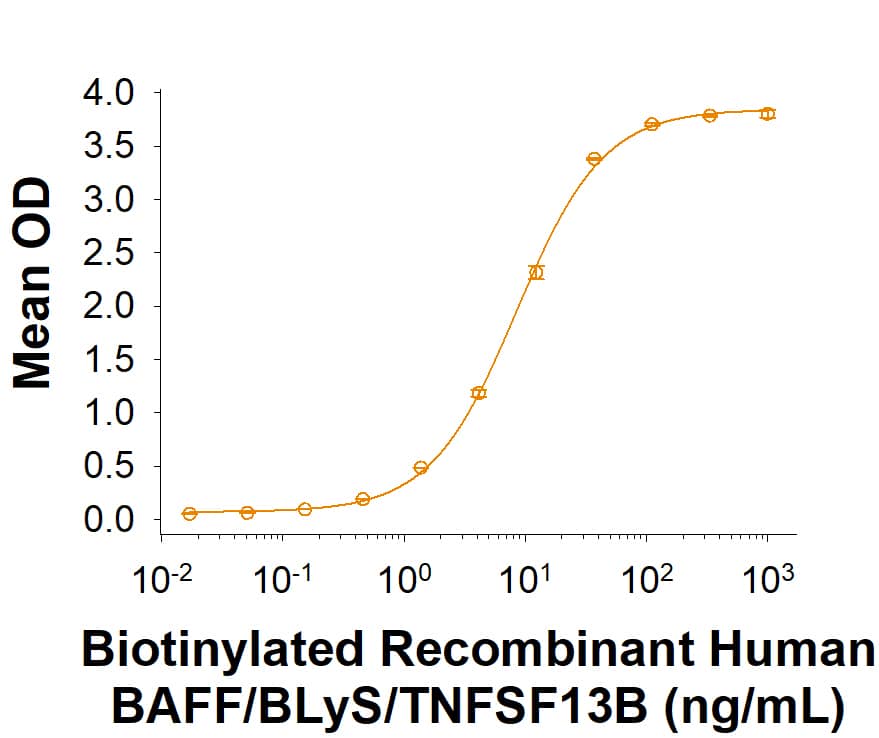
Biotinylated Recombinant Human BAFF/BLyS/TNFSF13B His-tag Protein Binding Activity.
Biotinylated Recombinant Human BAFF/BLyS/TNFSF13B His-tag Protein (Catalog # BT11403) binds Recombinant Human BAFF R/TNFRSF13C Fc Chimera (1162-BR) with an ED50 of 2.00-24.0 ng/mL.Formulation, Preparation and Storage
BT11403
| Formulation | Lyophilized from a 0.2 μm filtered solution in PBS with Trehalose. |
| Reconstitution | Reconstitute at 250 μg/mL in water. |
| Shipping | The product is shipped at ambient temperature. Upon receipt, store it immediately at the temperature recommended below. |
| Stability & Storage | Use a manual defrost freezer and avoid repeated freeze-thaw cycles.
|
Background: BAFF/BLyS/TNFSF13B
References
- Lied, G.A. and A. Berstad (2011) Scand. J. Immunol. 73:1.
- Mackay, F. et al. (2010) Immunol. Rev. 237:205.
- Moore, P.A. et al. (1999) Science 285:260.
- Schneider, P. et al. (1999) J. Exp. Med. 189:1747.
- Roschke, V. et al. (2002) J. Immunol. 169:4314.
- Scapini, P. et al. (2003) J. Exp. Med. 197:297.
- Gavin, A.L. et al. (2003) J. Biol. Chem. 278:38220.
- Alexaki, V.-I. et al. (2009) J. Immunol. 183:5948.
- Yu, G. et al. (2000) Nat. Immunol. 1:252.
- Thompson, J.S. et al. (2001) Science 293:2108.
- Schiemann, B. et al. (2001) Science 293:2111.
- Litinskiy, M.B. et al. (2002) Nat. Immunol. 3:822.
- Batten, M. et al. (2000) J. Exp. Med. 192:1453.
- Huard, B. et al. (2001) J. Immunol. 167:6225.
- Sutherland, A.P.R. et al. (2005) J. Immunol. 174:5537.
- Walters, S. et al. (2009) J. Immunol. 182:793.
- Chang, S.K. et al. (2006) Blood 108:2687.
Long Name
B cell Activating Factor
Alternate Names
BLyS, CD257, TALL1, THANK, TNFSF13B, ZTNF4
Gene Symbol
TNFSF13B
Additional BAFF/BLyS/TNFSF13B Products
Product Documents for Recombinant Human BAFF/BLyS His-tag Biotinylated Protein, CF
Product Specific Notices for Recombinant Human BAFF/BLyS His-tag Biotinylated Protein, CF
For research use only
Loading...
Loading...
Loading...
Loading...