
Human IL-1 beta/IL-1F2 QuicKit ELISA
R&D Systems, part of Bio-Techne | Catalog # QK201

Key Product Details
Assay Length
80 minutes
Sample Type & Volume Required Per Well
Cell Culture Supernates (50 µL), Serum (50 µL), EDTA Plasma (50 µL), Heparin Plasma (50 µL)
Sensitivity
1.95 pg/mL
Assay Range
15.6-1000 pg/mL (Cell Culture Supernates, Serum, EDTA Plasma, Heparin Plasma)
Product Summary for Human IL-1 beta/IL-1F2 QuicKit ELISA
The Quantikine® QuicKit™ Human IL-1 beta/IL-1F2 Immunoassay is a one step, 80-minute solid phase ELISA designed to measure human IL-1 beta in cell culture supernates, serum, and plasma. It contains E. coli-expressed recombinant human IL-1 beta and antibodies raised against the recombinant protein. Results obtained for naturally occurring human IL-1 beta showed linearcurves that were parallel to the standard curves obtained using the recombinant QuicKit™ standards. These results indicate that this kit can be used to determine relative mass values for natural human IL-1 beta.
Product Specifications
Measurement
Quantitative ELISA
Detection Method
Colorimetric - 450nm (TMB)
Conjugate
HRP
Reactivity
Human
Specificity
This assay recognizes natural and recombinant human IL-1 beta.
Cross-reactivity
< 0.5% cross-reactivity observed with available related molecules. < 50% cross-species reactivity observed with species tested.
Interference
No significant interference observed with available related molecules.
Sample Values
Serum/Plasma - Ten serum and plasma samples from apparently healthy volunteers were
evaluated for the presence of human IL-1 beta in this assay. All samples measured less than
15.6 pg/mL. No medical histories were available for the donors used in this study.
Cell culture Supernates - Human peripheral blood mononuclear cells (PBMCs)
(1 x 10⁶
cells/mL) were cultured in RPMI supplemented with 10% fetal bovine serum,
2 mM L-glutamine, 100 U/mL penicillin, and 100 μg/mL streptomycin sulfate. Cells were left
unstimulated or stimulated with 10 μg/mL PHA for 24 hours. Aliquots of the culture supernates
were removed, assayed for levels of human IL-1 beta, and measured at 37.2 pg/mL or 2,273 pg/mL,
respectively.
PBMCs (1 x 10⁶
cells/mL) were cultured as above. Cells were left unstimulated or stimulated
with 1.0 μg/mL LPS for 24 hours. Aliquots of the cell culture supernates were removed, assayed
for levels of human IL-1 beta, and were not detectable or measured 25,396 pg/mL, respectively.
Precision
Intra-Assay Precision (Precision within an assay) Two samples of known concentration were tested twenty times on one plate to assess intra-assay precision.
Inter-Assay Precision (Precision between assays) Two samples of known concentration were tested in ten separate assays to assess inter-assay precision.
Cell Culture Supernates, EDTA Plasma, Heparin Plasma, Serum
| Intra-Assay Precision | Inter-Assay Precision | |||
|---|---|---|---|---|
| Sample | 1 | 2 | 1 | 2 |
| n | 20 | 20 | 10 | 10 |
| Mean (pg/mL) | 102 | 526 | 103 | 528 |
| Standard Deviation | 1.93 | 7.77 | 4.22 | 16.4 |
| CV% | 1.9 | 1.5 | 4.1 | 3.1 |
Recovery for Human IL-1 beta/IL-1F2 QuicKit ELISA
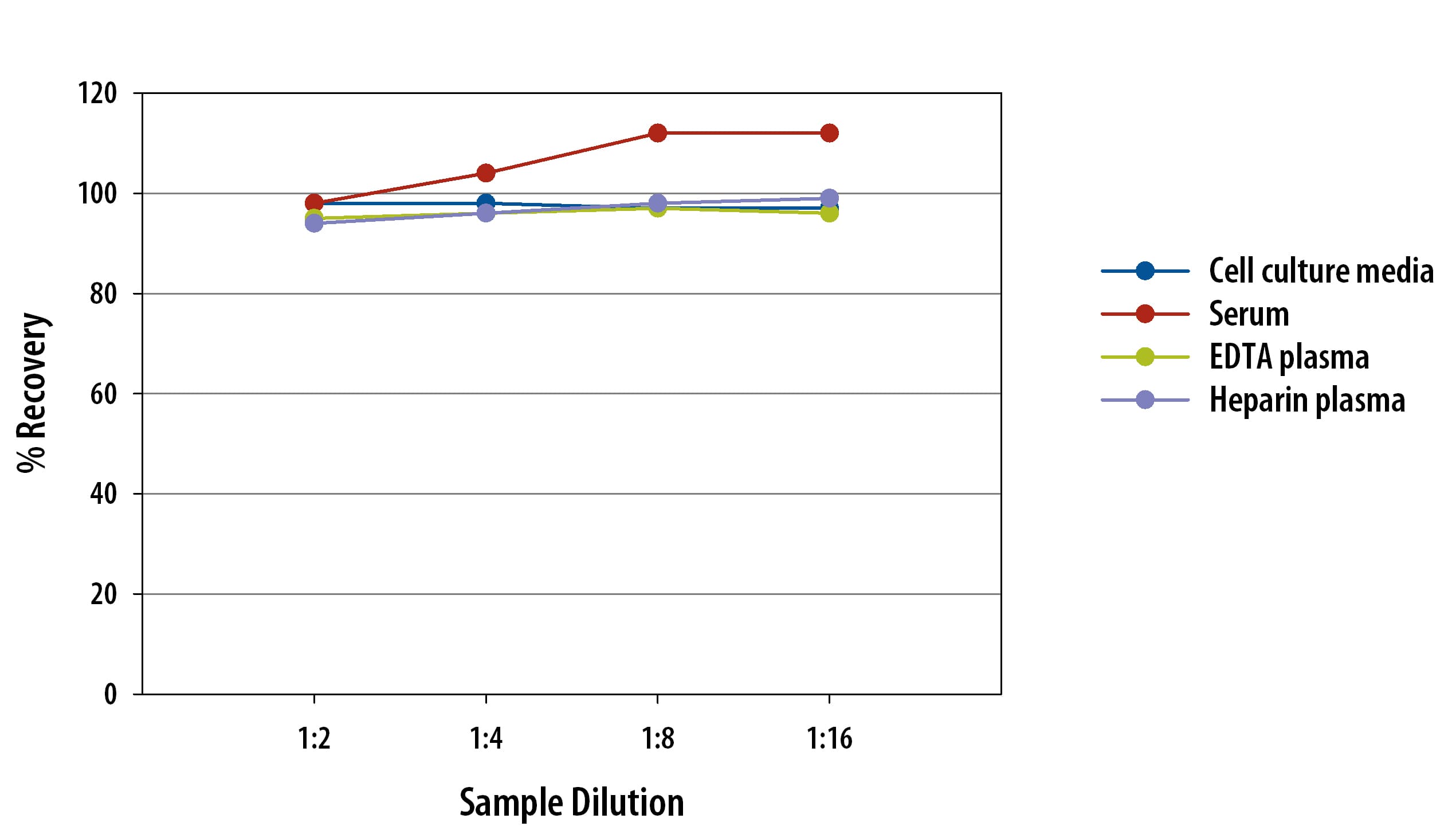
The recovery of human IL-1 beta spiked to three different levels in samples throughout the range of the assay in various matrices was evaluated.
| Sample Type | Average % Recovery | Range % |
|---|---|---|
| Cell Culture Media (n=4) | 105 | 99-108 |
| EDTA Plasma (n=2) | 110 | 106-118 |
| Heparin Plasma (n=2) | 105 | 99-113 |
| Serum (n=2) | 98 | 94-104 |
Linearity
<div>To assess the linearity of the assay, samples containing and/or spiked with high concentrations of human IL-1 beta in various matrices and diluted to produce samples with values within the dynamic range of the assay.</div>
Scientific Data Images for Human IL-1 beta/IL-1F2 QuicKit ELISA

Human IL-1 beta Standard Curve
Human IL-1b QuicKit Spiked Recovery Competitor Comparison
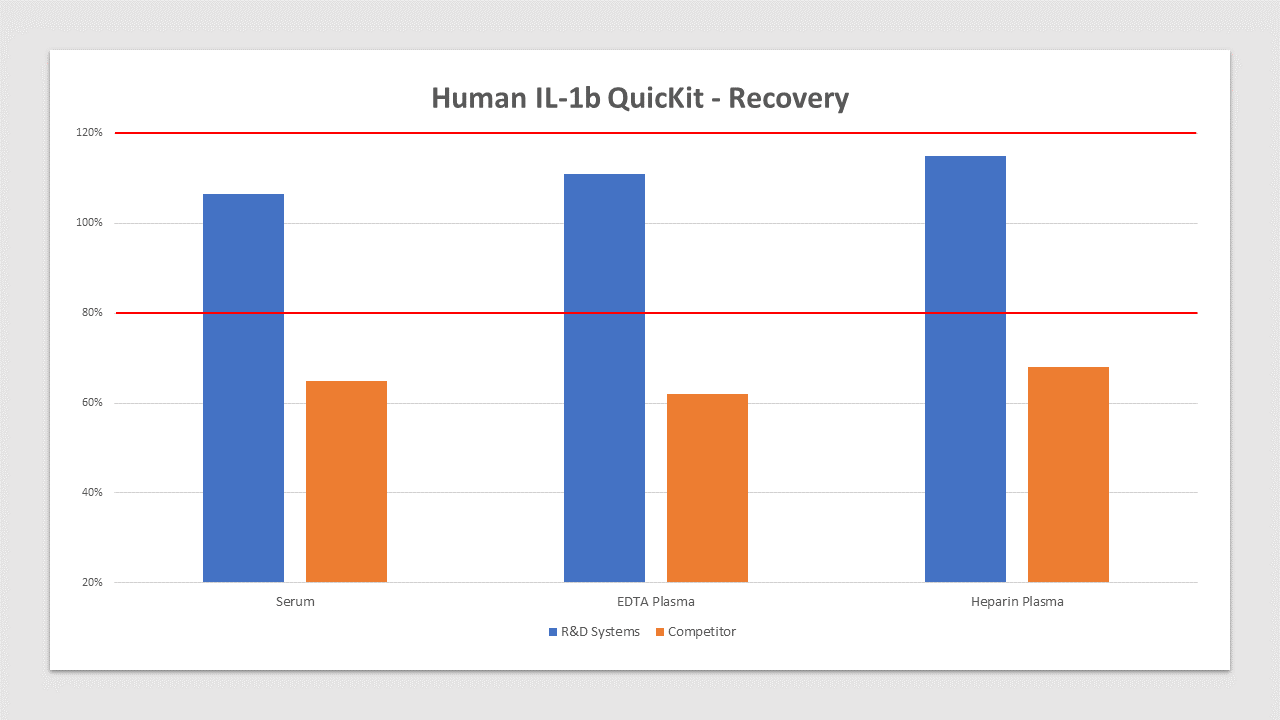
IL-1b is spiked at three known concentrations throughout the range of the assay and run to measure response of the spiked sample matrix. Serum recovery is 107% compared to 65% for the top competitor. EDTA plasma recovery is 111% compared to 62% for the top competitor. Heparin plasma recovery is 115% compared to 68% for the top competitor. In spike and recovery experiments, natural samples are spiked with the recombinant target analyte of interest to identify interference caused by sample matrices.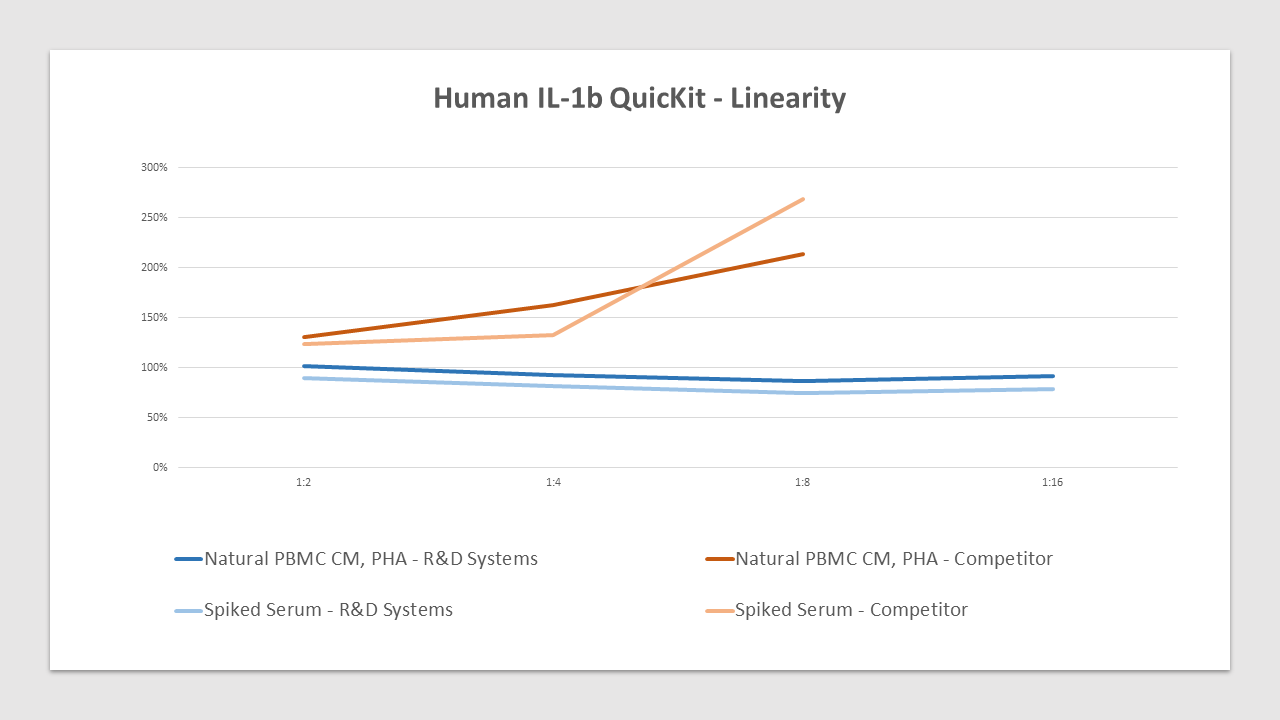
Human IL-1b QuicKit Linearity Competitor Comparison
Samples containing and/or spiked with high concentrations of Leptin in various matrices and diluted with appropriate Calibrator Diluent to produce samples with values within the dynamic range of the assay. The linearity is between 75%-102% compared to 124%-269% for the top competitor.Preparation and Storage
Shipping
The product is shipped at ambient temperature. Upon receipt, store it immediately at the temperature recommended below.
Stability & Storage
Store the unopened product at 2 - 8 °C. Do not use past expiration date.
Background: IL-1 beta/IL-1F2
IL-1 alpha and IL-1 beta are structurally related polypeptides that show approximately 25% homology at
the amino acid level. Both are synthesized as 31 kDa precursors that are subsequently cleaved into
mature proteins of approximately 17.5 kDa (6, 7). Cleavage of the IL-1 beta precursor by Caspase-1/ICE
is a key step in the inflammatory response (2, 8). Neither IL-1 alpha nor IL-1 beta contains a typical
hydrophobic signal peptide (9-11), but evidence suggests that these factors can be secreted by
non-classical pathways (12, 13). A portion of unprocessed IL-1 alpha can be presented on the cell
membrane and may retain biological activity (14). The precursor form of IL-1 beta, unlike the IL-1 alpha
precursor, shows little or no biological activity in comparison to the processed form (13, 15). Both
unprocessed and mature forms of IL-1 beta are exported from the cell.
IL-1 alpha and IL-1 beta exert their effects through immunoglobulin superfamily receptors that additionally
bind IL-1ra. The 80 kDa transmembrane type I receptor (IL-1 RI) is expressed on T cells, fibroblasts,
keratinocytes, endothelial cells, synovial lining cells, chondrocytes, and hepatocytes (16, 17). The
68 kDa transmembrane type II receptor (IL-1 RII) is expressed on B cells, neutrophils, and bone
marrow cells (18). The two IL-1 receptor types show approximately 28% homology in their
extracellular domains but differ significantly in that the type II receptor has a cytoplasmic domain
of only 29 amino acids (aa), whereas the type I receptor has a 213 aa cytoplasmic domain. IL-1 RII
does not appear to signal in response to IL-1 and may function as a decoy receptor that attenuates
IL-1 function (19). The IL-1 receptor accessory protein (IL-1 RAcP) associates with IL-1 RI and is
required for IL-1 RI signal transduction (20). IL-1ra is a secreted molecule that functions as a
competitive inhibitor of IL-1 (21, 22). Soluble forms of both IL-1 RI and IL-1 RII have been detected
in human plasma, synovial fluids, and the conditioned media of several human cell lines (23, 24). In
addition, IL-1 binding proteins that resemble soluble IL-1 RII are encoded by vaccinia and cowpox
viruses (25).
Long Name
Interleukin 1 beta
Alternate Names
IL-1b, IL-1F2, IL1 beta, IL1B
Entrez Gene IDs
Gene Symbol
IL1B
Additional IL-1 beta/IL-1F2 Products
Product Documents for Human IL-1 beta/IL-1F2 QuicKit ELISA
Product Specific Notices for Human IL-1 beta/IL-1F2 QuicKit ELISA
For research use only
Loading...
Loading...
Loading...
Loading...