
Rat ICAM-1/CD54 Fluorescein-conjugated Antibody
R&D Systems, part of Bio-Techne | Catalog # FAB5831F

Scientific images may be resized, cropped, or adjusted for brightness or contrast for presentation purposes. These updates are limited to presentation and do not affect the underlying scientific interpretation of the data. Where available, additional source data may be provided upon request.
Conjugate
Catalog #
Key Product Details
Species Reactivity
Validated:
Rat
Cited:
Human, Rat
Applications
Validated:
Flow Cytometry
Cited:
Flow Cytometry
Label
FITC (Excitation = 488 nm, Emission = 515-545 nm)
Antibody Source
Monoclonal Mouse IgG2B Clone # 141032
Product Specifications
Immunogen
Mouse myeloma cell line NS0-derived recombinant rat ICAM‑1/CD54
Gln28-Thr493 (predicted)
Accession # Q00238
Gln28-Thr493 (predicted)
Accession # Q00238
Specificity
Detects rat ICAM‑1/CD54 in direct ELISAs and Western blots. In direct ELISAs, no cross-reactivity with recombinant mouse (rm) DCC, recombinant human (rh) ICAM-1, rmICAM-1, rmICAM-2, rhICAM-3, rmICAM-5, rmMAdCAM-1, rhCD31 or rmVCAM-1 is observed.
Clonality
Monoclonal
Host
Mouse
Isotype
IgG2B
Scientific Data Images for Rat ICAM-1/CD54 Fluorescein-conjugated Antibody
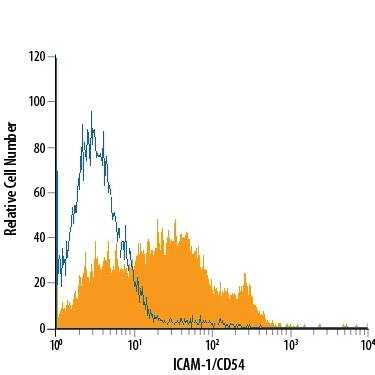
Detection of ICAM‑1/CD54 in Rat Splenocytes by Flow Cytometry.
Rat splenocytes were stained with Mouse Anti-Rat ICAM-1/CD54 Fluorescein-conjugated Monoclonal Antibody (Catalog # FAB5831F, filled histogram) or isotype control antibody (Catalog # IC0041F, open histogram). View our protocol for Staining Membrane-associated Proteins.Applications for Rat ICAM-1/CD54 Fluorescein-conjugated Antibody
Application
Recommended Usage
Flow Cytometry
10 µL/106 cells
Sample: Rat splenocytes
Sample: Rat splenocytes
Spectra Viewer
Plan Your Experiments
Use our spectra viewer to interactively plan your experiments, assessing multiplexing options. View the excitation and emission spectra for our fluorescent dye range and other commonly used dyes.
Spectra Viewer
Formulation, Preparation, and Storage
Purification
Protein A or G purified from hybridoma culture supernatant
Formulation
Supplied in a saline solution containing BSA and Sodium Azide.
Shipping
The product is shipped with polar packs. Upon receipt, store it immediately at the temperature recommended below.
Stability & Storage
Protect from light. Do not freeze.
- 12 months from date of receipt, 2 to 8 °C as supplied.
Background: ICAM-1/CD54
Intercellular Adhesion Molecule-1 (ICAM-1, CD54), binds the leukocyte integrins LFA-1 ( alphaL/ beta2 or CD11a/CD18) and Mac-1 ( alphaM/ beta2 or CD11b/CD18). ICAM-1 expression is weak on leukocytes, epithelial and resting endothelial cells, as well as some other cell types, but expression can be stimulated by IFN-gamma, TNF-alpha, IL-1 beta, and LPS. Within the extracellular domain, rat ICAM-1 shares 53% and 78% amino acid sequence identity with human and mouse ICAM-1, respectively. Soluble ICAM-1 is found in a biologically active form in serum, probably as a result of proteolytic cleavage from the cell surface, and is elevated in patients with various inflammatory syndromes such as septic shock, leukocyte adhesion deficiency syndrome (LAD), cancer, and transplantation.
References
- Pigott, R. and C. Power (1993) in The Adhesion Molecule Facts Book, p. 74. Academic Press.
- Siu, G. et al. (1989) J. Immunol. 143:3813.
- Ballantyne, C.M. et al. (1989) Nuc. Acid. Res. 17:5853.
Long Name
Intercellular Adhesion Molecule 1
Alternate Names
CD54, ICAM1
Gene Symbol
ICAM1
UniProt
Additional ICAM-1/CD54 Products
Product Documents for Rat ICAM-1/CD54 Fluorescein-conjugated Antibody
Product Specific Notices for Rat ICAM-1/CD54 Fluorescein-conjugated Antibody
For research use only
Loading...
Loading...
Loading...
Loading...
Loading...