
Mouse Uromodulin Antibody
R&D Systems, part of Bio-Techne | Catalog # MAB5175


Scientific images may be resized, cropped, or adjusted for brightness or contrast for presentation purposes. These updates are limited to presentation and do not affect the underlying scientific interpretation of the data. Where available, additional source data may be provided upon request.
Conjugate
Catalog #
Key Product Details
Species Reactivity
Validated:
Mouse
Cited:
Mouse
Applications
Validated:
Immunohistochemistry, Western Blot
Cited:
Immunohistochemistry, Immunohistochemistry-Paraffin, Immunohistochemistry-Frozen, Western Blot
Label
Unconjugated
Antibody Source
Monoclonal Rat IgG2A Clone # 774056
Product Specifications
Immunogen
Mouse myeloma cell line NS0-derived recombinant mouse Uromodulin
Ser24-Ala618
Accession # Q91X17
Ser24-Ala618
Accession # Q91X17
Specificity
Detects mouse Uromodulin in direct ELISAs and Western blots. In direct ELISAs, 100% cross-reactivity with
recombinant human Uromodulin is observed.
Clonality
Monoclonal
Host
Rat
Isotype
IgG2A
Scientific Data Images for Mouse Uromodulin Antibody
Detection of Mouse Uromodulin by Western Blot.
Western blot shows lysates of mouse kidney tissue. PVDF membrane was probed with 0.5 µg/mL of Rat Anti-Mouse Uromodulin Monoclonal Antibody (Catalog # MAB5175) followed by HRP-conjugated Anti-Rat IgG Secondary Antibody (Catalog # HAF005). A specific band was detected for Uromodulin at approximately 115 kDa (as indicated). This experiment was conducted under reducing conditions and using Immunoblot Buffer Group 8.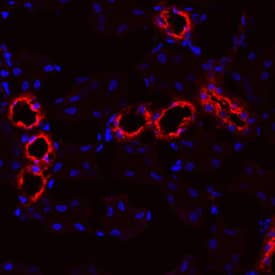
Uromodulin in Mouse Kidney.
Uromodulin was detected in immersion fixed frozen sections of mouse kidney using Rat Anti-Mouse Uromodulin Monoclonal Antibody (Catalog # MAB5175) at 10 µg/mL overnight at 4 °C. Tissue was stained using the NorthernLights™ 557-conjugated Anti-Rat IgG Secondary Antibody (red; Catalog # NL013) and counterstained with DAPI (blue). Specific staining was localized to convoluted tubule epithelial cells. View our protocol for Fluorescent IHC Staining of Frozen Tissue Sections.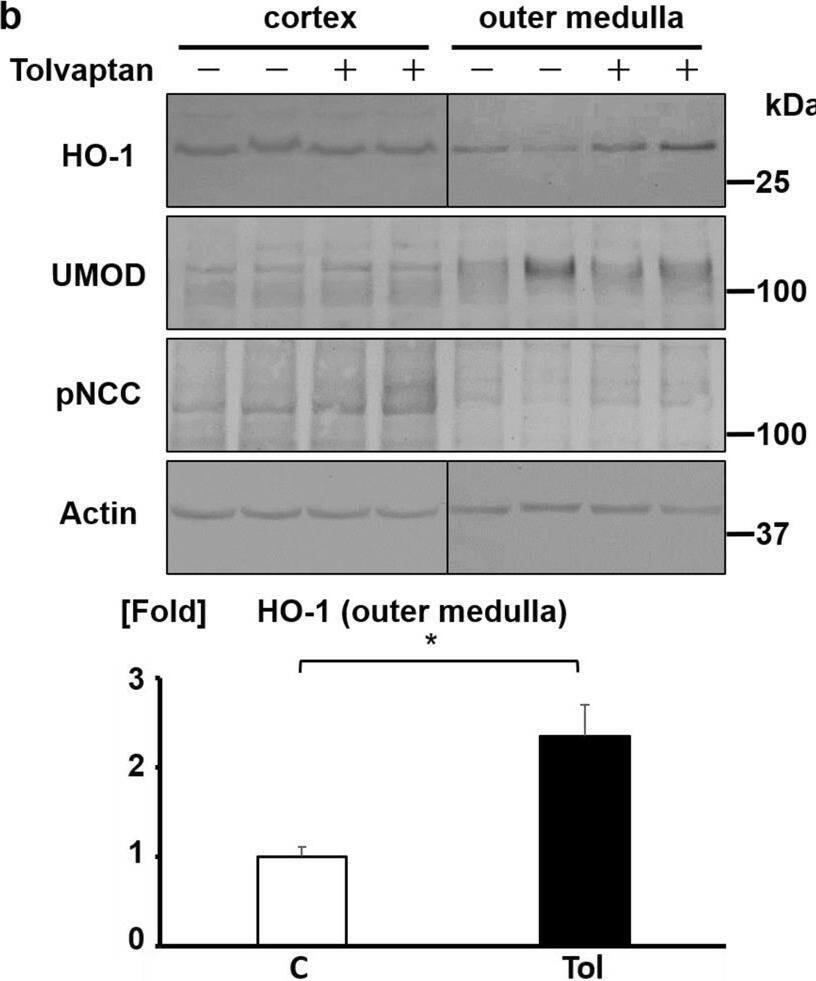
Detection of Uromodulin by Western Blot
Tolvaptan induces Nrf2 nuclear translocation and HO-1 expression in vivo. (a) Tolvaptan promotes Nrf2 nuclear translocation in the outer medulla of mouse kidneys. (Top panel) Male C57BL/6J mice aged 8–9-weeks were fed with a diet containing 0.5% tolvaptan for 24 h. The nuclear extract was obtained from the outer medulla. Arrow indicates the band of Nrf2. (Bottom panel) Nrf2 bands were quantified using densitometric analysis. Bar indicates average from four or five experiments (control: n = 4, tolvaptan: n = 5). Student’s t-test, **P < 0.01. C: control, Tol: 0.5% tolvaptan. (b) Tolvaptan increases HO-1 protein expression in the outer medulla of mouse kidneys. (Top panel) Tolvaptan (0.5%) was administered via diet to 8–9-week-old male C57BL/6J mice for 24 h. The kidneys were separated into the cortex and the outer medulla, and the whole protein extraction was performed. The blots of HO-1 and Actin were configured with the blot of cortex and that of outer medulla. Fractionation of the cortex and the outer medulla was verified using UMOD and pNCC antibodies. (Bottom panel) Densitometric analysis of HO-1 is shown. Bar indicates average from four or five experiments (control: n = 4, tolvaptan: n = 5). Student’s t-test, *P < 0.05. C: control, Tol: 0.5% tolvaptan. Image collected and cropped by CiteAb from the following open publication (https://pubmed.ncbi.nlm.nih.gov/31239473), licensed under a CC-BY license. Not internally tested by R&D Systems.Applications for Mouse Uromodulin Antibody
Application
Recommended Usage
Immunohistochemistry
8-25 µg/mL
Sample: Immersion fixed frozen sections of mouse kidney
Sample: Immersion fixed frozen sections of mouse kidney
Western Blot
0.5 µg/mL
Sample: Mouse kidney tissue
Sample: Mouse kidney tissue
Reviewed Applications
Read 2 reviews rated 5 using MAB5175 in the following applications:
Formulation, Preparation, and Storage
Purification
Protein A or G purified from hybridoma culture supernatant
Reconstitution
Sterile PBS to a final concentration of 0.5 mg/mL. For liquid material, refer to CoA for concentration.
Formulation
Lyophilized from a 0.2 μm filtered solution in PBS with Trehalose. *Small pack size (SP) is supplied either lyophilized or as a 0.2 µm filtered solution in PBS.
Shipping
Lyophilized product is shipped at ambient temperature. Liquid small pack size (-SP) is shipped with polar packs. Upon receipt, store immediately at the temperature recommended below.
Stability & Storage
Use a manual defrost freezer and avoid repeated freeze-thaw cycles.
- 12 months from date of receipt, -20 to -70 °C as supplied.
- 1 month, 2 to 8 °C under sterile conditions after reconstitution.
- 6 months, -20 to -70 °C under sterile conditions after reconstitution.
Background: Uromodulin
Uromodulin (also Tamm-Horsfall glycoprotein or THP) is a 105‑120 kDa urinary glycoprotein. It is secreted by renal tubule epithelium, acts as a binding protein for IL‑1, TNF-alpha and C1q, activates resting monocytes, and promotes neutrophil phagocytosis. Uromodulin forms high molecular weight oligomers that line the kidney tubules. Mouse Uromodulin is GPI-linked. Its proprecursor is 619 amino acids (aa) in length. It contains three EGF-like domains (aa 28‑148), a ZP domain that mediates oligomerization (aa 335‑590), and a cleavable C-terminal propeptide (aa 619‑642). There are multiple splice variants. One shows an alternate start site at Met343, and there are two substitutions, a 17 aa substitution for aa 601‑642, and a 166 aa substitution for aa 441‑642. Over aa 25‑618, mouse Uromodulin shares 78% and 89% aa identical to human and rat Uromodulin, respectively.
Alternate Names
ADMCKD2, FJHN, HNFJ, MCKD2, THGP, THP, UMOD, Uromucoid
Gene Symbol
UMOD
UniProt
Additional Uromodulin Products
Product Documents for Mouse Uromodulin Antibody
Product Specific Notices for Mouse Uromodulin Antibody
For research use only
Loading...
Loading...
Loading...
Loading...
Loading...