
Mouse Neuroplastin Antibody
R&D Systems, part of Bio-Techne | Catalog # AF7818


Conjugate
Catalog #
Key Product Details
Species Reactivity
Validated:
Mouse
Cited:
Human, Mouse, Transgenic Mouse
Applications
Validated:
Western Blot
Cited:
Immunohistochemistry, Immunohistochemistry-Frozen, Western Blot, Affinity Purification
Label
Unconjugated
Antibody Source
Polyclonal Sheep IgG
Product Specifications
Immunogen
Mouse myeloma cell line NS0-derived recombinant mouse Neuroplastin
Gln29-Pro338, predicted
Accession # P97300
Gln29-Pro338, predicted
Accession # P97300
Specificity
Detects mouse Neuroplastin in direct ELISAs and Western blots. In direct ELISAs, approximately 100% cross-reactivity with recombinant human Neuroplastin-65 is observed.
Clonality
Polyclonal
Host
Sheep
Isotype
IgG
Scientific Data Images for Mouse Neuroplastin Antibody
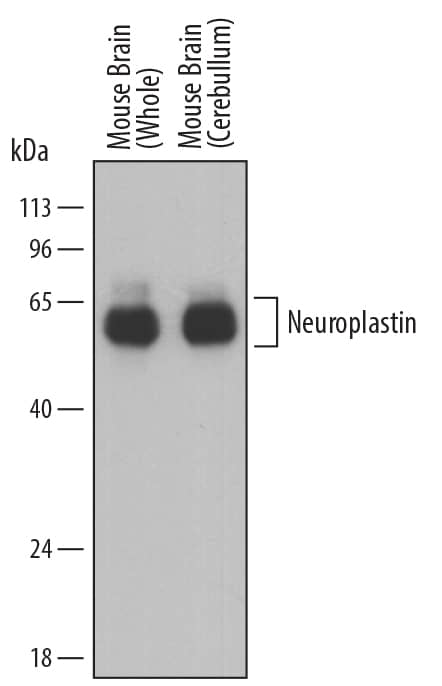
Detection of Mouse Neuroplastin by Western Blot.
Western blot shows lysates of mouse brain (whole) tissue and mouse brain (cerebellum) tissue. PVDF membrane was probed with 0.05 µg/mL of Sheep Anti-Mouse Neuroplastin Antigen Affinity-purified Polyclonal Antibody (Catalog # AF7818) followed by HRP-conjugated Anti-Sheep IgG Secondary Antibody (Catalog # HAF016). A specific band was detected for Neuroplastin at approximately 55-65 kDa (as indicated). This experiment was conducted under reducing conditions and using Immunoblot Buffer Group 1.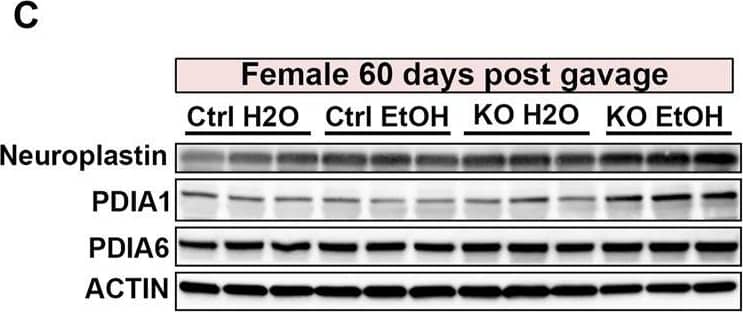
Detection of Mouse Neuroplastin by Western Blot
The effect of binge alcohol exposure and neuronal MANF deficiency on the expression of MANF interacting proteins. (A–D) Representative immunoblots (A, C) and quantification (B, D) of MANF interacting proteins neuroplasin, PDIA1, and PDIA6 in female control and MANF KO cerebral cortex 1 day (A, B) or 60 days (C, D) post H2O or EtOH treatment. (E–H) Representative immunoblots (E, G) and quantification (F, H) of MANF interacting proteins neuroplasin, PDIA1, and PDIA6 in male control and MANF KO cerebral cortex 1 day (E, F) or 60 days (G, H) post H2O or EtOH treatment. All data were expressed as mean ± SEM. n = 3 per group. Two-way ANOVA followed by Tukey’s post hoc test. *p < 0.05, **p < 0.01, ***p < 0.001, ****p < 0.0001 when compared to H2O treated control. #p < 0.05, ##p < 0.01, ####p < 0.0001 when compared to EtOH treated control. @p < 0.05, @@p < 0.01, @@@p < 0.001, @@@@p < 0.0001 when compared to H2O treated KO. Image collected and cropped by CiteAb from the following open publication (https://pubmed.ncbi.nlm.nih.gov/39130640), licensed under a CC-BY license. Not internally tested by R&D Systems.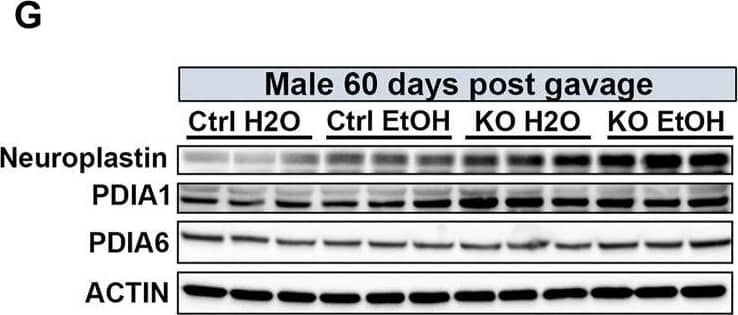
Detection of Mouse Neuroplastin by Western Blot
The effect of binge alcohol exposure and neuronal MANF deficiency on the expression of MANF interacting proteins. (A–D) Representative immunoblots (A, C) and quantification (B, D) of MANF interacting proteins neuroplasin, PDIA1, and PDIA6 in female control and MANF KO cerebral cortex 1 day (A, B) or 60 days (C, D) post H2O or EtOH treatment. (E–H) Representative immunoblots (E, G) and quantification (F, H) of MANF interacting proteins neuroplasin, PDIA1, and PDIA6 in male control and MANF KO cerebral cortex 1 day (E, F) or 60 days (G, H) post H2O or EtOH treatment. All data were expressed as mean ± SEM. n = 3 per group. Two-way ANOVA followed by Tukey’s post hoc test. *p < 0.05, **p < 0.01, ***p < 0.001, ****p < 0.0001 when compared to H2O treated control. #p < 0.05, ##p < 0.01, ####p < 0.0001 when compared to EtOH treated control. @p < 0.05, @@p < 0.01, @@@p < 0.001, @@@@p < 0.0001 when compared to H2O treated KO. Image collected and cropped by CiteAb from the following open publication (https://pubmed.ncbi.nlm.nih.gov/39130640), licensed under a CC-BY license. Not internally tested by R&D Systems.Applications for Mouse Neuroplastin Antibody
Application
Recommended Usage
Western Blot
0.05 µg/mL
Sample: Mouse brain (whole) tissue and mouse brain (cerebellum) tissue
Sample: Mouse brain (whole) tissue and mouse brain (cerebellum) tissue
Formulation, Preparation, and Storage
Purification
Antigen Affinity-purified
Reconstitution
Sterile PBS to a final concentration of 0.2 mg/mL. For liquid material, refer to CoA for concentration.
Formulation
Lyophilized from a 0.2 μm filtered solution in PBS with Trehalose. *Small pack size (SP) is supplied either lyophilized or as a 0.2 µm filtered solution in PBS.
Shipping
Lyophilized product is shipped at ambient temperature. Liquid small pack size (-SP) is shipped with polar packs. Upon receipt, store immediately at the temperature recommended below.
Stability & Storage
Use a manual defrost freezer and avoid repeated freeze-thaw cycles.
- 12 months from date of receipt, -20 to -70 °C as supplied.
- 1 month, 2 to 8 °C under sterile conditions after reconstitution.
- 6 months, -20 to -70 °C under sterile conditions after reconstitution.
Background: Neuroplastin
Neuroplastin (NPTN or neural plasticity-dependent synaptic rearrangement protein; also Np65 and SDR-1) is a 63-67 kDa member of the CD147 family, Ig‑superfamily of molecules. Its expression is primarily restricted to the PSD of select neurons, and it likely serves as a cell adhesion molecule between cells. NPTN is known to bind homotypically in trans, and this complex appears to interact with FGFR1 in cis. Engagement of the FGFR induces neurite outgrowth. Notably, rodent and human Np65 show distinctly different staining patterns in the hippocampus and cerebellum of the brain. Mature mouse NPTN is a 369 amino acid (aa) type I transmembrane glycoprotein. It possesses a 310 aa extracellular region (aa 29-338) that contains three Ig-like domains (aa 29-134; 148-234; 237-327), and a 38 aa cytoplasmic tail. There are three splice forms that have been described. One is a widely-expressed 53-57 kDa isoform (Np55) that contains a Glu substitution for aa 31‑147, a second is a splice form that shows the above substitution coupled to a deletion of aa 371-374, and a third is an isoform that contains a nine aa substitution for aa 1-235. Over aa 1-338, mouse NPTN shares 95% and 98% aa sequence identity with human and rat NPTN/Np65, respectively.
Alternate Names
AW554172, GP55, GP66, NPTN, SDFR1, SDR1
Gene Symbol
NPTN
UniProt
Additional Neuroplastin Products
Product Documents for Mouse Neuroplastin Antibody
Product Specific Notices for Mouse Neuroplastin Antibody
For research use only
Loading...
Loading...
Loading...
Loading...
Loading...