
Mouse Leptin/OB Antibody
R&D Systems, part of Bio-Techne | Catalog # AF498



Key Product Details
Species Reactivity
Validated:
Mouse
Cited:
Human, Mouse, Transgenic Mouse
Applications
Validated:
Immunohistochemistry, Western Blot, ELISA Capture (Matched Antibody Pair), Neutralization
Cited:
Immunohistochemistry, Immunohistochemistry-Frozen, Western Blot, Neutralization, ELISA Capture, ELISA Development, In vivo assay
Label
Unconjugated
Antibody Source
Polyclonal Goat IgG
Product Specifications
Immunogen
E. coli-derived recombinant mouse Leptin/OB
Specificity
Detects mouse Leptin/OB in ELISAs and Western blots.
Clonality
Polyclonal
Host
Goat
Isotype
IgG
Endotoxin Level
<0.10 EU per 1 µg of the antibody by the LAL method.
Scientific Data Images for Mouse Leptin/OB Antibody
Leptin/OB in Mouse Brain.
Leptin/OB was detected in perfusion fixed frozen sections of mouse brain using Mouse Leptin/OB Antigen Affinity-purified Polyclonal Antibody (Catalog # AF498) at 5 µg/mL overnight at 4 °C. Tissue was stained using the Anti-Goat HRP-DAB Cell & Tissue Staining Kit (brown; CTS008) and counterstained with hematoxylin (blue). Specific staining was localized to neuronal cytoplasm. View our protocol for Chromogenic IHC Staining of Frozen Tissue Sections.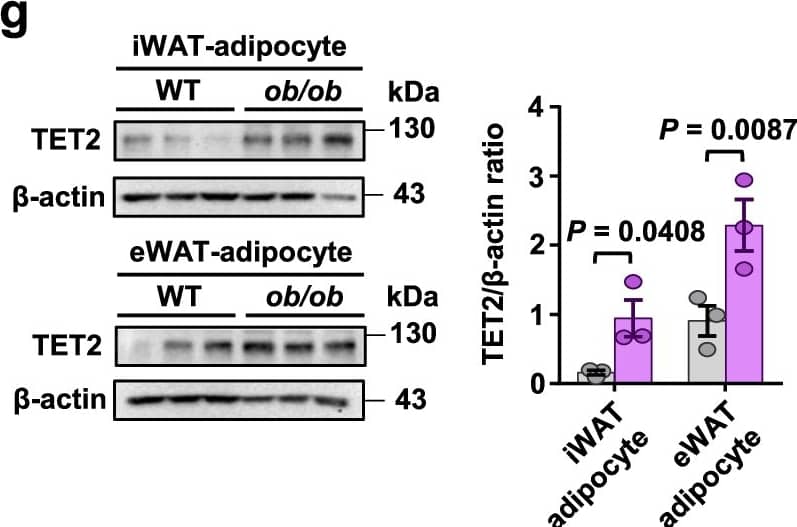
Detection of Mouse Leptin/OB by Western Blot
Leptin inhibits adipocyte Tet2 expression via JAK2-STAT3 signaling pathway in adipocytes.aTet2 mRNA levels relative to 36b4 in differentiated mature adipocytes that were treated with PBS, leptin (1 μg/mL), TNF-alpha (5 ng/mL), LPS (500 ng/mL), IFN-gamma (2 ng/mL), or TGF-beta 1 (10 ng/mL) for 24 h (n = 3). b-cTet2 expression in differentiated mature adipocytes treated with leptin at various time points (b) and concentrations (c). Time points and concentrations are indicated on the graphs (n = 3). d Leptin levels in conditioned medium (CM) from iWAT and eWAT of ND-fed and HFD-fed mice (n = 4).eTet2 expression in mature adipocytes treated with control antibody (IgG) or leptin neutralizing antibody (mLeptin) for 1 h, followed by treating with CM from eWAT of ND-fed and HFD-fed mice for another 24 h (n = 3). fTet2 mRNA levels relative to 36b4 in adipocytes of iWAT and eWAT from WT and ob/ob mice (n = 5 WT, n = 6 ob/ob). g Representative immunoblot images of TET2 in adipocytes of iWAT and eWAT from the mice shown in f and densitometry analysis. beta-actin was used as a loading control (n = 3 mice/group). hTet2 expression in differentiated 3T3-L1 adipocytes treated with DMSO (n = 4) or AZD1480 (JAK2 inhibitor, n = 3), Ctrl-siRNA (n = 3) or JAK2-siRNA (n = 3) for 24 h, followed by treating with leptin for another 24 h. iTet2 expression in differentiated 3T3-L1 adipocytes treated with Ctrl-siRNA or STAT3-siRNA for 24 h, followed by treating with leptin for another 24 h (n = 3). All data are presented as mean ± SEM. n indicates the number of biologically independent samples examined. P-values are indicated on the graph. Statistical values are determined by two-sided unpaired Student’s t-test. Source data are provided as a Source Data File. Image collected and cropped by CiteAb from the following open publication (https://www.nature.com/articles/s41467-024-46783-x), licensed under a CC-BY license. Not internally tested by R&D Systems.
Mouse Leptin / OB ELISA Standard Curve
Recombinant Mouse Leptin/OB (Catalog # 498-OB) was serially diluted and captured by Goat Anti-Mouse Leptin/OB Antigen Affinity-purified Polyclonal Antibody (Catalog # AF498) coated on a Clear Polystyrene Microplate (Catalog # DY990). Goat Anti-Mouse Leptin/OB Antigen Affinity-purified Polyclonal Antibody (Catalog # AF498) was biotinylated and incubated with the protein captured on the plate. Detection of the standard curve was achieved by incubating Streptavidin-HRP (Catalog # DY998)Applications for Mouse Leptin/OB Antibody
Application
Recommended Usage
Immunohistochemistry
5-15 µg/mL
Sample: Perfusion fixed frozen sections of rat brain and mouse brain
Sample: Perfusion fixed frozen sections of rat brain and mouse brain
Western Blot
0.1 µg/mL
Sample: Recombinant Mouse Leptin/OB (Catalog # 498-OB)
Sample: Recombinant Mouse Leptin/OB (Catalog # 498-OB)
Neutralization
Measured by its ability to neutralize Leptin/OB-induced proliferation in the BaF3 mouse pro-B cell line transfected with human Leptin R. The Neutralization Dose (ND50) is typically 0.05-0.3 µg/mL in the presence of 2.5 ng/mL Recombinant Mouse Leptin/OB.
Mouse Leptin/OB Sandwich Immunoassay
Please Note: Optimal dilutions of this antibody should be experimentally determined.
Formulation, Preparation, and Storage
Purification
Antigen Affinity-purified
Reconstitution
Reconstitute at 0.2 mg/mL in sterile PBS. For liquid material, refer to CoA for concentration.
Formulation
Lyophilized from a 0.2 μm filtered solution in PBS with Trehalose. *Small pack size (SP) is supplied either lyophilized or as a 0.2 µm filtered solution in PBS.
Shipping
Lyophilized product is shipped at ambient temperature. Liquid small pack size (-SP) is shipped with polar packs. Upon receipt, store immediately at the temperature recommended below.
Stability & Storage
Store the unopened product at -20 to -70 °C. Use a manual defrost freezer and avoid repeated freeze-thaw cycles. Do not use past expiration date.
Background: Leptin/OB
Leptin is a protein product of the mouse obese gene. Mice with mutations in the obese gene that block the synthesis of Leptin have been found to be obese and diabetic and to have reduced activity, metabolism and body temperature. cDNA clones encoding Leptin have been isolated from human, simian, mouse, and rat cells. Mouse Leptin shares approximately 96% and 84% sequence identity with the rat and human protein, respectively. Mouse Leptin cDNA encodes a 167 amino acid residue protein with a 21 amino acid residue signal sequence that is cleaved to yield the 146 amino acid residue mature protein. The expression of Leptin mRNA has been shown to be restricted to adipose tissue.
A high-affinity receptor for Leptin (OB-R) with homology to gp130 and the G-CSF receptor has been cloned. OB-R mRNA has been shown to be expressed in the choroid plexus and in the hypothalamus. OB-R has also been identified as an isoform of B219, a sequence that is expressed in at least four isoforms in very primitive hematopoietic cell populations and in a variety of lymphohematopoietic cell lines (1-3). The possible roles of Leptin in body weight regulation, hematopoiesis and reproduction are being investigated.
References
- Considine, R. and J. Caro (1996) Clinical Chemistry 42:843.
- Tartaglia, L.A. et al. (1995) Cell 83:1263.
- Cioffi, J.A. et al. (1996) Nature Medicine 2:585.
Alternate Names
LEP, OB
Gene Symbol
LEP
UniProt
Additional Leptin/OB Products
Product Documents for Mouse Leptin/OB Antibody
Product Specific Notices for Mouse Leptin/OB Antibody
For research use only
Loading...
Loading...
Loading...
Loading...
Loading...