
Mouse Klotho beta Antibody
R&D Systems, part of Bio-Techne | Catalog # AF2619

Conjugate
Catalog #
Key Product Details
Species Reactivity
Validated:
Mouse
Cited:
Human, Mouse, Transgenic Mouse
Applications
Validated:
Western Blot
Cited:
Immunohistochemistry, Western Blot
Label
Unconjugated
Antibody Source
Polyclonal Goat IgG
Product Specifications
Immunogen
Mouse myeloma cell line NS0-derived recombinant mouse Klotho beta (R&D Systems, Catalog # 2619-KB)
Phe53-Leu995
Accession # NP_112457
Phe53-Leu995
Accession # NP_112457
Specificity
Detects mouse Klotho beta in direct ELISAs and Western blots. In these formats, approximately 5% cross‑reactivity with recombinant mouse Klotho is observed.
Clonality
Polyclonal
Host
Goat
Isotype
IgG
Scientific Data Images for Mouse Klotho beta Antibody
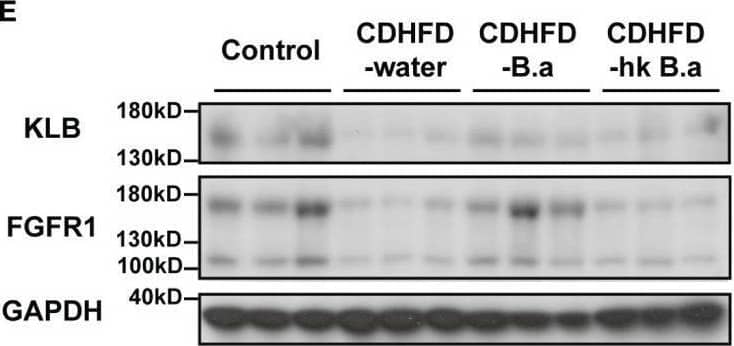
Detection of Klotho beta by Western Blot
B. adolescentis supplementation alleviated FGF21 resistance. Mice were grouped and treated as in Figure 1. (A) The serum level of FGF21 (n = 6 in each group). (B) FGF21 levels in liver measured by ELISA (n = 6 in each group). (C) The transcription of FGFR1 in liver (n = 6 in each group). (D) The transcription of KLB in liver (n = 6 in each group). (E) The expression of FGFR1 and beta-Klotho in liver detected by western blot analysis. (F) Quantification of the FGFR1 expression normalized to GAPDH (n = 3). (G) Quantification of the KLB expression normalized to GAPDH (n = 3). (H) Experiment schematics for FGF21 response test. The experiment schematic was created using BioRender.com. (I) Phosphorylation of Erk1/2 (Thr202/Tyr204) before and after rmFGF21 administration (2mg/kg) detected by western blot analysis. (J) Quantification analysis of the fold change of Erk1/2 phosphorylation (n = 4-6). FGF21, fibroblast growth factor; FGFR1, Fibroblast growth factor receptor 1; GAPDH, glyceraldehyde-3-phosphate dehydrogenase; KLB, beta-klotho; rmFGF21, recombinant mouse fibroblast growth factor 21. (K) The transcription of FGFR1 in hep1-6 after the treatment with LPS. (L) The transcription of KLB in hep1-6 after the treatment with LPS. Data are presented as mean ± SEM. Significance was determined by one-way ANOVA with Fisher’s LSD multiple-comparison analysis. *p < 0.05; **p < 0.01; ***p < 0.001. Image collected and cropped by CiteAb from the following open publication (https://pubmed.ncbi.nlm.nih.gov/35035378), licensed under a CC-BY license. Not internally tested by R&D Systems.Applications for Mouse Klotho beta Antibody
Application
Recommended Usage
Western Blot
0.1 µg/mL
Sample: Recombinant Mouse Klotho beta (Catalog # 2619-KB)
Sample: Recombinant Mouse Klotho beta (Catalog # 2619-KB)
Formulation, Preparation, and Storage
Purification
Antigen Affinity-purified
Reconstitution
Reconstitute at 0.2 mg/mL in sterile PBS. For liquid material, refer to CoA for concentration.
Formulation
Lyophilized from a 0.2 μm filtered solution in PBS with Trehalose. *Small pack size (SP) is supplied either lyophilized or as a 0.2 µm filtered solution in PBS.
Shipping
Lyophilized product is shipped at ambient temperature. Liquid small pack size (-SP) is shipped with polar packs. Upon receipt, store immediately at the temperature recommended below.
Stability & Storage
Use a manual defrost freezer and avoid repeated freeze-thaw cycles.
- 12 months from date of receipt, -20 to -70 °C as supplied.
- 1 month, 2 to 8 °C under sterile conditions after reconstitution.
- 6 months, -20 to -70 °C under sterile conditions after reconstitution.
Background: Klotho beta
Klotho beta, a divergent structural member of the glycosidase I superfamily, is expressed primarily in the liver and pancreas, with lower expression in adipose tissue (1). Like Klotho, Klotho beta facilitates binding between FGF19 subfamily members and their receptors via formation of a ternary complex (2). The Klotho beta mediated interaction of FGF15 (human FGF19) with FGF Receptor 4 in the liver negatively regulates bile acid synthesis by controlling the secretion of two key bile acid synthase genes, cholesterol 7-alpha hydroxylase (Cyp7a1) and sterol 12-alpha hydroxylase (Cyp8b1) (2 - 4). Klotho beta is also a cofactor for the interaction of FGF21 with FGF Receptor 1c in adipocytes, which allows FGF21 to stimulate GLUT1 expression, upregulating adipocyte insulin-dependent glucose uptake (2 - 3, 5). The 1043 amino acid (aa) type I transmembrane protein is composed of a 51 aa signal sequence, a 943 aa extracellular domain (ECD) containing two glycosidase-like regions, a 21 aa transmembrane domain, and 28 aa intracellular tail. Since Klotho-related proteins lack critical active site Glu residues present in beta-glycosidases, it was initially unclear whether they were functional enzymes (1, 6). However, glucuronidase activity has since been demonstrated for Klotho, indicating that physiologically relevant enzymatic activity for Klotho beta is also possible (7). The extracellular domain shares 79%, 79%, 80% and 67% identity with human, bovine, canine and rat Klotho beta, respectively. The low identity with rat reflects aa discordance within rodent ECD.
References
- Mian, I.S. (1998) Blood Cells Mol. Dis. 24:83.
- Ito, S. et al. (2005) J. Clin. Invest. 115:2202.
- Kurosu, H. et al. (2007) J. Biol. Chem. 282:26687.
- Lin, B. C. et al. (2007) J. Biol. Chem. 282:27277.
- Ogawa, Y. et al. (2007) Proc. Natl. Acad. Sci USA 104:7432.
- Chang, Q. et al. (2005) Science 310:490.
- Goetz, R. et al. (2007) Mol. Cell. Biol. 27:3417.
Alternate Names
KLB
Gene Symbol
KLB
UniProt
Additional Klotho beta Products
Product Documents for Mouse Klotho beta Antibody
Product Specific Notices for Mouse Klotho beta Antibody
For research use only
Loading...
Loading...
Loading...
Loading...
Loading...