
Mouse ALCAM/CD166 APC-conjugated Antibody
R&D Systems, part of Bio-Techne | Catalog # FAB1172A

Conjugate
Catalog #
Key Product Details
Species Reactivity
Mouse
Applications
Flow Cytometry
Label
Allophycocyanin (Excitation = 620-650 nm, Emission = 660-670 nm)
Antibody Source
Polyclonal Goat IgG
Product Specifications
Immunogen
Mouse myeloma cell line NS0-derived recombinant mouse ALCAM/CD166
Trp28-Lys527
Accession # AAC06342
Trp28-Lys527
Accession # AAC06342
Specificity
Detects mouse ALCAM in direct ELISAs and Western blots. In direct ELISAs, approximately 40% cross-reactivity with recombinant human (rh) ALCAM is observed, and less than 10% cross-reactivity with rhBCAM, recombinant mouse (rm) OCAM, and rmMAdCAM‑1 is observed.
Clonality
Polyclonal
Host
Goat
Isotype
IgG
Scientific Data Images for Mouse ALCAM/CD166 APC-conjugated Antibody
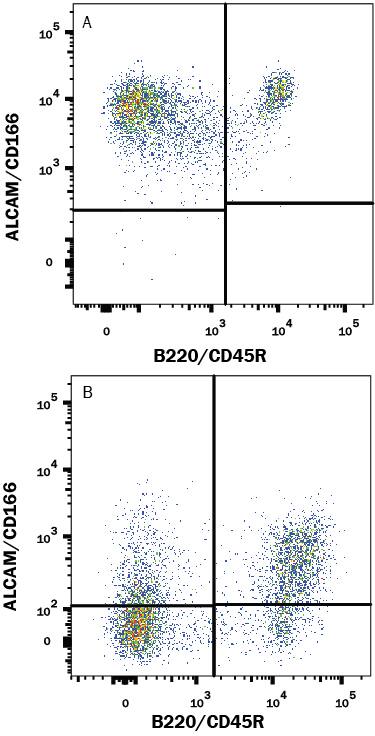
Detection of ALCAM/CD166 in Mouse Splenocytes by Flow Cytometry.
Mouse Splenocytes either (A) activated or (B) resting were stained with Goat Anti-Mouse ALCAM/CD166 APC-conjugated Antigen Affinity-purified Polyclonal Antibody (Catalog # FAB1172A) and Rat Anti-Mouse B220/CD45R PE-conjugated Monoclonal Antibody (Catalog # FAB1217P). Quadrant markers were set based on control antibody staining (Catalog # IC108A). View our protocol for Staining Membrane-associated Proteins.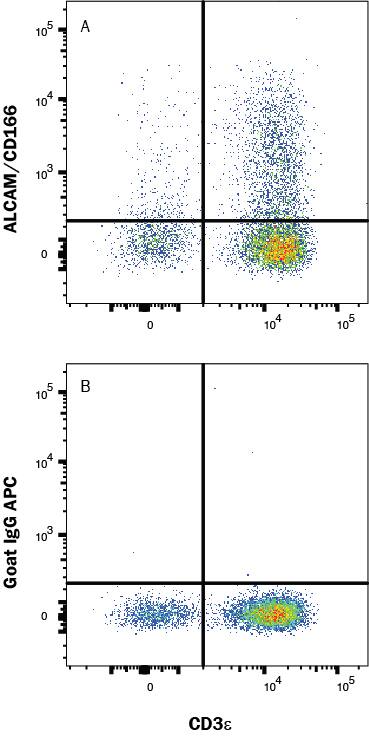
Detection of ALCAM/CD166 in Human PBMC's by Flow Cytometry
Human PBMC's were stained with Mouse Anti-Human CD3 epsilon PE-conjugated Monoclonal Antibody (Catalog # FAB100P) and either (A) Goat Anti-Mouse ALCAM/CD166 APC-conjugated Antigen Affinity-purified Polyclonal Antibody (Catalog # FAB1172A) or (B) isotype control antibody (Catalog # IC108A). View our protocol for Staining Membrane-associated Proteins.Applications for Mouse ALCAM/CD166 APC-conjugated Antibody
Application
Recommended Usage
Flow Cytometry
10 µL/106 cells
Sample: Mouse splenocytes and human PBMC's
Sample: Mouse splenocytes and human PBMC's
Spectra Viewer
Plan Your Experiments
Use our spectra viewer to interactively plan your experiments, assessing multiplexing options. View the excitation and emission spectra for our fluorescent dye range and other commonly used dyes.
Spectra Viewer
Formulation, Preparation, and Storage
Purification
Antigen Affinity-purified
Formulation
Supplied in a saline solution containing BSA and Sodium Azide.
Shipping
The product is shipped with polar packs. Upon receipt, store it immediately at the temperature recommended below.
Stability & Storage
Protect from light. Do not freeze.
- 12 months from date of receipt, 2 to 8 °C as supplied.
Background: ALCAM/CD166
ALCAM, activated leukocyte cell adhesion molecule, is a type I membrane glycoprotein and a member of the immunoglobulin supergene family. It is also known as CD166, MEMD, SC-1/DM-GRASP/BEN in the chicken, and KG-CAM in the rat. ALCAM is expressed on thymic epithelial cells, activated B and T cells, and monocytes. ALCAM can bind itself homotypically and is also capable of binding CD6, NgCAM, and other, as of yet, unidentified brain proteins. ALCAM/CD6 interaction may be involved in T cell development and T cell regulation. Additionally, ALCAM/CD6 and ALCAM/NgCAM interactions may play roles in the nervous system. ALCAM has also been observed to be upregulated on highly metastasizing melanoma cell lines and may play a role in tumor migration. ALCAM is a 583 amino acid (aa) protein consisting of a 27 aa signal peptide, a 500 aa extracellular domain, a 24 aa transmembrane domain, and a 32 aa cytoplasmic domain. The extracellular domain of ALCAM contains 5 Ig-like domains of which the amino-terminal V1 domain is essential for ligand binding and ALCAM-mediated cell aggregation (1-4). The ECD of mouse ALCAM shares 97.5% aa sequence identity with rat ALCAM ECD.
References
- Bowen, M.A. et al. (1995) J. Exp. Med. 181:2213.
- Aruffo, A. et al. (1997) Immunol. Today 18:498.
- Degen, W.G. et al. (1998) Am. J. Pathol. 152:805.
- Van Kempen, L. et al. (2001) J. Biol. Chem. 276:25783.
Long Name
Activated Leukocyte Cell Adhesion Molecule
Alternate Names
CD166
Gene Symbol
ALCAM
UniProt
Additional ALCAM/CD166 Products
Product Documents for Mouse ALCAM/CD166 APC-conjugated Antibody
Product Specific Notices for Mouse ALCAM/CD166 APC-conjugated Antibody
For research use only
Loading...
Loading...
Loading...
Loading...
Loading...