
Human Pro‑Cathepsin B Antibody
R&D Systems, part of Bio-Techne | Catalog # MAB2176

Conjugate
Catalog #
Key Product Details
Validated by
Knockout/Knockdown
Species Reactivity
Validated:
Human
Cited:
Human
Applications
Validated:
ELISA Capture (Matched Antibody Pair), Immunocytochemistry, Immunoprecipitation
Cited:
Immunodepletion
Label
Unconjugated
Antibody Source
Monoclonal Mouse IgG1 Clone # 155714
Product Specifications
Immunogen
Mouse myeloma cell line NS0-derived recombinant human Cathepsin B
Arg18-Ile339
Accession # P07858
Arg18-Ile339
Accession # P07858
Specificity
Detects human Cathepsin B. Does not cross-react with recombinant human Cathepsin A, C, D, E, L, S, V, X/Z/P, SA, or recombinant mouse Cathepsin B.
Clonality
Monoclonal
Host
Mouse
Isotype
IgG1
Scientific Data Images for Human Pro‑Cathepsin B Antibody
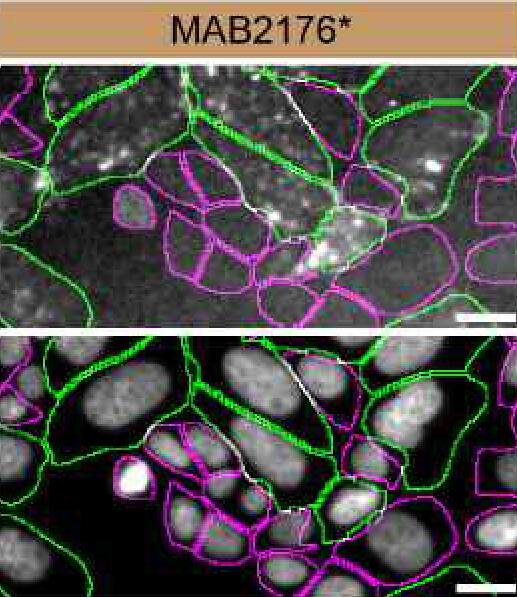
Cathepsin B Specificity is Shown by Immunocytochemistry in Knockout Cell Line.
HAP1 parental cell line WT and Cathepsin B HAP1 KO cells were labelled with a green or a far-red fluorescent dye, respectively. Cells were stained with Mouse Anti-Human Pro Cathepsin B Monoclonal Antibody (Catalog # MAB2176) followed by incubation with an Alexa-fluor 555 conjugated secondary antibody (upper panel). DAPI-only counterstained cells shown on a lower panel. Acquisition of the blue (nucleus-DAPI), green (identification of WT cells), red (antibody staining) and far-red (identification of KO cells) channels was performed. Representative images of the blue and red (grayscale) channels are shown. WT and KO cells are outlined with green and magenta dashed line, respectively. Primary antibody dilution used: 1 µg/mL. Image, protocol and testing courtesy of YCharOS Inc. (ycharos.com).
Human Total Cathepsin B ELISA Standard Curve
Recombinant Human Cathepsin B (Catalog # 953-CY) was serially diluted and captured by Mouse Anti-Human Pro Cathepsin B Monoclonal Antibody (Catalog # MAB2176) coated on a Clear Polystyrene Microplate (Catalog # DY990). Goat Anti-Human Cathepsin B Antigen Affinity-purified Polyclonal Antibody (Catalog # AF953) was biotinylated and incubated with the protein captured on the plate. Detection of the standard curve was achieved by incubating Streptavidin-HRP (Catalog # DY998)Applications for Human Pro‑Cathepsin B Antibody
Application
Recommended Usage
Immunocytochemistry
1 µg/mL
Sample: HAP1 cell line
Sample: HAP1 cell line
Immunoprecipitation
25 µg/mL
Sample: Conditioned cell culture medium spiked with Recombinant Human Cathepsin B (Catalog # 953-CY), see our available Western blot detection antibodies
Sample: Conditioned cell culture medium spiked with Recombinant Human Cathepsin B (Catalog # 953-CY), see our available Western blot detection antibodies
Human Cathepsin B Sandwich Immunoassay
ELISA Capture (Matched Antibody Pair)
Human Pro-Cathepsin B Sandwich Immunoassay
Please Note: Optimal dilutions of this antibody should be experimentally determined.
Formulation, Preparation, and Storage
Purification
Protein A or G purified from hybridoma culture supernatant
Reconstitution
Reconstitute at 0.5 mg/mL in sterile PBS. For liquid material, refer to CoA for concentration.
Formulation
Lyophilized from a 0.2 μm filtered solution in PBS with Trehalose. See Certificate of Analysis for details.
*Small pack size (-SP) is supplied either lyophilized or as a 0.2 µm filtered solution in PBS.
*Small pack size (-SP) is supplied either lyophilized or as a 0.2 µm filtered solution in PBS.
Shipping
Lyophilized product is shipped at ambient temperature. Liquid small pack size (-SP) is shipped with polar packs. Upon receipt, store immediately at the temperature recommended below.
Stability & Storage
Use a manual defrost freezer and avoid repeated freeze-thaw cycles.
- 12 months from date of receipt, -20 to -70 °C as supplied.
- 1 month, 2 to 8 °C under sterile conditions after reconstitution.
- 6 months, -20 to -70 °C under sterile conditions after reconstitution.
Background: Cathepsin B
Cathepsin B is the first described member of the family of lysosomal cysteine proteases (1). Cathepsin B possesses both endopeptidase and exopeptidase activities, in the latter case acting as a peptidyl-dipeptidase. It is known to process a number of proteins, including pro and active caspases, prorenin and secretory leucoprotease inhibitor (SLPI) (2 - 4). Therefore, Cathepsin B may play a role in activation and inactivation of caspases, activation of renin and inactivation of SLPI, the key steps in apoptosis, angiotensin production, and progression of emphysema, respectively. Because of its increased levels and redistribution of the enzyme in human and animal tumors, Cathepsin B may also have role in invasion and metastasis (5).
In addition to lysosome, Cathepsin B can be secreted or associated with plasma membrane, cytoplasm, and nucleus. It is synthesized as a preproenzyme. Following removal of the signal peptide, the inactive proenzyme undergoes further modifications including removal of the pro region to result in the active enzyme (1).
References
- Mort, J.S. (2004) in Handbook of Proteolytic Enzymes. Barrett, A.J. et al. (eds): Academic Press, San Diego, p. 1079.
- Vancompernolle, K. et al. (1998) FEBS Lett. 438:150.
- Jutras, I. and T.L. Reudelhuber (1999) FEBS Lett. 443:48.
- Taggart, C.C. et al. (2001) J. Biol. Chem. 276:33345.
- Bergquin, I.M. and B.F. Sloane (1996) Adv. Exp. Med. Biol. 389:281.
Alternate Names
CTSB
Gene Symbol
CTSB
UniProt
Additional Cathepsin B Products
Product Documents for Human Pro‑Cathepsin B Antibody
Product Specific Notices for Human Pro‑Cathepsin B Antibody
For research use only
Loading...
Loading...
Loading...
Loading...
Loading...