
Human Lyp Antibody
R&D Systems, part of Bio-Techne | Catalog # MAB3428


Conjugate
Catalog #
Key Product Details
Species Reactivity
Validated:
Human
Cited:
Human
Applications
Validated:
Immunohistochemistry, Western Blot
Cited:
Western Blot
Label
Unconjugated
Antibody Source
Monoclonal Mouse IgG2B Clone # 340113
Product Specifications
Immunogen
E. coli-derived recombinant human Lyp
Ser306-Ser684
Accession # Q9Y2R2
Ser306-Ser684
Accession # Q9Y2R2
Specificity
Detects human Lyp in Western blots.
Clonality
Monoclonal
Host
Mouse
Isotype
IgG2B
Scientific Data Images for Human Lyp Antibody
Detection of Human Lyp by Western Blot.
Western blot shows lysates of Jurkat human acute T cell leukemia cell line, Daudi human Burkitt's lymphoma cell line, and Ramos human Burkitt's lymphoma cell line. PVDF membrane was probed with 1 µg/mL of Mouse Anti-Human Lyp Monoclonal Antibody (Catalog # MAB3428) followed by HRP-conjugated Anti-Mouse IgG Secondary Antibody (Catalog # HAF007). A specific band was detected for Lyp at approximately 108 kDa (as indicated). This experiment was conducted under reducing conditions and using Immunoblot Buffer Group 1.
Lyp in Human Lymph Node.
Lyp was detected in immersion fixed paraffin-embedded sections of human lymph node using 25 µg/mL Mouse Anti-Human Lyp Monoclonal Antibody (Catalog # MAB3428) overnight at 4 °C. Tissue was stained with the Anti-Mouse HRP-DAB Cell & Tissue Staining Kit (brown; Catalog # CTS002) and counterstained with hematoxylin (blue). View our protocol for Chromogenic IHC Staining of Paraffin-embedded Tissue Sections.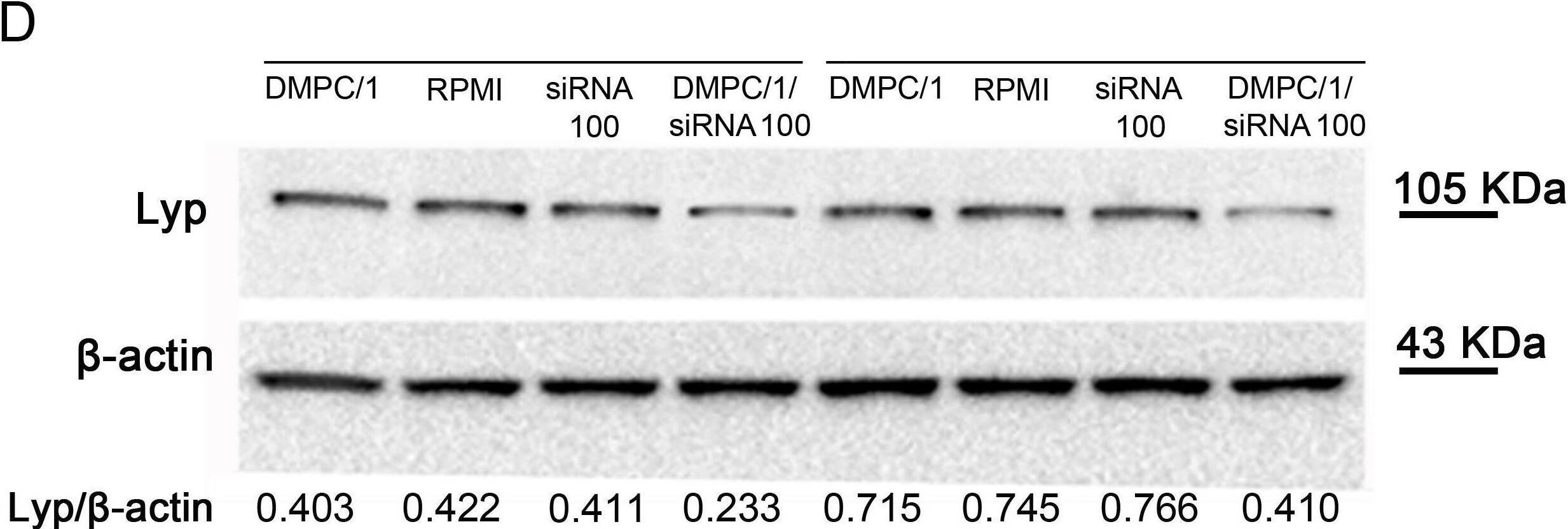
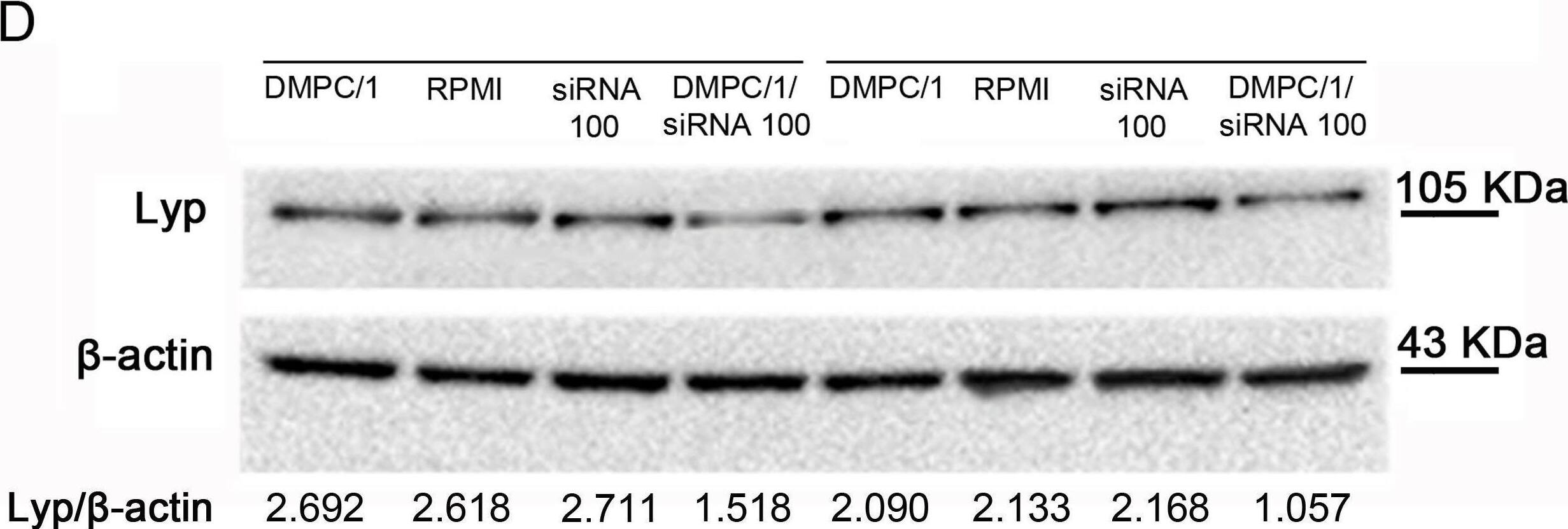
Detection of Lyp by Western Blot
Lyp protein expression in Jurkat T cells 72 hours after the beginning of O/N transfection with different doses of siRNA s/a in DMPC/1/siRNA lipoplexes.Representative duplicate experiment among all replicas in S4 Fig. (A) Lyp expression in Jurkat T cells after O/N transfection with DMPC/1 alone (DMPC/1), 20 pmols of siRNA alone (siRNA20) and 20 pmols of siRNA complexed with DMPC/1 (DMPC/1/siRNA20) or cultured in RPMI. 20 pmols of siRNA complexed with DMPC/1 resulted in a 15% reduction of Lyp expression. (B) Same experiment as in A using 60 pmols of siRNA (siRNA60) complexed with DMPC/1 (DMPC/1/siRNA60). 33% reduction of Lyp expression was obtained. (C) Same experiment as in A using 100 pmols of siRNA (siRNA100) complexed with DMPC/1 (DMPC/1/siRNA100). 45% reduction of Lyp expression was obtained. (D) Representative WB image within all experimental groups is shown. Image collected and cropped by CiteAb from the following open publication (https://pubmed.ncbi.nlm.nih.gov/28437437), licensed under a CC-BY license. Not internally tested by R&D Systems.Applications for Human Lyp Antibody
Application
Recommended Usage
Immunohistochemistry
8-25 µg/mL
Sample: Immersion fixed paraffin-embedded sections of human lymph node
Sample: Immersion fixed paraffin-embedded sections of human lymph node
Western Blot
1 µg/mL
Sample: Jurkat human acute T cell leukemia cell line, Daudi human Burkitt's lymphoma cell line, and Ramos human Burkitt's lymphoma cell line
Sample: Jurkat human acute T cell leukemia cell line, Daudi human Burkitt's lymphoma cell line, and Ramos human Burkitt's lymphoma cell line
Reviewed Applications
Read 1 review rated 5 using MAB3428 in the following applications:
Formulation, Preparation, and Storage
Purification
Protein A or G purified from hybridoma culture supernatant
Reconstitution
Reconstitute at 0.5 mg/mL in sterile PBS. For liquid material, refer to CoA for concentration.
Formulation
Lyophilized from a 0.2 μm filtered solution in PBS with Trehalose. *Small pack size (SP) is supplied either lyophilized or as a 0.2 µm filtered solution in PBS.
Shipping
Lyophilized product is shipped at ambient temperature. Liquid small pack size (-SP) is shipped with polar packs. Upon receipt, store immediately at the temperature recommended below.
Stability & Storage
Use a manual defrost freezer and avoid repeated freeze-thaw cycles.
- 12 months from date of receipt, -20 to -70 °C as supplied.
- 1 month, 2 to 8 °C under sterile conditions after reconstitution.
- 6 months, -20 to -70 °C under sterile conditions after reconstitution.
Background: Lyp
Lymphoid phosphatase (Lyp), also called LyPTP, Protein Tyrosine Phosphatase, Nonreceptor-type 22 (PTPN22), and PEST-domain Phosphatase (PEP), dephosphorylates tyrosine residues in proteins. Found primarily in bone marrow and lymphoid cell lines, an R620W gain-of-function mutation in Lyp has been associated with susceptibility to autoimmune diseases such as type I diabetes, rheumatoid arthritis, and lupus erythematosus. Mature PEP knockout mice have an excess of CD8 positive T cells and an exaggerated antigen-induced proliferative response.
Long Name
Lymphoid Phosphatase
Alternate Names
LyPTP, PEP, PTPN22, PTPN8 (former)
Gene Symbol
PTPN22
UniProt
Additional Lyp Products
Product Documents for Human Lyp Antibody
Product Specific Notices for Human Lyp Antibody
For research use only
Loading...
Loading...
Loading...
Loading...
Loading...