
Human LMP2/PSMB9 Antibody
R&D Systems, part of Bio-Techne | Catalog # MAB7709

Conjugate
Catalog #
Key Product Details
Validated by
Biological Validation
Species Reactivity
Human
Applications
Western Blot, Immunocytochemistry
Label
Unconjugated
Antibody Source
Monoclonal Mouse IgG2B Clone # 792520
Product Specifications
Immunogen
E. coli-derived recombinant human LMP2/PSMB9
Thr21-Glu219
Accession # P28065
Thr21-Glu219
Accession # P28065
Specificity
Detects human LMP2/PSMB9 in direct ELISAs and Western blots. In direct ELISAs, approximately 50%
cross-reactivity with recombinant human PSMB6 is observed.
Clonality
Monoclonal
Host
Mouse
Isotype
IgG2B
Scientific Data Images for Human LMP2/PSMB9 Antibody
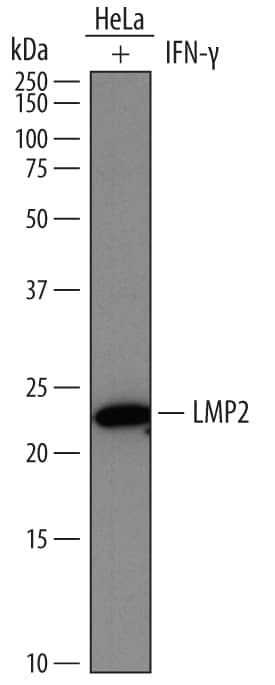
Detection of Human LMP2/PSMB9 by Western Blot.
Western blot shows lysates of HeLa human cervical epithelial carcinoma cell line treated (+) with 100 ng/mL Recombinant Human IFN-gamma (Catalog # 285-IF) for 24 hours. PVDF membrane was probed with 1 µg/mL of Mouse Anti-Human LMP2/PSMB9 Monoclonal Antibody (Catalog # MAB7709) followed by HRP-conjugated Anti-Mouse IgG Secondary Antibody (Catalog # HAF007). A specific band was detected for LMP2/PSMB9 at approximately 22 kDa (as indicated). This experiment was conducted under reducing conditions and using Immunoblot Buffer Group 1.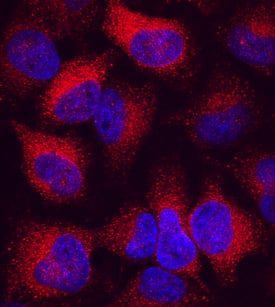
LMP2/PSMB9 in HeLa Human Cell Line.
LMP2/PSMB9 was detected in immersion fixed HeLa human cervical epithelial carcinoma cells stimulated with Recombinant Human IFN-gamma (Catalog # 285-IF) for 24 hours using Mouse Anti-Human LMP2/PSMB9 Monoclonal Antibody (Catalog # MAB7709) at 10 µg/mL for 3 hours at room temperature. Cells were stained using the NorthernLights™ 557-conjugated Anti-Mouse IgG Secondary Antibody (red; Catalog # NL007) and counterstained with DAPI (blue). Specific staining was localized to cytoplasm. View our protocol for Fluorescent ICC Staining of Cells on Coverslips.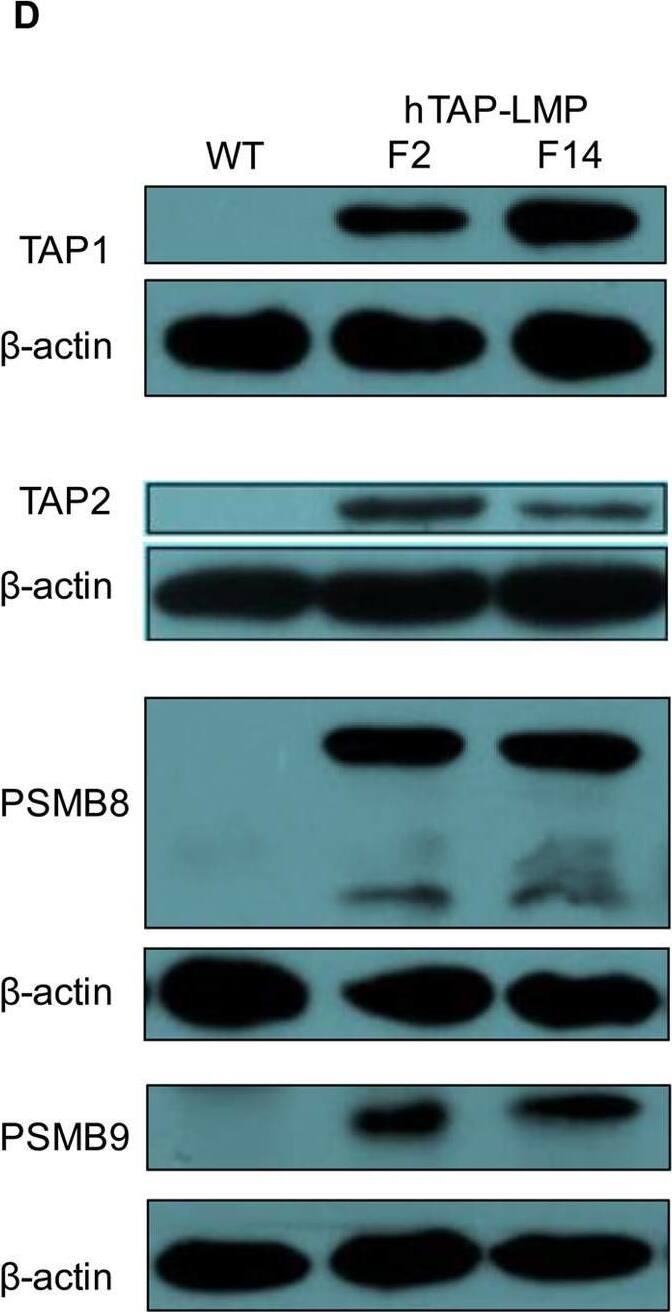
Detection of LMP2/PSMB9 by Western Blot
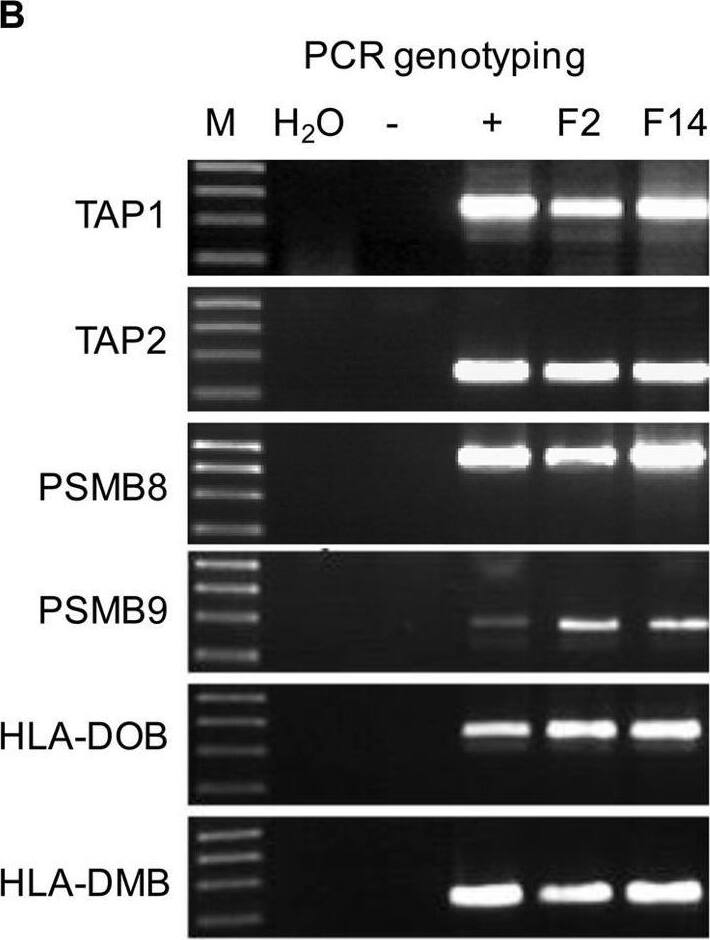
Generation of hTAP-LMP transgenic mice.(A) Schematic map of the BAC clone RP11-10A19. (B) PCR genotyping of the founder mice. F2 and F14 were the two positive founder mice. “−”, tail DNA samples of WT littermates; “+”, plasmid DNA of the BAC clone RP11-10A19. (C) Relative mRNA expression of human TAP1, TAP2, PSMB8, and PSMB9 in splenocytes from WT or hTAP-LMP mice as analyzed by qRT-PCR and normalized to 18S rRNA levels. (D) Expression of human TAP1 (65 kDa), TAP2 (75 kDa), PSMB8 (23/28 kDa), and PSMB9 (22 kDa) in WT or hTAP-LMP mice was determined by western blotting; beta-actin (42 kDa) was used as an internal control. (E) FACS analysis for CD4 and CD8 expression of splenocytes from WT and hTAP-LMP mice (up), with the percentage of CD4+ T cells (below, left) and CD8+ T cells (below, right). PCR genotyping and western blotting were performed on individual mice, and the depicted results are representative of at least three independent experiments. Full-length PCR gels and Western blots are presented in Supplementary Figs S6 and S7, respectively. Results of the qRT-PCR and FACS analysis are representative of at least three independent experiments with n ≥ 3. Data represent the mean ± SD. ns, not significant. Image collected and cropped by CiteAb from the following open publication (https://pubmed.ncbi.nlm.nih.gov/27634283), licensed under a CC-BY license. Not internally tested by R&D Systems.Applications for Human LMP2/PSMB9 Antibody
Application
Recommended Usage
Immunocytochemistry
8-25 µg/mL
Sample: Immersion fixed HeLa human cervical epithelial carcinoma cells stimulated with Recombinant Human IFN‑ gamma (Catalog # 285-IF) for 24 hours
Sample: Immersion fixed HeLa human cervical epithelial carcinoma cells stimulated with Recombinant Human IFN‑ gamma (Catalog # 285-IF) for 24 hours
Western Blot
1 µg/mL
Sample: HeLa human cervical epithelial carcinoma cell line treated with Recombinant Human IFN‑ gamma (Catalog # 285-IF)
Sample: HeLa human cervical epithelial carcinoma cell line treated with Recombinant Human IFN‑ gamma (Catalog # 285-IF)
Formulation, Preparation, and Storage
Purification
Protein A or G purified from hybridoma culture supernatant
Reconstitution
Sterile PBS to a final concentration of 0.5 mg/mL. For liquid material, refer to CoA for concentration.
Formulation
Lyophilized from a 0.2 μm filtered solution in PBS with Trehalose. *Small pack size (SP) is supplied either lyophilized or as a 0.2 µm filtered solution in PBS.
Shipping
Lyophilized product is shipped at ambient temperature. Liquid small pack size (-SP) is shipped with polar packs. Upon receipt, store immediately at the temperature recommended below.
Stability & Storage
Use a manual defrost freezer and avoid repeated freeze-thaw cycles.
- 12 months from date of receipt, -20 to -70 °C as supplied.
- 1 month, 2 to 8 °C under sterile conditions after reconstitution.
- 6 months, -20 to -70 °C under sterile conditions after reconstitution.
Background: LMP2/PSMB9
Long Name
Proteasome (Prosome, Macropain) Subunit, beta Type, 9
Alternate Names
Proteasome subunit beta-1i, PSMB9, RING12
Gene Symbol
PSMB9
UniProt
Additional LMP2/PSMB9 Products
Product Documents for Human LMP2/PSMB9 Antibody
Product Specific Notices for Human LMP2/PSMB9 Antibody
For research use only
Loading...
Loading...
Loading...
Loading...
Loading...