
Human IL-21R PE-conjugated Antibody
R&D Systems, part of Bio-Techne | Catalog # FAB9911P
Clone 152512 was used by HLDA to establish CD designation

Scientific images may be resized, cropped, or adjusted for brightness or contrast for presentation purposes. These updates are limited to presentation and do not affect the underlying scientific interpretation of the data. Where available, additional source data may be provided upon request.
Conjugate
Catalog #
Key Product Details
Species Reactivity
Validated:
Human
Cited:
Human
Applications
Validated:
Flow Cytometry
Cited:
Flow Cytometry
Label
Phycoerythrin (Excitation = 488 nm, Emission = 565-605 nm)
Antibody Source
Monoclonal Mouse IgG1 Clone # 152512
Product Specifications
Immunogen
S. frugiperda insect ovarian cell line Sf 21-derived recombinant human IL-21 R
Cys20-Pro236
Accession # Q9HBE5
Cys20-Pro236
Accession # Q9HBE5
Specificity
Detects human IL-21 R in direct ELISAs. In direct ELISAs, this antibody does not cross-react with recombinant human (rh)IL‑2 R beta or rmIL‑21 R.
Clonality
Monoclonal
Host
Mouse
Isotype
IgG1
Scientific Data Images for Human IL-21R PE-conjugated Antibody
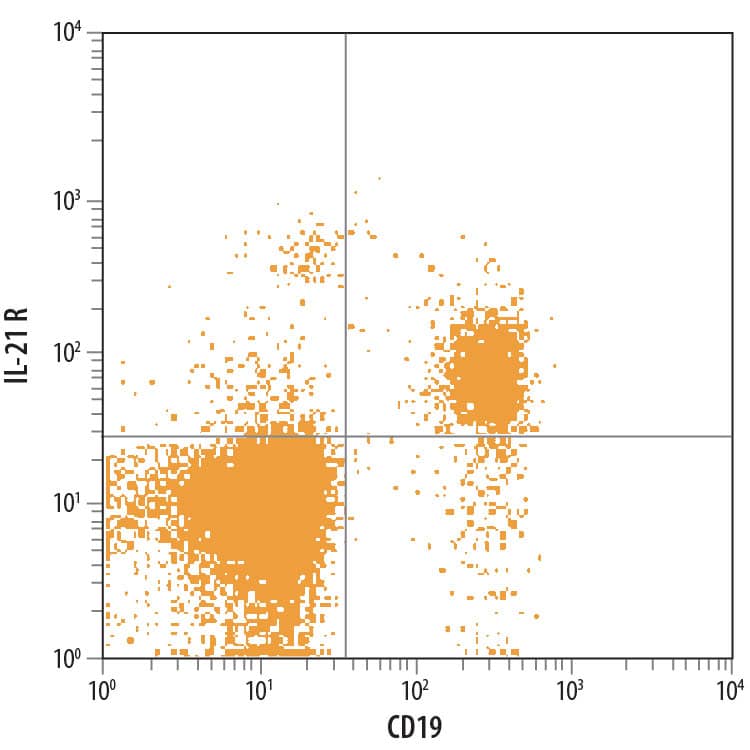
Detection of IL-21 R in Human Blood Lymphocytes by Flow Cytometry.
Human peripheral blood lymphocytes were stained with Mouse Anti-Human IL-21 R PE-conjugated Monoclonal Antibody (Catalog # FAB9911P) and Mouse Anti-Human CD19 Fluorescein-conjugated Monoclonal Antibody (Catalog # FAB4867F). Quadrant markers were set based on control antibody staining (Catalog # IC002P). View our protocol for Staining Membrane-associated Proteins.Applications for Human IL-21R PE-conjugated Antibody
Application
Recommended Usage
Flow Cytometry
10 µL/106 cells
Sample: Human peripheral blood lymphocytes
Sample: Human peripheral blood lymphocytes
Spectra Viewer
Plan Your Experiments
Use our spectra viewer to interactively plan your experiments, assessing multiplexing options. View the excitation and emission spectra for our fluorescent dye range and other commonly used dyes.
Spectra Viewer
Formulation, Preparation, and Storage
Purification
Protein A or G purified from hybridoma culture supernatant
Formulation
Supplied in a saline solution containing BSA and Sodium Azide.
Shipping
The product is shipped with polar packs. Upon receipt, store it immediately at the temperature recommended below.
Stability & Storage
Protect from light. Do not freeze.
- 12 months from date of receipt, 2 to 8 °C as supplied.
Background: IL-21R
Interleukin-21 (IL-21) and its receptor play an important role in the regulation of the immune system. IL-21 R, also called NILR (novel interleukin receptor), is a type I cytokine receptor with 4 conserved cysteine residues and an extracellular WSXWS motif. It is most closely related to IL-2 R beta, IL-4 R alpha, and IL-9 R. The gene for human IL-21 R has been mapped to chromosome 16p12. Human IL-21 R is a 538 amino acid (aa) residue type I transmembrane protein with a 19 aa signal peptide, a 217 aa extracellular domain, a 19 aa transmembrane domain, and a 283 aa cytoplasmic domain. IL-21 R is expressed on lymphoid tissues, peripheral B cells, and cell lines of T, B, and NK lineage. The common gamma chain ( gammac) is required for IL-21 R signaling. The IL-21/IL-21 R interaction appears to play an important role in B and T cell proliferation after antigen stimulation and NK cell maturation.
References
- Parrish-Novak, et al. (2000) Nature 408:57.
- Ozaki, K. et al. (2000) Proc. Natl. Acad. Sci. USA 97:11439.
- Dumoutier, L. et al. (2000) Proc. Natl. Acad. Sci. USA 97:10144.
- Asao, H. et al. (2001) J. Immunol. 167:1.
Long Name
Interleukin 21 Receptor
Alternate Names
CD360, IL-21 R, IL21R, NILR
Entrez Gene IDs
Gene Symbol
IL21R
UniProt
Additional IL-21R Products
Product Documents for Human IL-21R PE-conjugated Antibody
Product Specific Notices for Human IL-21R PE-conjugated Antibody
For research use only
Loading...
Loading...
Loading...
Loading...
Loading...