
Human DR6/TNFRSF21 Antibody
R&D Systems, part of Bio-Techne | Catalog # AF144

Conjugate
Catalog #
Key Product Details
Species Reactivity
Validated:
Human
Cited:
Human, Rat
Applications
Validated:
Western Blot, ELISA Capture (Matched Antibody Pair)
Cited:
Western Blot, Neutralization, Flow Cytometry
Label
Unconjugated
Antibody Source
Polyclonal Goat IgG
Product Specifications
Immunogen
Mouse myeloma cell line NS0-derived recombinant human DR6
Gln42-Leu350
Accession # O75509
Gln42-Leu350
Accession # O75509
Specificity
Detects human DR6 in ELISAs and Western blots. In sandwich ELISAs, less than 0.2% cross-reactivity with recombinant human (rh) OPG and rhTNF RII is observed.
Clonality
Polyclonal
Host
Goat
Isotype
IgG
Scientific Data Images for Human DR6/TNFRSF21 Antibody
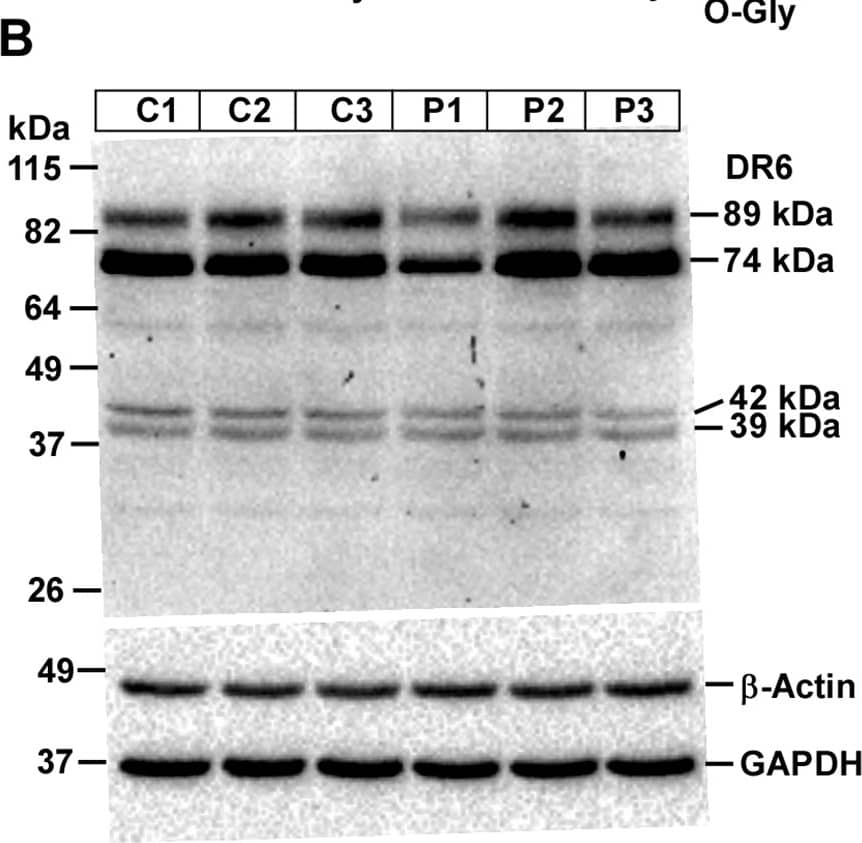
Detection of DR6/TNFRSF21 by Western Blot
Expression pattern of DR6 and p75NTR protein isoforms varies between control (C) and prion-diseased (P) C57BL/6J mice brains. A Schema of a 68-kDa DR6 protein structure shows various domains, glycosylation sites and epitope of anti-DR6 antibody. B Western blot analysis of DR6 on lysates showing similar expression pattern of all DR5 isoforms between control and prion-diseased mice brains. D The densitometry of 89-kDa, D 74-kDa DR6 isoforms show similar levels of expression within prion-diseased and control mice brains. E Schematic structure of p75NTR protein exhibiting various domains, glycosylation sites and epitope of anti-p75NTR antibody. E Western blot analysis of p75NTR shows a dominant 75 kDa band with increased p75NTR level in prion-diseased mice brains than controls. F The densitometry of 75 kDa band show significant increased intensity in prion diseased mice brain lysates than controls. GAPDH and beta-actin were used as loading controls. Each histogram represents mean ± SD of a set of three brain lysates from control or prion-diseased mice. Two-tailed unpaired t-test was performed to compare the significance of difference between two groups. P ≤ 0.05 is considered statistically significant Image collected and cropped by CiteAb from the following open publication (https://pubmed.ncbi.nlm.nih.gov/38802941), licensed under a CC-BY license. Not internally tested by R&D Systems.Applications for Human DR6/TNFRSF21 Antibody
Application
Recommended Usage
Western Blot
0.1 µg/mL
Sample: Recombinant Human DR6/TNFRSF21 Fc Chimera (Catalog # 144-DR)
Sample: Recombinant Human DR6/TNFRSF21 Fc Chimera (Catalog # 144-DR)
Human DR6/TNFRSF21 Sandwich Immunoassay
Please Note: Optimal dilutions of this antibody should be experimentally determined.
Formulation, Preparation, and Storage
Purification
Antigen Affinity-purified
Reconstitution
Reconstitute at 0.2 mg/mL in sterile PBS. For liquid material, refer to CoA for concentration.
Formulation
Lyophilized from a 0.2 μm filtered solution in PBS with Trehalose. *Small pack size (SP) is supplied either lyophilized or as a 0.2 µm filtered solution in PBS.
Shipping
Lyophilized product is shipped at ambient temperature. Liquid small pack size (-SP) is shipped with polar packs. Upon receipt, store immediately at the temperature recommended below.
Stability & Storage
Use a manual defrost freezer and avoid repeated freeze-thaw cycles.
- 12 months from date of receipt, -20 to -70 °C as supplied.
- 1 month, 2 to 8 °C under sterile conditions after reconstitution.
- 6 months, -20 to -70 °C under sterile conditions after reconstitution.
Background: DR6/TNFRSF21
Death Receptor 6 (DR6), also known as TNFRSF21 and CD358, is a type I transmembrane protein in the TNF receptor superfamily (1). Human DR6 consists of a 308 amino acid (aa) extracellular domain (ECD) with four cysteine‑rich motifs, a 21 aa transmembrane segment, and a 285 aa palmitylated cytoplasmic region that contains one death domain (2, 3). Within the ECD, human and mouse DR6 share 82% aa sequence identity. DR6 is expressed as an approximately 110 kDa molecule that carries extensive N‑linked and O‑linked glycosylation in its extracellular region (3, 4). Among hematopoietic cells, DR6 is expressed on monocytes, resting CD4+ T cells, and pro‑, pre‑, and naïve B cells (5 ‑ 7). DR6 knockout mice exhibit a Th2‑biased immune response characterized by exaggerated Th2 and B cell responsiveness in combination with reduced Th1 cell responsiveness and inflammatory leukocyte infiltration (6 ‑ 9). DR6 knockout mice are resistant to induced airway inflammation and experimental autoimmune encephalitis but more susceptible to severe graft versus host disease (9 ‑ 11). DR6 is also expressed on developing neurons where it can bind a shed 35 kDa N‑terminal fragment of APP or a fragment of APLP2 (12, 13). This APP fragment is generated following deprivation of neurotrophic factors, and its binding to DR6 triggers DR6‑mediated axonal pruning (12). DR6 is constitutively expressed on some prostate cancer cells and can be induced by TNF‑ alpha on others (3, 4).
References
- Benschop, R. et al. (2009) Adv. Exp. Med. Biol. 647:186.
- Pan, G. et al. (1998) FEBS Lett. 431:351.
- Klima, M. et al. (2009) Biochim. Biophys. Acta 1793:1579.
- Kasof, G.M. et al. (2001) Oncogene 20:7965.
- Matesanz-Isabel, J. et al. (2011) Immunol. Lett. 134:104.
- Schmidt, C.S. et al. (2003) J. Exp. Med. 197:51.
- Liu, J. et al. (2001) Immunity 15:23.
- Zhao, H. et al. (2001) J. Exp. Med. 194:1441.
- Venkataraman, C. et al. (2006) Immunol. Lett. 106:42.
- Schmidt, C.S. et al. (2005) J. Immunol. 175:2286.
- Liu, J. et al. (2002) J. Immunol. 169:3993.
- Nikolaev, A. et al. (2009) Nature 457:981.
- Kuester, M. et al. (2011) J. Mol. Biol. 409:189.
Long Name
Death Receptor 6
Alternate Names
BM-018, CD358, TNFRSF21
Gene Symbol
TNFRSF21
UniProt
Additional DR6/TNFRSF21 Products
Product Documents for Human DR6/TNFRSF21 Antibody
Product Specific Notices for Human DR6/TNFRSF21 Antibody
For research use only
Loading...
Loading...
Loading...
Loading...
Loading...