
Human Cyr61/CCN1 Antibody
R&D Systems, part of Bio-Techne | Catalog # MAB4055

Scientific images may be resized, cropped, or adjusted for brightness or contrast for presentation purposes. These updates are limited to presentation and do not affect the underlying scientific interpretation of the data. Where available, additional source data may be provided upon request.
Conjugate
Catalog #
Key Product Details
Species Reactivity
Validated:
Human
Cited:
Human
Applications
Validated:
Western Blot
Cited:
Western Blot, ELISA Development
Label
Unconjugated
Antibody Source
Monoclonal Mouse IgG1 Clone # 365108
Product Specifications
Immunogen
Mouse myeloma cell line NS0-derived recombinant human Cyr61
Ala22-Asp381
Accession # O00622
Ala22-Asp381
Accession # O00622
Specificity
Detects human Cyr61/CCN1 in direct ELISAs and Western blots.
Clonality
Monoclonal
Host
Mouse
Isotype
IgG1
Scientific Data Images for Human Cyr61/CCN1 Antibody
Detection of Cyr61/CCN1 by Flow Cytometry
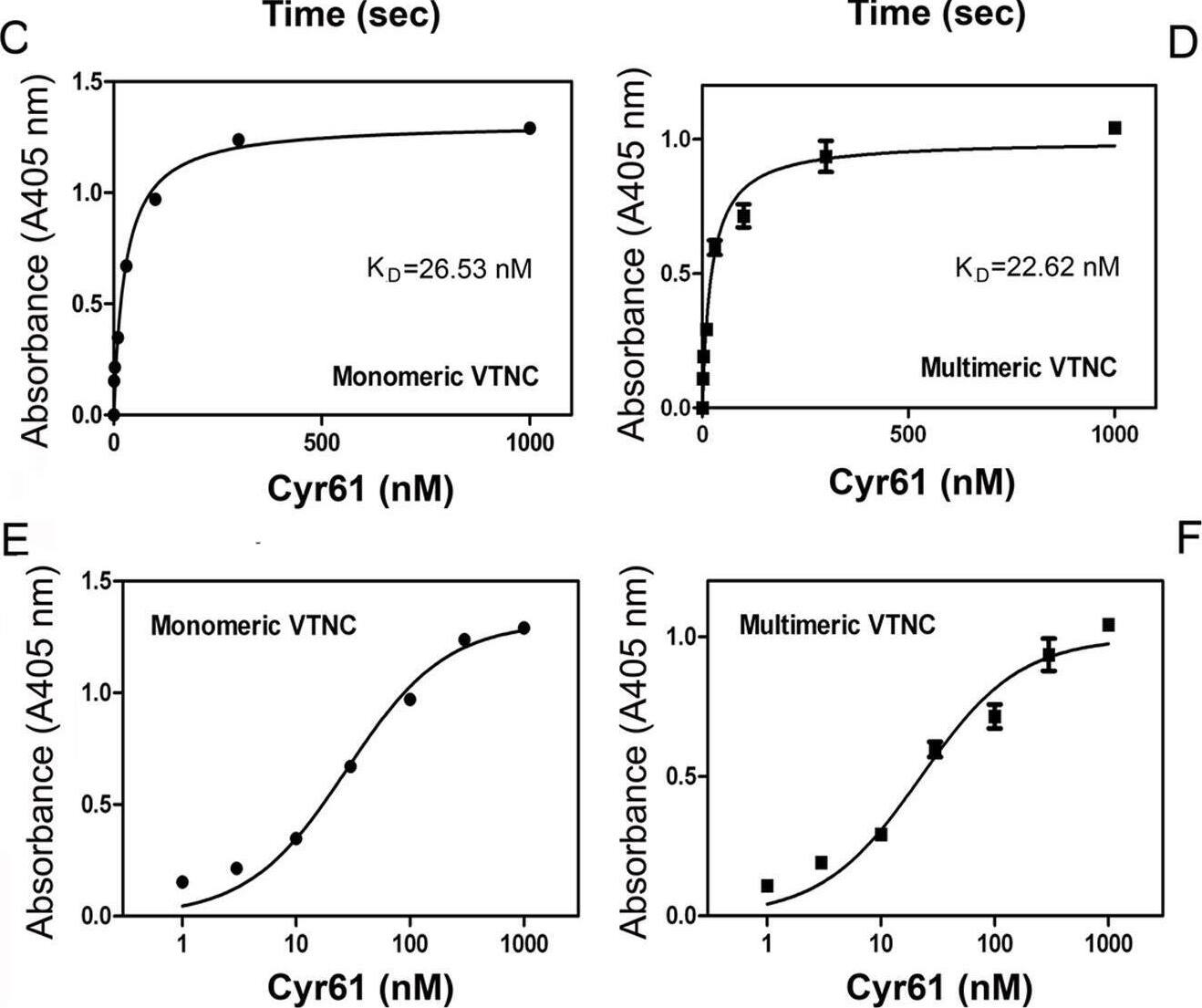
Cyr61 displays high-affinity binding to immobilized VTNC.(A) Sensorgrams for Cyr61 (in nM: a, 40; b, 20; c, 5; d, 2.5) binding to immobilized monomeric VTNC. (B) Sensorgrams show Cyr61 (in nM: a, 50; b, 25, c, 12.5; d, 6.25) binding to multimeric VTNC. Data were fitted using global two-state binding model. RU, resonance units. (C) and (D) solid-phase-binding assay for Cyr61 (0–1 µM) interaction with immobilized monomeric or multimeric VTNC, respectively. Binding was estimated with anti-Cyr61 monoclonal antibody followed by alkaline-phosphatase labeled anti-mouse secondary antibody and appropriate substrate as described in Materials and Methods. (E) and (F) Semi log-transformation of the data depicted in (C) and (D), respectively. The (apparent) KD values for Cyr61/VTNC interactions were calculated by nonlinear regression analysis of the binding data according to the Langmuir isotherm equation. All treatments were performed in quadruplicate or quintuplicate (n = 3). Image collected and cropped by CiteAb from the following open publication (https://pubmed.ncbi.nlm.nih.gov/20195466), licensed under a CC0-1.0 license. Not internally tested by R&D Systems.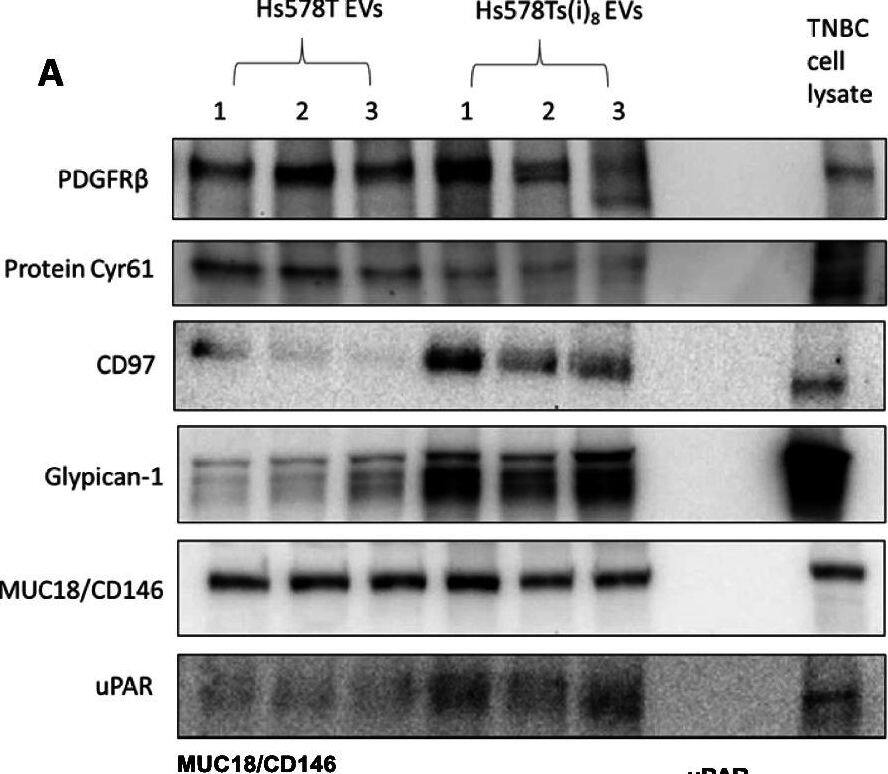
Detection of Cyr61/CCN1 by Western Blot
Immunoblot image are shown (A), along with densitometric analysis of (B) PDGFR beta, (C) Cyr61, (D) CD97, (E) Glypican-1, (F) MUC18/CD146 and (G) uPAR. (H) A summary of proteins detected by mass spectrometry and immunoblot. Graphs represent mean ± SEM of n = 3 independent biological experiments, shown as 1,2,3. Unpaired t-test was used as statistical test. *P < 0.05, **P < 0.01, ***P < 0.001 Image collected and cropped by CiteAb from the following open publication (https://pubmed.ncbi.nlm.nih.gov/36171564), licensed under a CC-BY license. Not internally tested by R&D Systems.
Detection of Cyr61/CCN1 by Western Blot
Immunoblot image are shown (A), along with densitometric analysis of (B) PDGFR beta, (C) Cyr61, (D) CD97, (E) Glypican-1, (F) MUC18/CD146 and (G) uPAR. (H) A summary of proteins detected by mass spectrometry and immunoblot. Graphs represent mean ± SEM of n = 3 independent biological experiments, shown as 1,2,3. Unpaired t-test was used as statistical test. *P < 0.05, **P < 0.01, ***P < 0.001 Image collected and cropped by CiteAb from the following open publication (https://pubmed.ncbi.nlm.nih.gov/36171564), licensed under a CC-BY license. Not internally tested by R&D Systems.Applications for Human Cyr61/CCN1 Antibody
Application
Recommended Usage
Western Blot
1 µg/mL
Sample: Recombinant Human Cyr61/CCN1 Fc Chimera (Catalog # 4055-CR)
under non-reducing conditions only
Sample: Recombinant Human Cyr61/CCN1 Fc Chimera (Catalog # 4055-CR)
under non-reducing conditions only
Reviewed Applications
Read 1 review rated 5 using MAB4055 in the following applications:
Formulation, Preparation, and Storage
Purification
Protein A or G purified from hybridoma culture supernatant
Reconstitution
Reconstitute at 0.5 mg/mL in sterile PBS. For liquid material, refer to CoA for concentration.
Formulation
Lyophilized from a 0.2 μm filtered solution in PBS with Trehalose. *Small pack size (SP) is supplied either lyophilized or as a 0.2 µm filtered solution in PBS.
Shipping
Lyophilized product is shipped at ambient temperature. Liquid small pack size (-SP) is shipped with polar packs. Upon receipt, store immediately at the temperature recommended below.
Stability & Storage
Use a manual defrost freezer and avoid repeated freeze-thaw cycles.
- 12 months from date of receipt, -20 to -70 °C as supplied.
- 1 month, 2 to 8 °C under sterile conditions after reconstitution.
- 6 months, -20 to -70 °C under sterile conditions after reconstitution.
Background: Cyr61/CCN1
Cyr61, also known as CCN1, is a 40 - 45 kDa matricellular glycoprotein that plays an important role in cellular adhesion and migration (1). Cyr61 consists of an IGFBP domain, a VWF type C domain, a TSP type I domain, and a cysteine knot domain (2). Mature human Cyr61 shares 93% amino acid sequence identity with mouse and rat Cyr61. It is widely expressed during development and in adult tissues (2, 3). Cyr61 associates with the extracellular matrix (ECM) and with many cell surface molecules including Integrins alphaV beta3, alphaV beta5, alphaM beta2, and alpha6 beta1, Syndecan-4, and heparan sulfate proteoglycans (1, 3). Cyr61 mediates the adhesion and migration of multiple cell types and also promotes vascular endothelial cell tubule formation (4 - 6). Plasmin cleavage of ECM-bound Cyr61 releases a 28 kDa N-terminal fragment which retains the ability to promote endothelial cell migration (7). Cyr61 exhibits both tumorigenic and tumor suppressor properties. It is upregulated and promotes tumorigenesis, angiogenesis, and metastasis in breast, renal, gastric, squamous cell, and colorectal carcinomas as well as in glioma (8 - 12). In contrast, when downregulated, it suppresses tumor growth in endometrial, hepatic, and non-small cell lung cancers (8, 13, 14). Cyr61 is also upregulated in injured skin and bone where it induces the expression of growth factors, cytokines, proteases, and integrins involved in wound repair (15, 16).
References
- Chen, Y. and X.Y. Du (2007) J. Cell. Biochem. 100:1337.
- Jay, P. et al. (1997) Oncogene 14:1753.
- Feng, P. et al. (2008) Int. J. Biochem. Cell Biol. 40:98.
- Chen, N. et al. (2000) J. Biol. Chem. 275:24953.
- Leu, S-J. et al. (2002) J. Biol. Chem. 277:46248.
- Schutze, N. et al. (2007) BMC Cell Biol. 8:45.
- Pendurthi, U.R. et al. (2005) Cancer Res. 65:9705.
- O'Kelly, J. et al. (2008) Int. J. Oncol. 33:59.
- Chintalapudi, M.R. et al. (2008) Carcinogenesis 29:696.
- Xie, D. et al. (2004) Cancer Res. 64:1987.
- Lin, M-T. et al. (2007) J. Biol. Chem. 282:34594.
- Monnier, Y. et al. (2008) Cancer Res. 68:7323.
- Tong, X. et al. (2001) J. Biol. Chem. 276:47709.
- Chien, W. et al. (2004) J. Biol. Chem. 279:53087.
- Hadjiargyrou, M. et al. (2000) J. Bone Miner. Res.15:1014.
- Chen, C-C. et al. (2001) J. Biol. Chem. 276:47329.
Long Name
Cysteine-Rich, Angiogenic Inducer 61
Alternate Names
CCN1, GIG1, IGFBP-10
Gene Symbol
CCN1
UniProt
Additional Cyr61/CCN1 Products
Product Documents for Human Cyr61/CCN1 Antibody
Product Specific Notices for Human Cyr61/CCN1 Antibody
For research use only
Loading...
Loading...
Loading...
Loading...
Loading...