
Human CD81 Antibody
R&D Systems, part of Bio-Techne | Catalog # MAB4615


Conjugate
Catalog #
Key Product Details
Species Reactivity
Validated:
Human
Cited:
Human
Applications
Validated:
Flow Cytometry, CyTOF-ready
Cited:
Western Blot, Flow Cytometry
Label
Unconjugated
Antibody Source
Monoclonal Mouse IgG2B Clone # 454720
Product Specifications
Immunogen
HEK293 human embryonic kidney cell line transfected with human CD81
Accession # P60033
Accession # P60033
Specificity
Detects human CD81. Stains human CD81 transfectants but not irrelevant transfectants.
Clonality
Monoclonal
Host
Mouse
Isotype
IgG2B
Scientific Data Images for Human CD81 Antibody
Detection of CD81 in Human Lymphocytes by Flow Cytometry.
Human whole blood lymphocytes were stained with Mouse Anti-Human CD81 Monoclonal Antibody (Catalog # MAB4615, filled histogram) or isotype control antibody (Catalog # MAB0041, open histogram), followed by Phycoerythrin-conjugated Anti-Mouse IgG F(ab')2Secondary Antibody (Catalog # F0102B).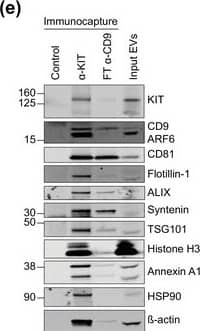
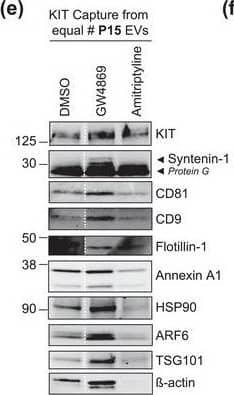
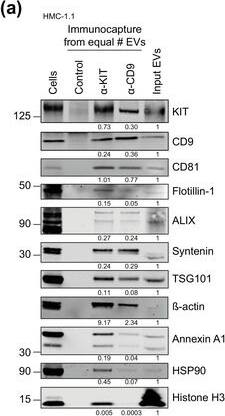
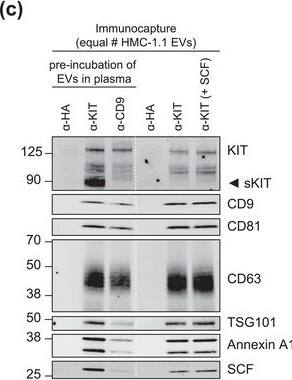
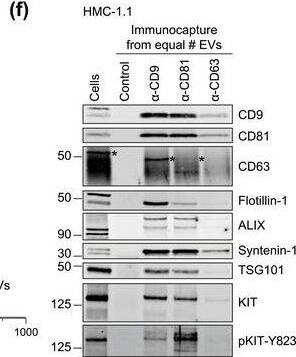
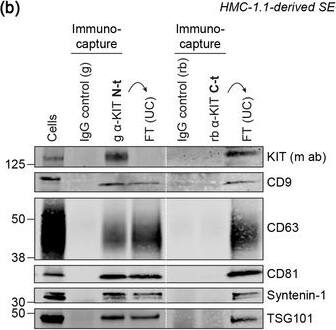
Detection of Human CD81 by Western Blot
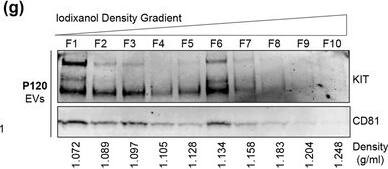
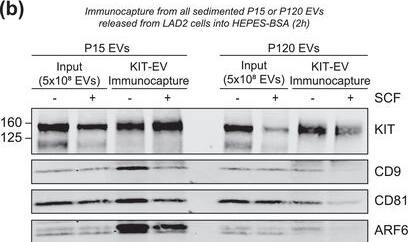
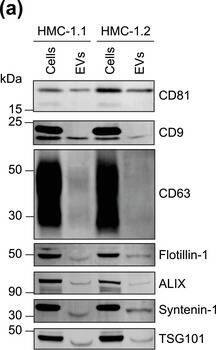
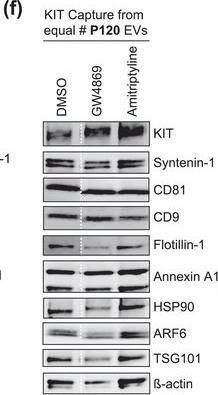
KIT‐captured EVs reveal distinct EV marker profiles compared to CD9‐enriched vesicles. (E) Representative immunoblot of bead‐captured KIT‐positive (second lane)&CD9(+)/KIT(‐) EVs from the flow‐through (third lane). Unconjugated beads used as a negative control (first lane). KIT immunocapture was performed with an antibody against N‐terminal KIT from 2.4 × 10¹⁰ EVs. FT, flow‐through. Image collected & cropped by CiteAb from the following open publication (https://pubmed.ncbi.nlm.nih.gov/36239715), licensed under a CC-BY license. Not internally tested by R&D Systems.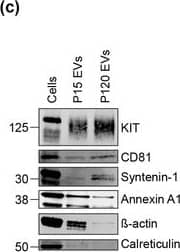
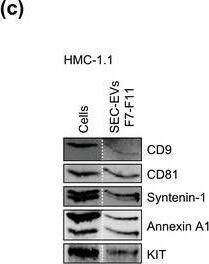
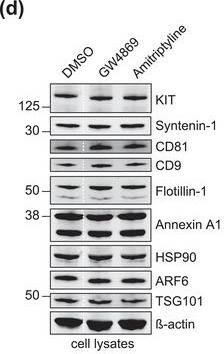
Detection of Human CD81 by Western Blot
KIT‐EVs are released as heterogeneous subpopulations with different physical properties. (A) Cell culture supernatant was subjected to differential ultracentrifugation to obtain P15 and P120 EV pellets, as illustrated. Where indicated, P15 and P120 EVs were further separated by iodixanol density gradients. Vesicles from each density fraction were pelleted and analyzed. (B) P15 and P120 EVs obtained from HMC‐1.1 cells were analyzed by nanoparticle tracking. Representative concentration and size profiles averaged from five workflow repetitions are depicted. The averaged percentage (%) of different size ranges within the P15 or P120 population is shown on top (bar chart). (C) Representative Western blot of HMC‐1.1 cell, P15 and P120 EV lysates (30 μg) probed with the indicated antibodies. (D, E) HMC‐1.1‐derived P15 (D) or P120 (E) EV pellets were separated by density gradients and the vesicles from each fraction (F1‐F10) were analyzed by nanoparticle tracking for concentration (particles/ml), shown as box plots, and size (represented as average mode, nm), shown as a line graph. Data in the box plots represent the median with the whiskers indicating minimum and maximum values; data in the line graph are represented as mean ± S.D. from five repetitions. Representative results are shown. (F, G) Representative immunoblots showing the presence of KIT and annexin A1 in P15 EV fractions (F) and KIT and CD81 in P120 EV fractions (G). The density (g/ml) of each fraction is indicated below Image collected and cropped by CiteAb from the following open publication (https://pubmed.ncbi.nlm.nih.gov/36239715), licensed under a CC-BY license. Not internally tested by R&D Systems.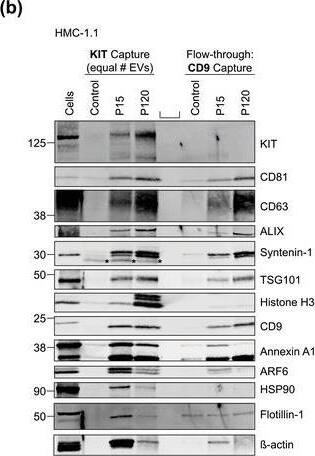
Applications for Human CD81 Antibody
Application
Recommended Usage
CyTOF-ready
Ready to be labeled using established conjugation methods. No BSA or other carrier proteins that could interfere with conjugation.
Flow Cytometry
2.5 µg/106 cells
Sample: Human whole blood lymphocytes
Sample: Human whole blood lymphocytes
Formulation, Preparation, and Storage
Purification
Protein A or G purified from hybridoma culture supernatant
Reconstitution
Reconstitute at 0.5 mg/mL in sterile PBS. For liquid material, refer to CoA for concentration.
Formulation
Lyophilized from a 0.2 μm filtered solution in PBS with Trehalose. *Small pack size (SP) is supplied either lyophilized or as a 0.2 µm filtered solution in PBS.
Shipping
Lyophilized product is shipped at ambient temperature. Liquid small pack size (-SP) is shipped with polar packs. Upon receipt, store immediately at the temperature recommended below.
Stability & Storage
Use a manual defrost freezer and avoid repeated freeze-thaw cycles.
- 12 months from date of receipt, -20 to -70 °C as supplied.
- 1 month, 2 to 8 °C under sterile conditions after reconstitution.
- 6 months, -20 to -70 °C under sterile conditions after reconstitution.
Background: CD81
CD81, also known as TAPA-1 and TM4SF4, is a widely expressed protein in the tetraspanin family. CD81 is a multifunctional protein that interacts with a variety of other molecules, including tetraspanins, and is important for organization of the plasma membrane into microdomains. CD81 facilitates B cell and T cell activation and is an integrin-binding adhesion molecule. CD81 expression on lymphocytes is altered during infection by hepatitis C virus or HIV-1 and contributes to the pathogenicity of those viruses. Human CD81 shares 92%‑93% aa sequence identity with mouse and rat CD81.
Alternate Names
CD81, TAPA-1, TSPAN28
Gene Symbol
CD81
UniProt
Additional CD81 Products
Product Documents for Human CD81 Antibody
Product Specific Notices for Human CD81 Antibody
For research use only
Loading...
Loading...
Loading...
Loading...
Loading...
Loading...