
Human CD24 Antibody
R&D Systems, part of Bio-Techne | Catalog # AF5247

Scientific images may be resized, cropped, or adjusted for brightness or contrast for presentation purposes. These updates are limited to presentation and do not affect the underlying scientific interpretation of the data. Where available, additional source data may be provided upon request.
Conjugate
Catalog #
Key Product Details
Species Reactivity
Validated:
Human
Cited:
Human
Applications
Validated:
Immunohistochemistry, Western Blot
Cited:
Western Blot, Immunocytochemistry
Label
Unconjugated
Antibody Source
Polyclonal Sheep IgG
Product Specifications
Immunogen
Chinese hamster ovary cell line CHO-derived recombinant human CD24
Ser27-Gly59
Accession # NP_037362
Ser27-Gly59
Accession # NP_037362
Specificity
Detects human CD24 in direct ELISAs and Western blots.
Clonality
Polyclonal
Host
Sheep
Isotype
IgG
Scientific Data Images for Human CD24 Antibody
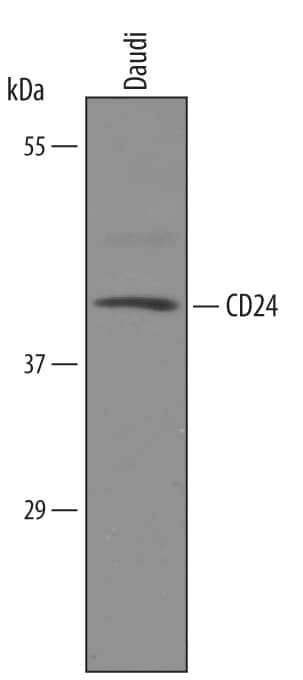
Detection of Human CD24 by Western Blot.
Western blot shows lysates of Daudi human Burkitt's lymphoma cell line. PVDF Membrane was probed with 1 µg/mL of Sheep Anti-Human CD24 Antigen Affinity-purified Polyclonal Antibody (Catalog # AF5247) followed by HRP-conjugated Anti-Sheep IgG Secondary Antibody (HAF016). A specific band was detected for CD24 at approximately 42 kDa (as indicated). This experiment was conducted under reducing conditions and using Immunoblot Buffer Group 8.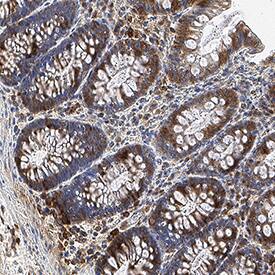
Detection of CD24 in Human Colon.
CD24 was detected in immersion fixed paraffin-embedded sections of human colon using Sheep Anti-Human CD24 Antigen Affinity-purified Polyclonal Antibody (Catalog # AF5247) at 1 µg/ml for 1 hour at room temperature followed by incubation with the HRP-conjugated Anti-Sheep IgG Secondary Antibody (Catalog # HAF016). Before incubation with the primary antibody, tissue was subjected to heat-induced epitope retrieval using VisUCyte Antigen Retrieval Reagent-Basic (Catalog # VCTS021). Tissue was stained using DAB (brown) and counterstained with hematoxylin (blue). Specific staining was localized to the cell surface. View our protocol for Chromogenic IHC Staining of Paraffin-embedded Tissue Sections.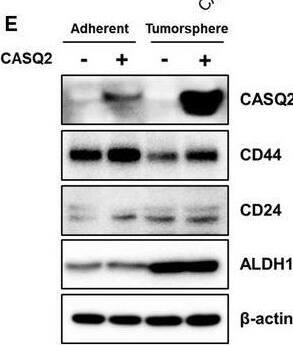
Detection of CD24 by Western Blot
CASQ2 induces phenotypic changes in breast cancer cells. (A) Relationship between the proliferation rate and overexpression of CASQ2 in breast cancer cell lines (mean ± SEM, n = 3; *P < 0.05, **P < 0.01, and ***P < 0.001 using the multiple t‐test). (B) Migration and invasion rates of Hs578T cells (mean ± SEM, n = 3; **P < 0.01 using two‐tailed Student’s t‐test). Scale bar = 50 μm. (C) Three‐dimensional culture of Hs578T cells (mean ± SEM, n = 3; **P < 0.01 using two‐tailed Student’s t‐test). Scale bar = 100 μm. (D) Tumorsphere culture of Hs578T cells (mean ± SEM, n = 3; **P < 0.01 using two‐tailed Student’s t‐test). Scale bar = 100 μm. (E) Expression of CD44, CD24, and ALDH1 cancer stem cell markers in adherent and tumorsphere cultures of Hs578T cells. (F) Measurement of intracellular Ca2+ in Hs578T cells using a calcium crimson reagent. Cells were loaded with the calcium indicator calcium crimson (5 μm) for 30 min, and then, BAPTA‐AM (10 μm) was added. After washing, the cells were stimulated by treatment with 5 μm caffeine to measure the intracellular calcium concentration at 360 s (mean ± SEM, n = 3; *P < 0.05 and **P < 0.01 after ANOVA with Tukey’s post hoc test). (G) Effect of lacidipine on the expression of cancer stem cell markers in tumorspheres of breast cancer cells. The figure shows one of three independent experiments. Statistical test result is shown in Fig. S6. (H) Epithelial–mesenchymal transition (EMT)‐related protein expression in breast cancer cells. All results are representatives of three independent experiments. Image collected and cropped by CiteAb from the following open publication (https://pubmed.ncbi.nlm.nih.gov/34743414), licensed under a CC-BY license. Not internally tested by R&D Systems.Applications for Human CD24 Antibody
Application
Recommended Usage
Immunohistochemistry
1-15 µg/mL
Sample: Immersion fixed paraffin-embedded sections of human colon tissue
Sample: Immersion fixed paraffin-embedded sections of human colon tissue
Western Blot
1 µg/mL
Sample: Daudi human Burkitt's lymphoma cell line
Sample: Daudi human Burkitt's lymphoma cell line
Formulation, Preparation, and Storage
Purification
Antigen Affinity-purified
Reconstitution
Reconstitute at 0.2 mg/mL in sterile PBS. For liquid material, refer to CoA for concentration.
Formulation
Lyophilized from a 0.2 μm filtered solution in PBS with Trehalose. See Certificate of Analysis for details.
*Small pack size (-SP) is supplied either lyophilized or as a 0.2 µm filtered solution in PBS.
*Small pack size (-SP) is supplied either lyophilized or as a 0.2 µm filtered solution in PBS.
Shipping
Lyophilized product is shipped at ambient temperature. Liquid small pack size (-SP) is shipped with polar packs. Upon receipt, store immediately at the temperature recommended below.
Stability & Storage
Use a manual defrost freezer and avoid repeated freeze-thaw cycles.
- 12 months from date of receipt, -20 to -70 °C as supplied.
- 1 month, 2 to 8 °C under sterile conditions after reconstitution.
- 6 months, -20 to -70 °C under sterile conditions after reconstitution.
Background: CD24
CD24 (signal transducer 24; also HSA/heat shock antigen) is a variably glycosylated, 35‑50 kDa member of the CD24 family of proteins. It is a GPI‑linked sialoprotein that is expressed on B cell precursors and unactivated B cells, keratinocytes, and neutrophils and thymocytes. Ligation of CD24 appears to inhibit B cell differentiation, likely through the initiation of apoptosis. Potential CD24 ligands include P‑Selectin. The human CD24 precursor is 80 amino acids (aa) in length. It contains a 26 aa signal sequence plus a cleavable C‑terminal propeptide (aa 60‑80). There is one potential alternate start site at Met5. Over aa 27‑59, human CD24 shares only 30% aa identity with mouse CD24.
Alternate Names
CD24, CD24A
Gene Symbol
CD24
UniProt
Additional CD24 Products
Product Documents for Human CD24 Antibody
Product Specific Notices for Human CD24 Antibody
For research use only
Loading...
Loading...
Loading...
Loading...
Loading...