
Human Cathepsin C/DPPI Antibody
R&D Systems, part of Bio-Techne | Catalog # AF1071

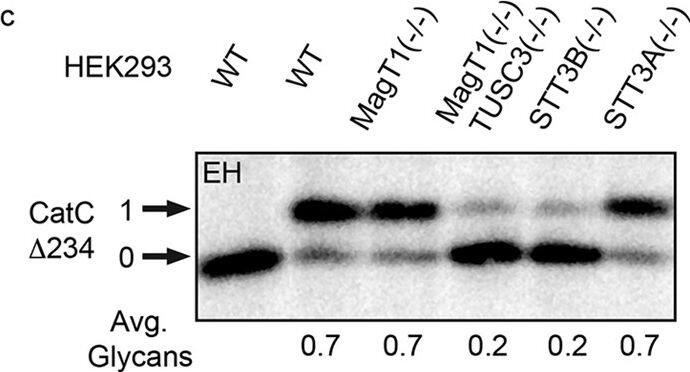
Scientific images may be resized, cropped, or adjusted for brightness or contrast for presentation purposes. These updates are limited to presentation and do not affect the underlying scientific interpretation of the data. Where available, additional source data may be provided upon request.
Conjugate
Catalog #
Key Product Details
Validated by
Biological Validation
Species Reactivity
Validated:
Human
Cited:
Human
Applications
Validated:
Immunohistochemistry, Western Blot, Simple Western
Cited:
Immunohistochemistry-Paraffin, Western Blot, Immunocytochemistry, Immunoprecipitation
Label
Unconjugated
Antibody Source
Polyclonal Goat IgG
Product Specifications
Immunogen
Mouse myeloma cell line NS0-derived recombinant human pro Cathepsin C/DPPI
Asp25-Leu463
Accession # P53634
Asp25-Leu463
Accession # P53634
Specificity
Detects human Cathepsin C/DPPI in direct ELISAs and Western blots.
Clonality
Polyclonal
Host
Goat
Isotype
IgG
Scientific Data Images for Human Cathepsin C/DPPI Antibody
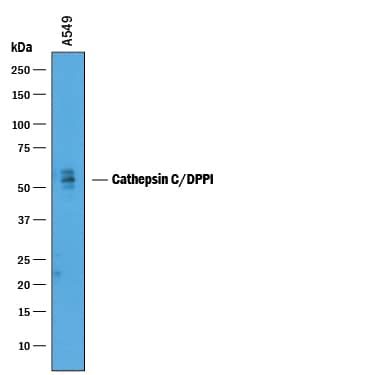
Detection of Human Cathepsin C/DPPI by Western Blot.
Western blot shows lysates of A549 human lung carcinoma cell line. PVDF membrane was probed with 1 µg/mL of Goat Anti-Human Cathepsin C/DPPI Antigen Affinity-purified Polyclonal Antibody (Catalog # AF1071) followed by HRP-conjugated Anti-Goat IgG Secondary Antibody (Catalog # HAF019). A specific band was detected for Cathepsin C/DPPI at approximately 55 kDa (as indicated). This experiment was conducted under reducing conditions and using Immunoblot Buffer Group 1.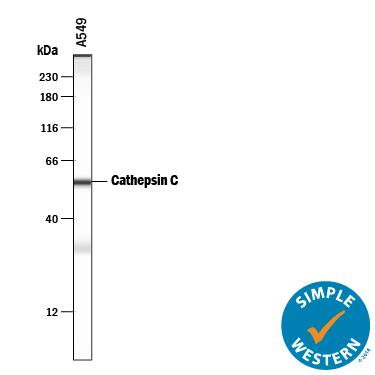
Detection of Human Cathepsin C/DPPI by Simple WesternTM.
Simple Western lane view shows lysates of A549 human lung carcinoma cell line, loaded at 0.2 mg/mL. A specific band was detected for Cathepsin C/DPPI at approximately 56 kDa (as indicated) using 50 µg/mL of Goat Anti-Human Cathepsin C/DPPI Antigen Affinity-purified Polyclonal Antibody (Catalog # AF1071) followed by 1:50 dilution of HRP-conjugated Anti-Goat IgG Secondary Antibody (Catalog # HAF109). This experiment was conducted under reducing conditions and using the 12-230 kDa separation system. Non-specific interaction with the 230 kDa Simple Western standard may be seen with this antibody.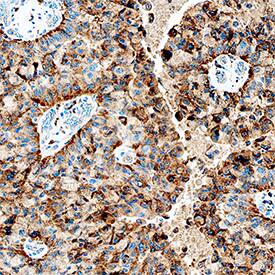
Cathepsin C/DPPI in Human Lung Cancer Tissue.
Cathepsin C/DPPI was detected in immersion fixed paraffin-embedded sections of human lung cancer tissue using Goat Anti-Human Cathepsin C/DPPI Antigen Affinity-purified Polyclonal Antibody (Catalog # AF1071) at 1 µg/mL overnight at 4 °C. Tissue was stained using the Anti-Goat HRP-DAB Cell & Tissue Staining Kit (brown; Catalog # CTS008) and counterstained with hematoxylin (blue). Specific staining was localized to cytoplasm in cancer cells. View our protocol for Chromogenic IHC Staining of Paraffin-embedded Tissue Sections.Applications for Human Cathepsin C/DPPI Antibody
Application
Recommended Usage
Immunohistochemistry
5-15 µg/mL
Sample: Immersion fixed paraffin-embedded sections of human lung subjected to Antigen Retrieval Reagent-Basic (Catalog # CTS013) and immersion fixed paraffin-embedded sections of human lung cancer tissue
Sample: Immersion fixed paraffin-embedded sections of human lung subjected to Antigen Retrieval Reagent-Basic (Catalog # CTS013) and immersion fixed paraffin-embedded sections of human lung cancer tissue
Simple Western
50 µg/mL
Sample: A549 human lung carcinoma cell line
Sample: A549 human lung carcinoma cell line
Western Blot
1 µg/mL
Sample: A549 human lung carcinoma cell line
Sample: A549 human lung carcinoma cell line
Formulation, Preparation, and Storage
Purification
Antigen Affinity-purified
Reconstitution
Reconstitute at 0.2 mg/mL in sterile PBS. For liquid material, refer to CoA for concentration.
Formulation
Lyophilized from a 0.2 μm filtered solution in PBS with Trehalose. *Small pack size (SP) is supplied either lyophilized or as a 0.2 µm filtered solution in PBS.
Shipping
Lyophilized product is shipped at ambient temperature. Liquid small pack size (-SP) is shipped with polar packs. Upon receipt, store immediately at the temperature recommended below.
Stability & Storage
Use a manual defrost freezer and avoid repeated freeze-thaw cycles.
- 12 months from date of receipt, -20 to -70 °C as supplied.
- 1 month, 2 to 8 °C under sterile conditions after reconstitution.
- 6 months, -20 to -70 °C under sterile conditions after reconstitution.
Background: Cathepsin C/DPPI
Cathepsin C, also known as dipeptidyl-peptidase I (DPPI), is a cysteine protease of the papain family (1). Cathepsin C sequentially removes dipeptides from the free N-termini of proteins and peptides. It has broad specificity except that it does not cleave a basic amino acid (Arg or Lys) in the N-terminal position or Pro on either side of the scissle bond. It requires halide ions for activity. The pro form contains a pro peptide and a catalytic region, which can be further processed into heavy/ alpha and light/ beta chains that are linked by a disulfide bond. It is broadly distributed. Cathepsin C plays a role in the lysosomal degradation. It also functions as a key enzyme in the activation of granule serine proteases in cytotoxic T lymphocytes and natural killer cells (granzymes A and B), mast cells (tryptase and chymase), and neutrophils (Cathepsin G and elastase) by removing their N-terminal activation dipeptides (2). Loss of function mutations in the Cathepsin C gene result in periodontal disease and palmoplantar keratosis (3).
References
- Turk, B. et al. (2004) in Handbook of Proteolytic Enzymes (ed. Barrett, A.J. et al.) p. 1192, Academic Press, San Diego.
- Dahl, S.W. et al. (2001) Biochemistry 40:1671.
- Toomes, A.J. et al. (1999) Nat. Genet. 23:421.
Alternate Names
CTSC, DPPI, PALS, PLS
Gene Symbol
CTSC
UniProt
Additional Cathepsin C/DPPI Products
Product Documents for Human Cathepsin C/DPPI Antibody
Product Specific Notices for Human Cathepsin C/DPPI Antibody
For research use only
Loading...
Loading...
Loading...
Loading...
Loading...