
Human c-Myc Antibody Best Seller
R&D Systems, part of Bio-Techne | Catalog # MAB3696

Conjugate
Catalog #
Key Product Details
Validated by
Knockout/Knockdown
Species Reactivity
Validated:
Human
Cited:
Human, Mouse, E. coli
Applications
Validated:
Knockout Validated, Immunohistochemistry, Western Blot, Flow Cytometry, Immunocytochemistry, Simple Western, Immunoprecipitation, CyTOF-ready
Cited:
Immunohistochemistry, Immunohistochemistry-Paraffin, Western Blot
Label
Unconjugated
Antibody Source
Monoclonal Mouse IgG1 Clone # 9E10
Product Specifications
Immunogen
C-terminal region peptide of human c-Myc
Ala408-Ala439
Accession # P01106
Ala408-Ala439
Accession # P01106
Specificity
Detects endogenous human c-Myc and c-Myc tagged proteins in Western blots.
Clonality
Monoclonal
Host
Mouse
Isotype
IgG1
Scientific Data Images for Human c-Myc Antibody
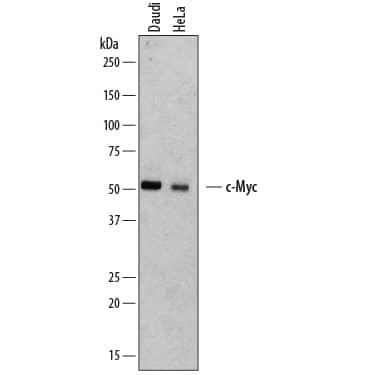
Detection of Human c‑Myc by Western Blot.
Western blot shows lysates of Daudi human Burkitt's lymphoma cell line and HeLa human cervical epithelial carcinoma cell line. PVDF membrane was probed with 2 µg/mL of Mouse Anti-Human c-Myc Monoclonal Antibody (Catalog # MAB3696) followed by HRP-conjugated Anti-Mouse IgG Secondary Antibody (Catalog # HAF007). A specific band was detected for c-Myc at approximately 52 kDa (as indicated). This experiment was conducted under reducing conditions and using Immunoblot Buffer Group 1.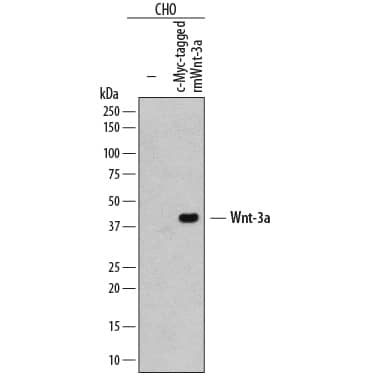
Detection of c‑Myc-tagged Protein by Western Blot.
Western blot shows lysates of CHO Chinese hamster ovary cell line either mock transfected (-) or transfected with c-Myc-tagged recombinant mouse Wnt-3a. PVDF membrane was probed with 2 µg/mL of Mouse Anti-Human c-Myc Monoclonal Antibody (Catalog # MAB3696) followed by HRP-conjugated Anti-Mouse IgG Secondary Antibody (Catalog # HAF007). A specific band was detected for c-Myc-tagged recombinant mouse Wnt-3a at approximately 41 kDa (as indicated). This experiment was conducted under reducing conditions and using Immunoblot Buffer Group 1.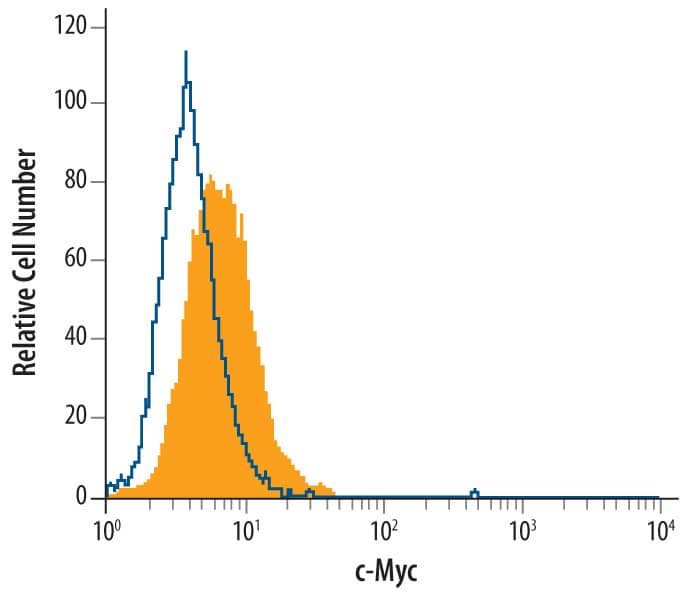
Detection of c‑Myc in Jurkat Human Cell Line by Flow Cytometry.
Jurkat human acute T cell leukemia cell line was stained with Mouse Anti-Human c-Myc Mono-clonal Antibody (Catalog # MAB3696, filled histogram) or isotype control antibody (Catalog # MAB002, open histogram), followed by Phycoerythrin-conjugated Anti-Mouse IgG Secondary Antibody (Catalog # F0102B). To facilitate intracellular staining, cells were fixed with paraformaldehyde and permeabilized with methanol.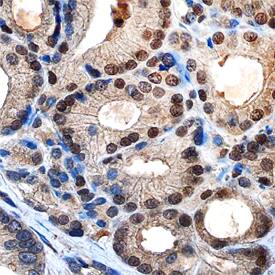
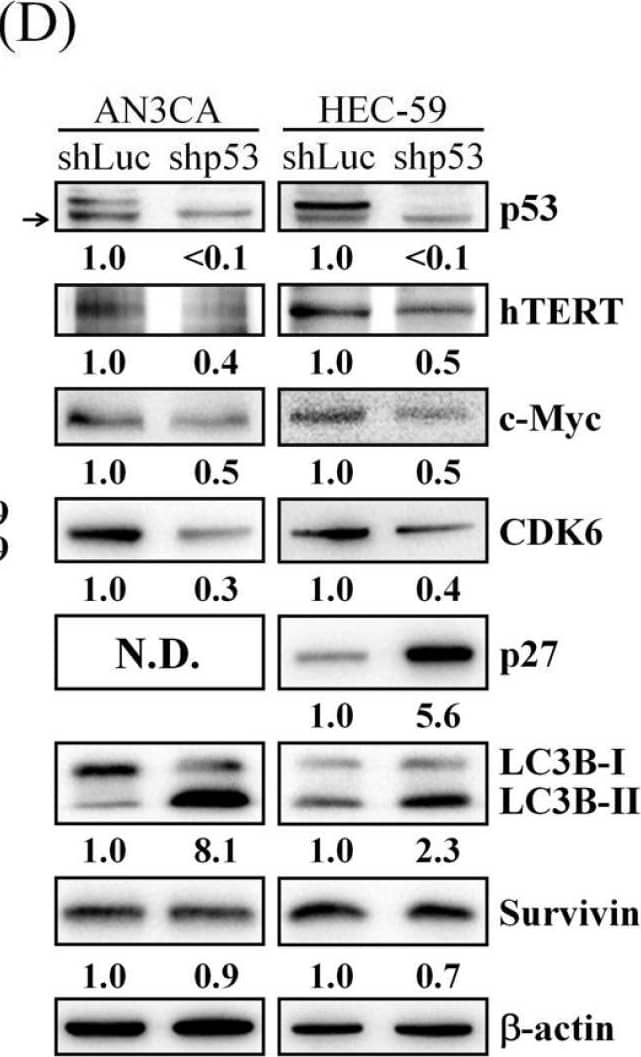
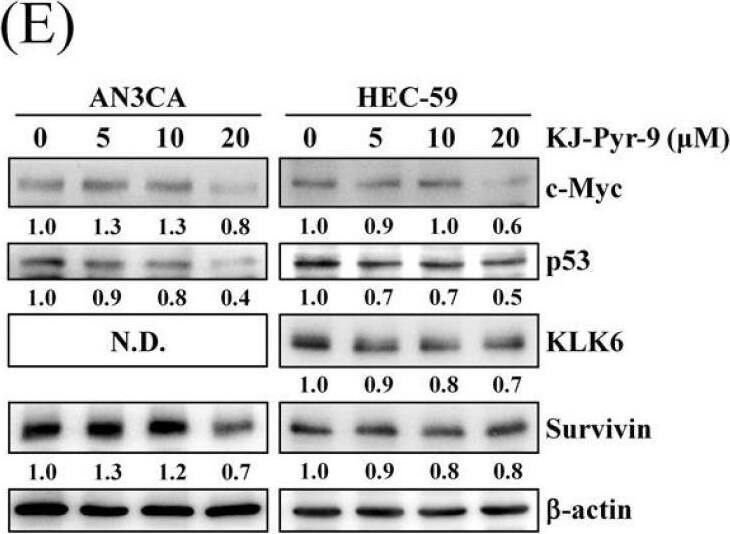
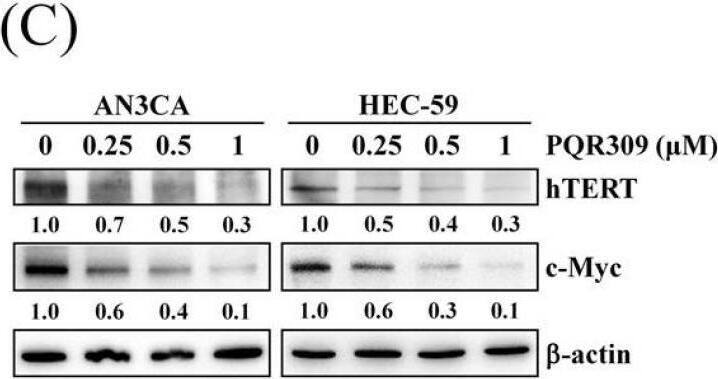
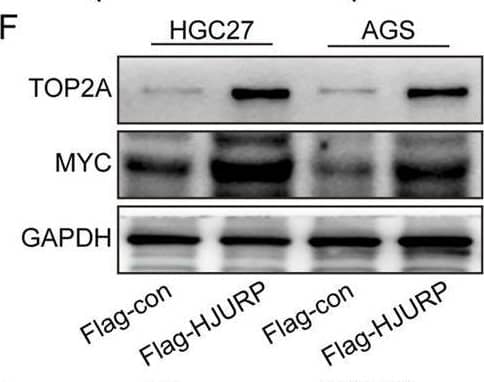
Applications for Human c-Myc Antibody
Application
Recommended Usage
CyTOF-ready
Ready to be labeled using established conjugation methods. No BSA or other carrier proteins that could interfere with conjugation.
Flow Cytometry
2.5 µg/106 cells
Sample: Jurkat human acute T cell leukemia cell line fixed with paraformaldehyde and permeabilized with methanol.
Sample: Jurkat human acute T cell leukemia cell line fixed with paraformaldehyde and permeabilized with methanol.
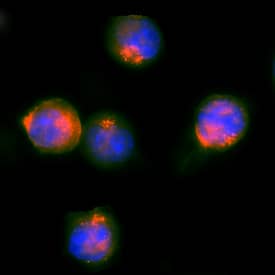
Immunocytochemistry
8-25 µg/mL
Sample: Immersion fixed HEK293 human embryonic kidney cell line
Sample: Immersion fixed HEK293 human embryonic kidney cell line
Immunohistochemistry
8-25 µg/mL
Sample: Immersion fixed paraffin-embedded sections of human prostate
Sample: Immersion fixed paraffin-embedded sections of human prostate
Immunoprecipitation
Fan H, et al. (1998) Biochem. Cell. Biol. 76:125.
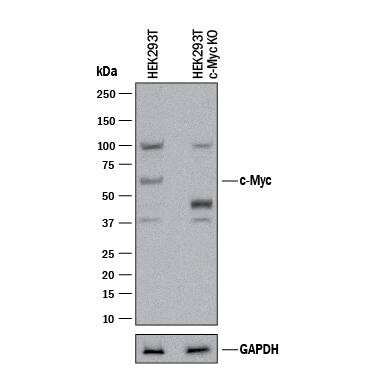
Knockout Validated
c‑Myc
is specifically detected in HEK293T human embryonic kidney parental cell line but is not detectable in
c‑Myc knockout HEK293T cell line.
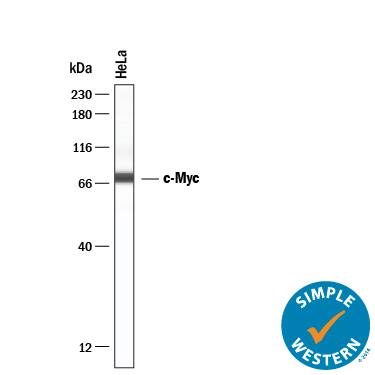
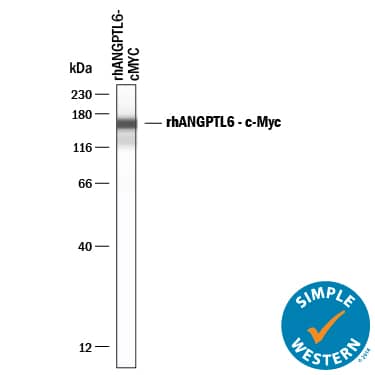
Simple Western
20 µg/mL
Sample: HeLa human cervical epithelial carcinoma cell line and c-Myc-tagged recombinant human ANGPTL6
Sample: HeLa human cervical epithelial carcinoma cell line and c-Myc-tagged recombinant human ANGPTL6
Western Blot
2 µg/mL
Sample: Daudi human Burkitt's lymphoma cell line, HeLa human cervical epithelial carcinoma cell line, and CHO Chinese hamster ovary cell line either transfected with c-Myc-tagged recombinant mouse Wnt-3a
Sample: Daudi human Burkitt's lymphoma cell line, HeLa human cervical epithelial carcinoma cell line, and CHO Chinese hamster ovary cell line either transfected with c-Myc-tagged recombinant mouse Wnt-3a
Reviewed Applications
Read 3 reviews rated 4.3 using MAB3696 in the following applications:
Formulation, Preparation, and Storage
Purification
Protein A or G purified from hybridoma culture supernatant
Reconstitution
Sterile PBS to a final concentration of 0.5 mg/mL. For liquid material, refer to CoA for concentration.
Formulation
Lyophilized from a 0.2 μm filtered solution in PBS with Trehalose. *Small pack size (SP) is supplied either lyophilized or as a 0.2 µm filtered solution in PBS.
Shipping
Lyophilized product is shipped at ambient temperature. Liquid small pack size (-SP) is shipped with polar packs. Upon receipt, store immediately at the temperature recommended below.
Stability & Storage
Use a manual defrost freezer and avoid repeated freeze-thaw cycles.
- 12 months from date of receipt, -20 to -70 °C as supplied.
- 1 month, 2 to 8 °C under sterile conditions after reconstitution.
- 6 months, -20 to -70 °C under sterile conditions after reconstitution.
Background: c-Myc
Human c-Myc is a helix-loop-helix transcription factor which efficiently binds DNA after heterodimerization with the bHLH protein Max. It is often overexpressed and mutated in hematopoietic tumors. Mutations frequently result in truncation around amino acid (aa) 252, before the C-terminal DNA binding, HLH and leucine zipper domains. The 439 aa human c-Myc has one O-glycosylation site and has three Ser/Thr phosphorylation sites near the N-terminus. Human c-Myc shows 92% aa identity with mouse or rat c-Myc.
Long Name
v-Myc Avian Myelocytomatosis Viral Oncogene Homolog (Avian)
Alternate Names
cMyc, Myc, Myc2, Niard, Nird
Gene Symbol
MYC
UniProt
Additional c-Myc Products
Product Documents for Human c-Myc Antibody
Product Specific Notices for Human c-Myc Antibody
For research use only
Loading...
Loading...
Loading...
Loading...
Loading...
Loading...