
Human BMP-2/BMP-4 Antibody
R&D Systems, part of Bio-Techne | Catalog # MAB3552


Scientific images may be resized, cropped, or adjusted for brightness or contrast for presentation purposes. These updates are limited to presentation and do not affect the underlying scientific interpretation of the data. Where available, additional source data may be provided upon request.
Conjugate
Catalog #
Key Product Details
Species Reactivity
Validated:
Human
Cited:
Human, Mouse, Avian - Chicken, Transgenic Mouse
Applications
Validated:
Western Blot, Neutralization
Cited:
Immunohistochemistry, Western Blot, Neutralization, Immunoprecipitation, Bioassay, Cell Culture
Label
Unconjugated
Antibody Source
Monoclonal Mouse IgG1 Clone # 100230
Product Specifications
Immunogen
Chinese hamster ovary cell line CHO-derived recombinant human BMP-2
Gln283-Arg396
Accession # P12643
Gln283-Arg396
Accession # P12643
Specificity
Detects human BMP-2 and human BMP-4 in direct ELISAs and Western blots. In direct ELISAs, 100% cross-reactivity with recombinant zebra fish (rzf) BMP-2 and rhBMP-4, 20%-40% cross-reactivity with rhBMP-3, -3b, -6, and no cross-reactivity with rhBMP-5, -7, -10, or -15 is observed.
Clonality
Monoclonal
Host
Mouse
Isotype
IgG1
Endotoxin Level
<0.10 EU per 1 μg of the antibody by the LAL method.
Scientific Data Images for Human BMP-2/BMP-4 Antibody
Alkaline Phosphatase Production Induced by BMP‑2 and Neutralization by Human BMP-2/BMP-4 Antibody.
Recombinant Human BMP-2 (Catalog # 355-BM) induces alkaline phosphatase production in the the ATDC5 mouse chondrogenic cell line in a dose-dependent manner (orange line). Alkaline Phosphatase Production elicited by Recombinant Human BMP-2 (1 µg/mL) is neutralized (green line) by increasing concentrations of Mouse Anti-Human BMP-2/BMP-4 Monoclonal Antibody (Catalog # MAB3552). The ND50 is typically 5-15 µg/mL in the presence of heparin (2 µg/mL).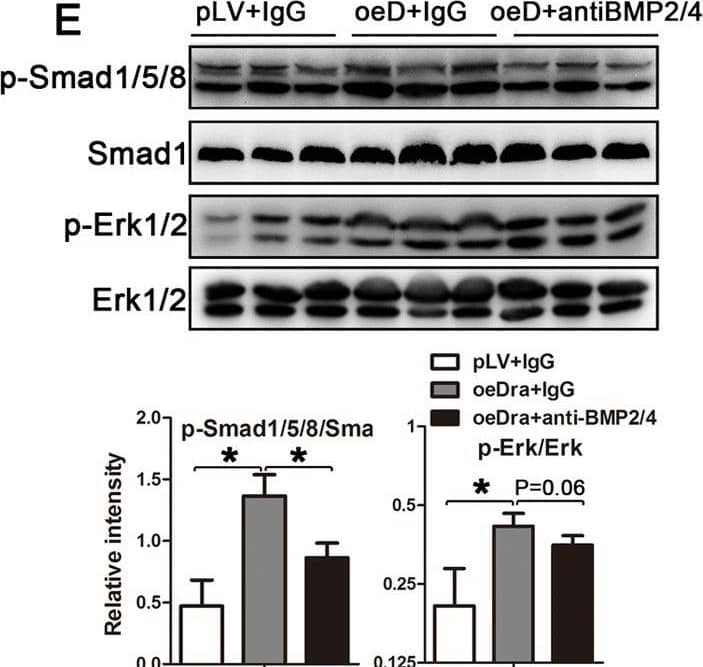
Detection of BMP-2/BMP-4 by Western Blot
Effects of neutralization of BMP2 and BMP4 on xenografted tumor growth induced by DragonCMT93 cells with or without Dragon over-expression were injected into C57BL/6 mice, followed by intraperitoneal injection of 2 μg/body weight of BMP2/4 antibody or IgG1 once every 2 days from the day of cell injection to 22 days after cell injection. A.Xenografted tumors were isolated from mice at 22 days after cell injection. B. The sizes of xenografted tumors were measured at days 7, 10, 13, 16 19 and 22 after cell injection (n = 6). P < 0.05, oeDra+anti-BMP2/4 vs oeDra+IgG. C. Representative images from Micro-PET/CT performed on mice at day 20 after cell injection: white circular outlines indicate xenografted tumors; arrows indicate SUV-MAX absorbance. D. Tumor volumes and SUV-MAX absorbance are quantified by Micro-PET/CT at day 20 after cell injection (n = 6). E. Phosphorylation levels of Erk1/2 and Smad1/5/8 in tumors collected at day 22 after cell injections (upper panel, Western blots; lower panel, densitometric analysis). F. Schematic diagram depicting Dragon action in regulating proliferation in colon cancer cells. Dragon/BMPs activate the Smad1/5/8 and Erk1/2 pathways via a mechanism yet to be determined and then promote colon cancer cell proliferation and tumor growth. *P < 0.05, **P < 0.01. Image collected and cropped by CiteAb from the following open publication (https://pubmed.ncbi.nlm.nih.gov/26029998), licensed under a CC-BY license. Not internally tested by R&D Systems.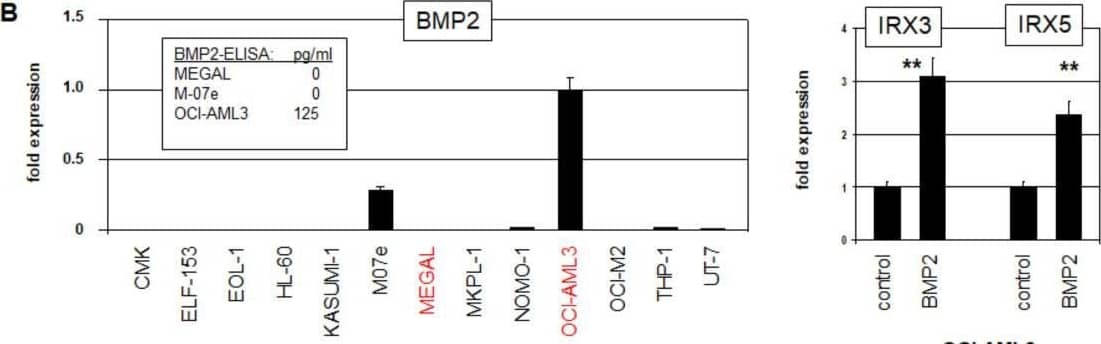
Detection of Human BMP-2/BMP-4 by Flow Cytometry
Transcriptional regulation of IRX3 and IRX5. (A) RQ-PCR analysis of HOXA10 in AML cell lines (left). Transcript levels are indicated in relation to OCI-AML3, and IRX3/IRX5-positive cell lines are indicated in red. RQ-PCR analysis of OCI-AML3 (above) and MEGAL (below) showed downregulation of IRX3 and IRX5 after siRNA-mediated knockdown of HOXA10 (right). (B) RQ-PCR analysis of BMP2 in AML cell lines (left). Transcript levels are indicated in relation to OCI-AML3. ELISA results for BMP2 protein levels in AML cell line supernatants are inserted. RQ-PCR analysis of OCI-AML3 treated with BMP2 resulted in the upregulation of IRX3 and IRX5 (right). (C) RQ-PCR analysis of OCI-AML3 after siRNA-mediated knockdown of JUNB (left) and SMAD4 (right) showed downregulation of IRX3 and IRX5. (D) RQ-PCR analysis of JUNB in AML cell lines (left). Transcript levels are indicated in relation to OCI-AML3. RQ-PCR analysis of OCI-AML3 treated with inhibitory BMP2-antibody resulted in downregulation of JUNB, IRX3, and IRX5, while HOXA10 was not significantly affected (right). p-values are indicated by asterisks (* p < 0.05, ** p < 0.01, *** p < 0.001, n.s. not significant). Image collected and cropped by CiteAb from the following open publication (https://pubmed.ncbi.nlm.nih.gov/35328612), licensed under a CC-BY license. Not internally tested by R&D Systems.Applications for Human BMP-2/BMP-4 Antibody
Application
Recommended Usage
Western Blot
1 µg/mL
Sample: Recombinant Human BMP-2 (Catalog # 355-BM)
Recombinant Human BMP-4 (Catalog # 314-BP)
under non-reducing conditions only
Sample: Recombinant Human BMP-2 (Catalog # 355-BM)
Recombinant Human BMP-4 (Catalog # 314-BP)
under non-reducing conditions only
Neutralization
Measured by its ability to neutralize BMP‑2-induced alkaline phosphatase production in the ATDC5 mouse chondrogenic cell line. Nakamura, K. et al. (1999) Exp. Cell Res. 250:351. The Neutralization Dose (ND50) is typically 5-15 µg/mL in the presence of 1 µg/mL Recombinant Human BMP‑2 and 2 µg/mL heparin. This antibody also neutralizes Human BMP-4 induced activity in the ATDC5 mouse chondrogenic cell line. The ND50 is approximately 3 μg/mL in the presence of 75 ng/mL of Recombinant Human BMP-4.
Reviewed Applications
Read 2 reviews rated 4 using MAB3552 in the following applications:
Formulation, Preparation, and Storage
Purification
Protein A or G purified from hybridoma culture supernatant
Reconstitution
Reconstitute at 0.5 mg/mL in sterile PBS. For liquid material, refer to CoA for concentration.
Formulation
Lyophilized from a 0.2 μm filtered solution in PBS with Trehalose. *Small pack size (SP) is supplied either lyophilized or as a 0.2 µm filtered solution in PBS.
Shipping
Lyophilized product is shipped at ambient temperature. Liquid small pack size (-SP) is shipped with polar packs. Upon receipt, store immediately at the temperature recommended below.
Stability & Storage
Use a manual defrost freezer and avoid repeated freeze-thaw cycles.
- 12 months from date of receipt, -20 to -70 °C as supplied.
- 1 month, 2 to 8 °C under sterile conditions after reconstitution.
- 6 months, -20 to -70 °C under sterile conditions after reconstitution.
Background: BMP-2/BMP-4
Bone Morphogenetic Protein 2 (BMP-2) and BMP-4 are two of at least 15 structurally and functionally related BMPs, which are members of the transforming growth factor beta (TGF-beta) superfamily, BMPs were originally identified as protein regulators of cartilage and bone formation. However, they have since been shown to be involved in embryogenesis and morphogenesis of various tissues and organs.
Long Name
Bone Morphogenetic Protein 2/4
Alternate Names
BDA2, BMP-2, BMP2A, BMP-2A, BMP2ABone morphogenetic protein 2A, bone morphogenetic protein 2
Gene Symbol
BMP2
UniProt
Additional BMP-2/BMP-4 Products
Product Documents for Human BMP-2/BMP-4 Antibody
Product Specific Notices for Human BMP-2/BMP-4 Antibody
For research use only
Loading...
Loading...
Loading...
Loading...
Loading...