
Human beta-NGF Biotinylated Antibody
R&D Systems, part of Bio-Techne | Catalog # BAF256


Conjugate
Catalog #
Key Product Details
Species Reactivity
Validated:
Human
Cited:
Human, Transgenic Mouse
Applications
Validated:
Western Blot, ELISA Detection (Matched Antibody Pair)
Cited:
Flow Cytometry, Bioassay, ELISA Development, Luminex Development
Label
Biotin
Antibody Source
Polyclonal Goat IgG
Product Specifications
Immunogen
Mouse myeloma cell line NS0-derived recombinant human beta-NGF (R&D Systems, Catalog # 256-GF)
Ser122-Ala241
Accession # CAA36832
Ser122-Ala241
Accession # CAA36832
Specificity
Detects human beta-NGF in ELISAs and Western blots. In sandwich immunoassays, less than 35% cross-reactivity with recombinant mouse beta‑NGF is observed and less than 3% cross-reactivity with recombinant rat beta‑NGF is observed.
Clonality
Polyclonal
Host
Goat
Isotype
IgG
Scientific Data Images for Human beta-NGF Biotinylated Antibody
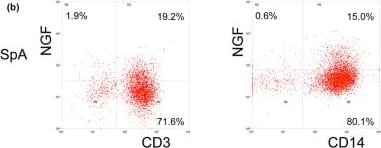
Detection of Human beta-NGF by Flow Cytometry
NGF staining by flow cytometry. PBMC of (a) healthy controls (HC) and (b) synovial fluid mononuclear cells (SFMC) from spondyloarthritis (SpA), and (c) rheumatoid arthritis (RA) patients were first stained with surface markers (CD3 and CD14) and permeabilized in order to enable intracellular detection of nerve growth factor (NGF). The cells were analysed by flow cytometry after setting lymphocyte (left column) and monocyte (right column) gates according to forward scatter vs side scatter properties of the cells. Dot plots of one representative individual of each group are shown. Image collected and cropped by CiteAb from the following publication (https://arthritis-research.biomedcentral.com/articles/10.1186/ar2716), licensed under a CC-BY license. Not internally tested by R&D Systems.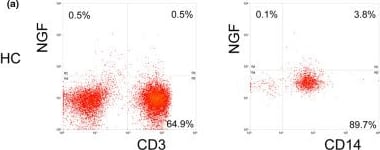
Detection of Human beta-NGF by Flow Cytometry
NGF staining by flow cytometry. PBMC of (a) healthy controls (HC) and (b) synovial fluid mononuclear cells (SFMC) from spondyloarthritis (SpA), and (c) rheumatoid arthritis (RA) patients were first stained with surface markers (CD3 and CD14) and permeabilized in order to enable intracellular detection of nerve growth factor (NGF). The cells were analysed by flow cytometry after setting lymphocyte (left column) and monocyte (right column) gates according to forward scatter vs side scatter properties of the cells. Dot plots of one representative individual of each group are shown. Image collected and cropped by CiteAb from the following publication (https://arthritis-research.biomedcentral.com/articles/10.1186/ar2716), licensed under a CC-BY license. Not internally tested by R&D Systems.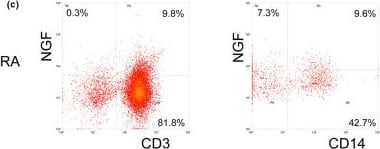
Detection of Human beta-NGF by Flow Cytometry
NGF staining by flow cytometry. PBMC of (a) healthy controls (HC) and (b) synovial fluid mononuclear cells (SFMC) from spondyloarthritis (SpA), and (c) rheumatoid arthritis (RA) patients were first stained with surface markers (CD3 and CD14) and permeabilized in order to enable intracellular detection of nerve growth factor (NGF). The cells were analysed by flow cytometry after setting lymphocyte (left column) and monocyte (right column) gates according to forward scatter vs side scatter properties of the cells. Dot plots of one representative individual of each group are shown. Image collected and cropped by CiteAb from the following publication (https://arthritis-research.biomedcentral.com/articles/10.1186/ar2716), licensed under a CC-BY license. Not internally tested by R&D Systems.Applications for Human beta-NGF Biotinylated Antibody
Application
Recommended Usage
Western Blot
0.1 µg/mL
Sample: Recombinant Human beta-NGF (Catalog # 256-GF)
Sample: Recombinant Human beta-NGF (Catalog # 256-GF)
Human beta-NGF Sandwich Immunoassay
ELISA Detection (Matched Antibody Pair)
Please Note: Optimal dilutions of this antibody should be experimentally determined.
Formulation, Preparation, and Storage
Purification
Antigen Affinity-purified
Reconstitution
Reconstitute at 0.2 mg/mL in sterile PBS.
Formulation
Lyophilized from a 0.2 μm filtered solution in PBS with BSA as a carrier protein.
Shipping
The product is shipped at ambient temperature. Upon receipt, store it immediately at the temperature recommended below.
Stability & Storage
Use a manual defrost freezer and avoid repeated freeze-thaw cycles.
- 12 months from date of receipt, -20 to -70 °C as supplied.
- 1 month, 2 to 8 °C under sterile conditions after reconstitution.
- 6 months, -20 to -70 °C under sterile conditions after reconstitution.
Background: beta-NGF
NGF was initially isolated in the mouse submandibular gland as a 7S complex composed of three non-covalently linked subunits, alpha, beta, and gamma. Both the alpha and gamma subunits of NGF are members of the kallikrein family of serine proteases while the beta subunit, called beta-NGF or 2.5S NGF, exhibits all the biological activities ascribed to NGF. Recombinant human beta-NGF is a homodimer of two 120 amino acid polypeptides. The human protein shares approximately 90% homology at the amino acid level with both the mouse and rat beta-NGF and exhibits cross-species activity.
NGF is a well-characterized neurotropic protein that plays a critical role in the development of sympathetic and some sensory neurons in the peripheral nervous system. In addition, NGF can also act in the central nervous system as a trophic factor for basal forebrain cholinergic neurons. NGF has also been shown to have biological effects on non-neuronal tissues. NGF is mitogenic for a factor-dependent human erythroleukemic cell line, TF-1. NGF has been found to increase the number of mast cells in neonatal rats and to induce histamine release from peritoneal mast cells. NGF will enhance histamine release and strongly modulate the formation of lipid mediators by basophils in response to various stimuli. NGF will also induce the growth and differentiation of human B lymphocytes as well as suppress apoptosis of murine peritoneal neutrophils. These results, taken together, suggest that NGF is a pleiotropic cytokine which, in addition to its neurotropic activities, may have an important role in the regulation of the immune system.
Long Name
beta Nerve Growth Factor
Alternate Names
betaNGF, NGFB
Gene Symbol
NGF
UniProt
Additional beta-NGF Products
Product Documents for Human beta-NGF Biotinylated Antibody
Product Specific Notices for Human beta-NGF Biotinylated Antibody
For research use only
Loading...
Loading...
Loading...
Loading...
Loading...