
Human 4-1BB Ligand/TNFSF9 PE-conjugated Antibody
R&D Systems, part of Bio-Techne | Catalog # FAB2295P

Conjugate
Catalog #
Key Product Details
Species Reactivity
Human
Applications
Flow Cytometry
Label
Phycoerythrin (Excitation = 488 nm, Emission = 565-605 nm)
Antibody Source
Monoclonal Mouse IgG2B Clone # 282220
Product Specifications
Immunogen
E. coli-derived recombinant human 4‑1BB Ligand/TNFSF9
Arg71-Glu254
Accession # P41273.1
Arg71-Glu254
Accession # P41273.1
Specificity
Detects human 4‑1BB Ligand/TNFSF9 in direct ELISAs and Western blots. In Western blots, no cross-reactivity with recombinant mouse (rm) 4-1BB Ligand, recobinant human (rh) APRIL, rhBAFF, rmEDA-A2, rhFas Ligand, rhGITR Ligand, rhLIGHT, rhLymphotoxin alpha1/ beta2, rhLymphotoxin alpha2/ beta1, rhOX40 Ligand, rhTNF-alpha, rhTRAIL, rhTRANCE, or rhTWEAK is observed.
Clonality
Monoclonal
Host
Mouse
Isotype
IgG2B
Scientific Data Images for Human 4-1BB Ligand/TNFSF9 PE-conjugated Antibody
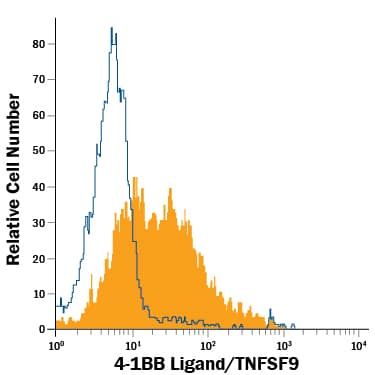
Detection of 4‑1BB Ligand/TNFSF9 in Raji Human Cell Line by Flow Cytometry.
Raji human Burkitt's lymphoma cell line was stained with Mouse Anti-Human 4-1BB Ligand/TNFSF9 PE-conjugated Monoclonal Antibody (Catalog # FAB2295P, filled histogram) or isotype control antibody (IC0041P, open histogram). View our protocol for Staining Membrane-associated Proteins.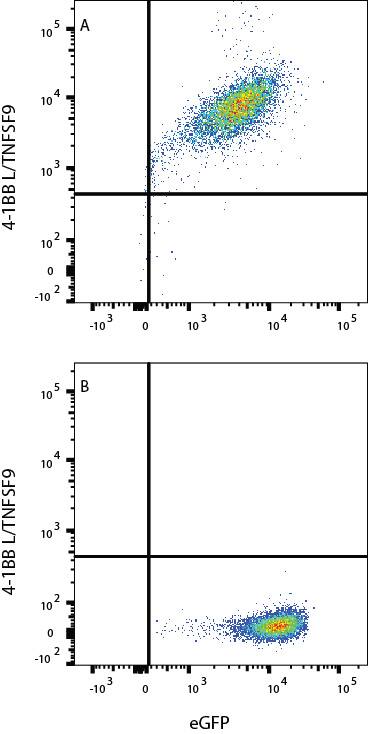
Detection of 4-1BB Ligand/TNFSF9 in HEK 293 cells transfected with Human 4-1BBL by Flow Cytometry
HEK 293 cells transfected with Human 4-1BBL (A) vs Irrelevant (B) were stained with Mouse Anti-Human 4-1BB Ligand/TNFSF9 PE-conjugated Monoclonal Antibody (Catalog # FAB2295P) and eGFP. View our protocol for Staining Membrane-associated Proteins.Applications for Human 4-1BB Ligand/TNFSF9 PE-conjugated Antibody
Application
Recommended Usage
Flow Cytometry
10 µL/106 cells
Sample: Raji human Burkitt's lymphoma cell line; Transfectants
Sample: Raji human Burkitt's lymphoma cell line; Transfectants
Spectra Viewer
Plan Your Experiments
Use our spectra viewer to interactively plan your experiments, assessing multiplexing options. View the excitation and emission spectra for our fluorescent dye range and other commonly used dyes.
Spectra Viewer
Formulation, Preparation, and Storage
Purification
Protein A or G purified from hybridoma culture supernatant
Formulation
Supplied in a saline solution containing BSA and Sodium Azide.
Shipping
The product is shipped with polar packs. Upon receipt, store it immediately at the temperature recommended below.
Stability & Storage
Store the unopened product at 2 - 8° C. Do not use past expiration date. Protect from light.
Background: 4-1BB Ligand/TNFSF9
4-1BB Ligand (4-1BBL; also CD137L) is a 32 kDa type II transmembrane protein that belongs to the TNF superfamily (TNFSF) of molecules (1‑4). The human 4-1BBL cDNA encodes a 254 amino acid (aa) protein that contains a 25 aa N-terminal cytoplasmic domain, a 23 aa transmembrane segment, and a 206 aa C-terminal extracellular region (5). The extracellular domain (ECD) of 4-1BBL has a jelly-roll, beta-sandwich tertiary structure that is similar to other TNFSF members. There is only one cysteine in the human ECD, and no potential N-linked glycosylation sites. The potential exists, however, for O-linked glycosylation. The human 4-1BBL ECD shares 32% and 35% aa identity with mouse and rat ECD, respectively. In the cytoplasmic domain, human 4-1BBL is 55 aa shorter than the equivalent region in rodents. 4-1BBL is expressed by activated B cells, macrophages, dendritic cells, activated T cells, neurons and astrocytes (2, 3, 6). A bioactive 26 kDa soluble form of 4-1BBL, presumably generated by MMP cleavage, occurs in humans (4). Human 4-1BBL signals through both CD137/4-1BB and itself. Its cytoplasmic tail participates in reverse signaling that induces apoptosis in T cells and cytokine secretion (IL-6; TNF-alpha) by monocytes (7, 8). 4-1BBL binding to CD137/4-1BB produces a number of effects. It seems to play a key role in the T cell recall response. It maintains T cell numbers at the end of a primary response, and induces CD4+ and CD8+ T cells to proliferate and secrete cytokines such as IL-2 and IFN-gamma in CD4+ T cells, and IFN-gamma in CD8+ T cells (9, 10).
References
- Kwon, B. et al. (2003) Exp. Mol. Med. 35:8.
- Salih, H.R. et al. (2002) Int. J. Clin. Pharmacol. Ther. 40:348.
- Vinay, D.S. and B.S. Kwon (1998) Semin. Immunol. 10:481.
- Salih, H.R. et al. (2001) J. Immunol. 167:4059.
- Alderson, M.R. et al. (1994) Eur. J. Immunol. 24:2219.
- Reali, C. et al. (2003) J. Neurosci. Res. 74:67.
- Michel, J. et al. (1999) Immunology 98:42.
- Langstein, J. et al. (1998) J. Immunol. 160:2488.
- Wen, T. et al. (2002) J. Immunol. 168:4897.
- Dawicki, W. and T.H. Watts (2004) Eur. J. Immunol. 34:743.
Alternate Names
41BB Ligand, CD137L, TNFSF9
Gene Symbol
TNFSF9
UniProt
Additional 4-1BB Ligand/TNFSF9 Products
Product Documents for Human 4-1BB Ligand/TNFSF9 PE-conjugated Antibody
Product Specific Notices for Human 4-1BB Ligand/TNFSF9 PE-conjugated Antibody
For research use only
Loading...
Loading...
Loading...
Loading...
Loading...