
Recombinant Viral CCI Fc Chimera (CHO-expressed) Protein
R&D Systems, part of Bio-Techne | Catalog # 7055-CC

Key Product Details
- R&D Systems CHO-derived Recombinant Viral CCI Fc Chimera (CHO-expressed) Protein (7055-CC)
- Quality control testing to verify active proteins with lot specific assays by in-house scientists
- All R&D Systems proteins are covered with a 100% guarantee
Source
CHO
Accession #
Structure / Form
Disulfide-linked homodimer
Conjugate
Unconjugated
Applications
Bioactivity
Product Specifications
Source
Chinese Hamster Ovary cell line, CHO-derived viral CCI protein
| Viral CCI (Met1-Val258) Accession # P19063 |
IEGRMD | Human IgG1 (Pro100-Lys330) |
| N-terminus | C-terminus |
Purity
>95%, by SDS-PAGE under reducing conditions and visualized by silver stain.
Endotoxin Level
<0.01 EU per 1 μg of the protein by the LAL method.
N-terminal Sequence Analysis
Met17
Predicted Molecular Mass
52.6 kDa (monomer)
SDS-PAGE
60-66 kDa, reducing conditions
Activity
Measured by its ability to inhibit JE-induced chemotaxis of BaF3 mouse pro-B cells transfected with human CCR2A.
The ED50 for this effect is 0.06-0.3 μg/mL in the presence of 20 ng/mL of Recombinant Mouse CCL2/JE/MCP-1 (Catalog # 479-JE).
The ED50 for this effect is 0.06-0.3 μg/mL in the presence of 20 ng/mL of Recombinant Mouse CCL2/JE/MCP-1 (Catalog # 479-JE).
Scientific Data Images for Recombinant Viral CCI Fc Chimera (CHO-expressed) Protein
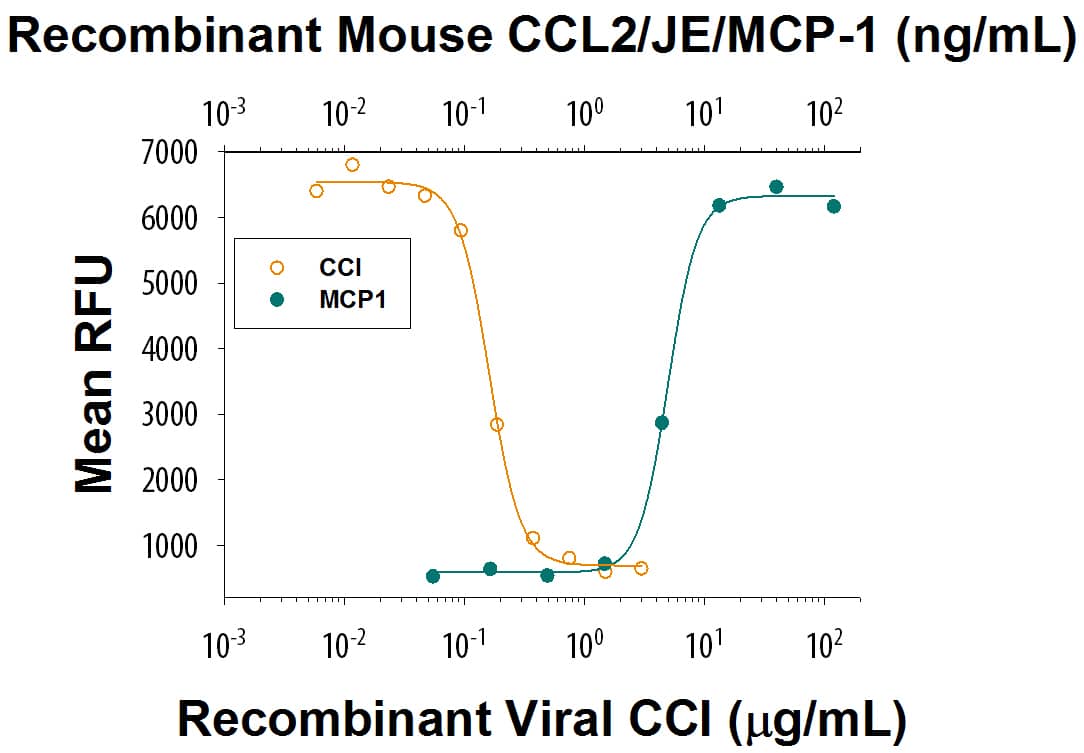
Recombinant Viral CCI Fc Chimera (CHO-expressed) Protein Bioactivity
Measured by its ability to inhibit JE-induced chemotaxis of BaF3 mouse proB cells transfected with human CCR2A. The ED50 for this effect is 0.06 -0.3 µg/mL in the presence of 20 ng/mL of Recombinant Mouse CCL2/JE/MCP-1 (Catalog # 479-JE).Formulation, Preparation and Storage
Carrier Free
What does CF mean?CF stands for Carrier Free (CF). We typically add Bovine Serum Albumin (BSA) as a carrier protein to our recombinant proteins. Adding a carrier protein enhances protein stability, increases shelf-life, and allows the recombinant protein to be stored at a more dilute concentration. The carrier free version does not contain BSA.
What formulation is right for me?In general, we advise purchasing the recombinant protein with BSA for use in cell or tissue culture, or as an ELISA standard. In contrast, the carrier free protein is recommended for applications, in which the presence of BSA could interfere.
Carrier: 7055-CC
| Formulation | Lyophilized from a 0.2 μm filtered solution in PBS with BSA as a carrier protein. |
| Reconstitution | Reconstitute at 100 μg/mL in PBS containing at least 0.1% human or bovine serum albumin. |
| Shipping | The product is shipped at ambient temperature. Upon receipt, store it immediately at the temperature recommended below. |
| Stability & Storage | Use a manual defrost freezer and avoid repeated freeze-thaw cycles.
|
Carrier Free: 7055-CC/CF
| Formulation | Lyophilized from a 0.2 μm filtered solution in PBS. |
| Reconstitution | Reconstitute at 100 μg/mL in PBS. |
| Shipping | The product is shipped at ambient temperature. Upon receipt, store it immediately at the temperature recommended below. |
| Stability & Storage | Use a manual defrost freezer and avoid repeated freeze-thaw cycles.
|
Background: CCI
CC-chemokines with high affinity and are termed viral chemokine inhibitor (vCCI). Viral CCI from various poxviruses share multiple stretches of sequence identity and eight conserved cysteine residues (1). The vaccinia virus (strain Lister) vCCI cDNA encodes a 258 amino acid (aa) protein with a putative 17 aa signal peptide (2). Vaccinia virus (strain Lister) vCCI shows greater than 90% aa sequence identity with vCCI from other orthopoxviruses and approximately 40% aa sequence identity with the leporipoxvirus T-1 proteins. vCCI binds with high affinity to many human, mouse, and rat CC-chemokines (1, 3-5). It binds to the same surfaces of these chemokines that are involved in chemokine receptor interactions (4-7). Some CC-chemokines utilize common binding surfaces on vCCI, while others interact with distinct sites on vCCI (8). vCCI inhibits CC-chemokine induced monocyte chemotaxis in vitro but does not block cellular effects induced by CXCL5/ENA-78, CXCL8/IL-8, or CXCL10/IP-10 (3-5). In vivo, vCCI restricts the infiltration of immune cells into sites of inflammation (3, 9, 10) and also the CC-chemokine induced migration of arterial vascular smooth muscle cells (11).
References
- Graham, K.A. et al. (1997) Virology 229:12.
- Patel, A.H. et al. (1990) J. Gen. Virol. 71:2013.
- Buatois, V. et al. (2010) J. Immunol. 185:2544.
- Smith, C.A. et al. (1997) Virology 236:316.
- Lalani, A.S. et al. (1998) Virology 250:173.
- Beck, C.G. et al. (2001) J. Biol. Chem. 276:43270.
- Seet, B.T. et al. (2001) Proc. Natl. Acad. Sci. 98:9008.
- Burns, J.M. et al. (2002) J. Biol. Chem. 277:2785.
- Dabbagh, K. et al. (2000) J. Immunol. 165:3418.
- Reading, P.C. et al. (2003) J. Immunol. 170:1435.
- Spinetti, G. et al. (2004) Arterioscler. Throm. Vasc. Biol. 24:1397.
Long Name
CC Chemokine Inhibitor
UniProt
Additional CCI Products
Product Documents for Recombinant Viral CCI Fc Chimera (CHO-expressed) Protein
Product Specific Notices for Recombinant Viral CCI Fc Chimera (CHO-expressed) Protein
For research use only
Loading...
Loading...
Loading...
Loading...