
Recombinant Human STING/TMEM173 His-tag Protein, CF

R&D Systems, part of Bio-Techne | Catalog # 11821-ST

Catalog #
Availability
Size / Price
Qty
Loading...
11821-ST-050

Key Product Details

Source

E. coli

Accession #

Conjugate

Unconjugated

Applications

Bioactivity

Product Specifications

Source

E. coli-derived human STING/TMEM173 protein
Leu139 - Ser379, with an N-terminal Met-His6 tag

Purity

>90%, by SDS-PAGE visualized with Silver Staining and quantitative densitometry by Coomassie® Blue Staining.

Endotoxin Level

<0.10 EU per 1 μg of the protein by the LAL method.

N-terminal Sequence Analysis

Met-His

Predicted Molecular Mass

28 kDa

SDS-PAGE

28-35 kDa, under reducing conditions.

Activity

Measured by its binding ability in a functional ELISA.

Recombinant Human STING/TMEM173 His-tag (Catalog # 11821-ST) binds Human STING/TMEM173 Antibody (Catalog # MAB7169) with an ED50 of <50.0 ng/mL.

Scientific Data Images for Recombinant Human STING/TMEM173 His-tag Protein, CF
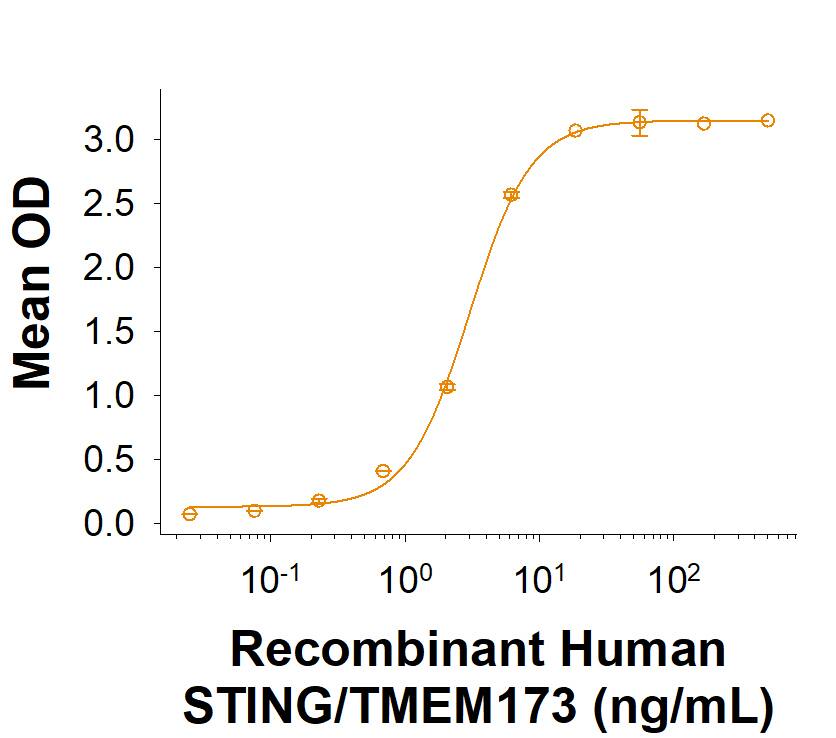
Recombinant Human STING/TMEM173 His-tag Protein Binding Activity.

Recombinant Human STING/TMEM173 His-tag Protein (Catalog # 11821-ST) binds Human STING/TMEM173 Antibody (MAB7169) with an ED50 of <50.0 ng/mL.
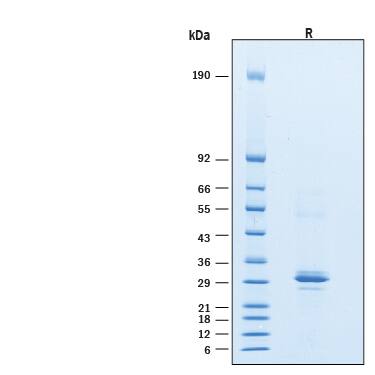
Recombinant Human STING/TMEM173 His-tag Protein SDS-PAGE.

2 μg/lane of Recombinant Human STING/TMEM173 His-tag Protein (Catalog # 11821-ST) was resolved with SDS-PAGE under reducing (R) condition and visualized by Coomassie® Blue staining, showing bands at 28-35 kDa.

Formulation, Preparation and Storage

11821-ST
Formulation Supplied as a 0.2 μm filtered solution in Tris, NaCl, DTT and Glycerol with Trehalose.
Shipping The product is shipped with dry ice or equivalent. Upon receipt, store it immediately at the temperature recommended below.
Stability & Storage Use a manual defrost freezer and avoid repeated freeze-thaw cycles.
  • 6 months from date of receipt, -20 to -70 °C as supplied.
  • 3 months, -20 to -70 °C under sterile conditions after opening.

Background: STING/TMEM173

Stimulator of interferon genes (STING) is a critical innate immune adaptor protein that mediates cellular responses to cytosolic DNA and cyclic dinucleotide signaling, playing a central role in host defense, inflammation, and immune surveillance. STING is encoded by the TMEM173 gene and is primarily localized to the endoplasmic reticulum membrane, where it functions as a key signaling hub downstream of DNA sensors such as cyclic GMP–AMP synthase (cGAS) (1). Under basal conditions, STING remains in an inactive state; however, detection of cytosolic double-stranded DNA leads to production of cyclic GMP–AMP (cGAMP), which directly binds and activates STING (2). Human STING is a ~42 kDa transmembrane protein composed of four N-terminal transmembrane helices, a cytosolic ligand-binding domain, and a C-terminal tail required for downstream signaling (3). Upon ligand binding, STING undergoes conformational changes and translocates from the endoplasmic reticulum to the Golgi apparatus, where it recruits and activates TANK-binding kinase 1 (TBK1) and interferon regulatory factor 3 (IRF3) (2, 4). This results in robust induction of type I interferons and other inflammatory cytokines, establishing an antiviral state and promoting innate and adaptive immune responses (1, 3). In addition to its canonical role in antiviral immunity, STING has broader functions in cancer biology, autophagy, and cellular stress responses. STING signaling can promote antitumor immunity by enhancing dendritic cell activation and T cell priming, but chronic or dysregulated activation may contribute to inflammatory diseases and autoimmunity (4, 5). STING has also been implicated in noncanonical processes, including regulation of apoptosis, senescence, and metabolic pathways, highlighting its role as a multifunctional signaling regulator (3, 5). Genetic and pharmacological studies have demonstrated that altered STING activity is associated with a range of human diseases, including autoinflammatory disorders such as STING-associated vasculopathy with onset in infancy (SAVI), as well as cancer and infectious diseases (2, 6). Consequently, STING has emerged as a major therapeutic target, with agonists being developed for cancer immunotherapy and vaccine adjuvants, and antagonists for treatment of autoimmune and inflammatory conditions (6, 7). Recombinant human STING is therefore an essential research reagent for studies of innate immune signaling, protein–ligand interactions, cyclic dinucleotide recognition, inflammation biology, and therapeutic discovery targeting immune modulation and host defense pathways.

References

  1. Ishikawa, H. and Barber, G.N. (2008) Nature 455:674.
  2. Chen, Q. et al. (2016) Nat. Immunol. 17:1142.
  3. Shang, G. et al. (2019) Nat. Struct. Mol. Biol. 26:103.
  4. Hopfner, K.P. and Hornung, V. (2020) Nat. Rev. Mol. Cell Biol. 21:501.
  5. Decout, A. et al. (2021) Nat. Rev. Immunol. 21:548.
  6. Liu, Y. et al. (2014) N. Engl. J. Med. 371:507.
  7. Corrales, L. and Gajewski, T.F. (2015) Immunity 42:561.

Long Name

Stimulator of Interferon Genes Protein/Transmembrane protein 173

Alternate Names

ERIS, MITA, MPYS, NET23, TMEM173

Entrez Gene IDs

340061 (Human); 72512 (Mouse)

Gene Symbol

STING1

UniProt

Additional STING/TMEM173 Products

Product Documents for Recombinant Human STING/TMEM173 His-tag Protein, CF

Certificate of Analysis

To download a Certificate of Analysis, please enter a lot number in the search box below.

Note: Certificate of Analysis not available for kit components.

Product Specific Notices for Recombinant Human STING/TMEM173 His-tag Protein, CF

For research use only

Loading...
Loading...
Loading...