
Recombinant Human IGF-II R/IGF2R Fc Chimera Protein, CF New
R&D Systems, part of Bio-Techne | Catalog # 11782-GR

Key Product Details
Source
CHO
Structure / Form
Disulfide linked homodimer
Conjugate
Unconjugated
Applications
Bioactivity
Product Specifications
Source
Chinese Hamster Ovary cell line, CHO-derived human IGF-II R/IGF2R protein
| Human IGF2R (Ser1510-Val2127) Accession # NP_000867.2 |
IEGRMD | Human IgG1 (Pro100-Lys330) |
| N-terminus | C-terminus |
Purity
>95%, by SDS-PAGE visualized with Silver Staining and quantitative densitometry by Coomassie® Blue Staining.
Endotoxin Level
<0.10 EU per 1 μg of the protein by the LAL method.
N-terminal Sequence Analysis
Ser1510
Predicted Molecular Mass
95 kDa
SDS-PAGE
100-115 kDa, under reducing conditions.
Activity
Measured by its binding ability in a functional ELISA.
Recombinant Human IGF-II R/IGF2R Fc Chimera (Catalog # 11782-GR) binds to Recombinant Human IGF-II/IGF2 (Catalog # 292-G2) with an ED50 of 7.50-90.0 ng/mL.
Recombinant Human IGF-II R/IGF2R Fc Chimera (Catalog # 11782-GR) binds to Recombinant Human IGF-II/IGF2 (Catalog # 292-G2) with an ED50 of 7.50-90.0 ng/mL.
Scientific Data Images for Recombinant Human IGF-II R/IGF2R Fc Chimera Protein, CF
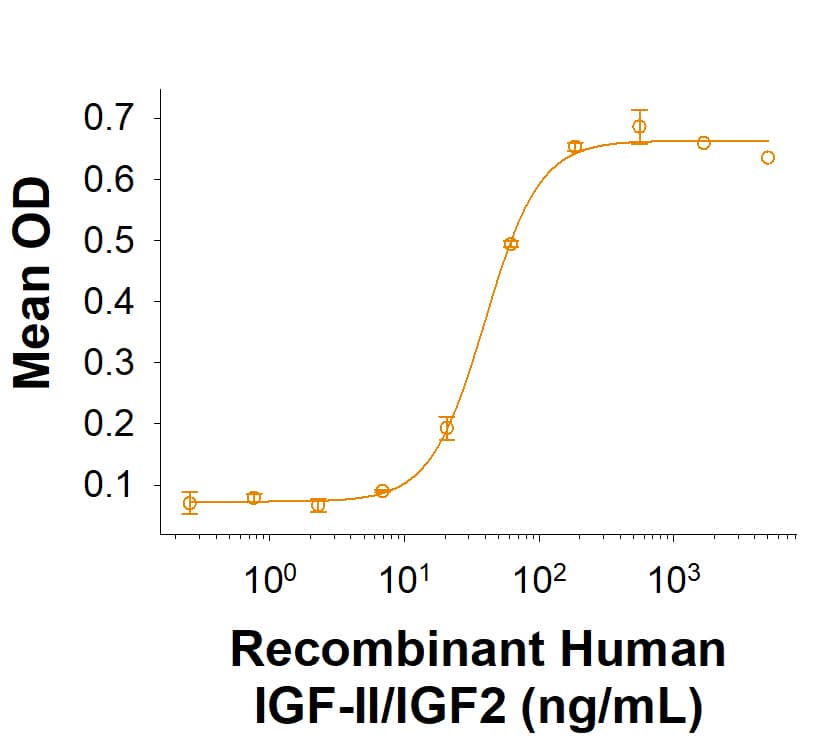
Recombinant Human IGF-II R/IGF2R Fc Chimera Protein Binding Activity.
In a functional ELISA, Recombinant Human IGF-II R/IGF2R Fc Chimera Protein (Catalog # 11782-GR) binds to Recombinant Human IGF-II/IGF2 (292-G2) with an ED50 of 7.50-90.0 ng/mL.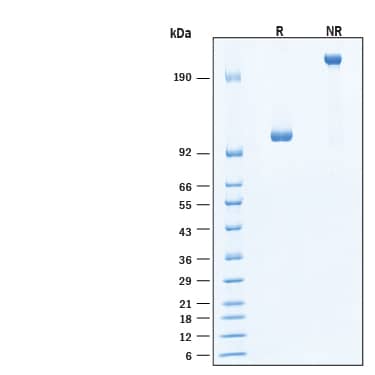
Recombinant Human IGF-II R/IGF2R Fc Chimera Protein SDS-PAGE.
2 μg/lane of Recombinant Human IGF-II R/IGF2R Fc Chimera Protein (Catalog # 11782-GR) was resolved with SDS-PAGE under reducing (R) and non-reducing (NR) conditions and visualized by Coomassie® Blue staining, showing bands at 100-115 kDa and 200-230 kDa, respectively.Formulation, Preparation and Storage
11782-GR
| Formulation | Lyophilized from a 0.2 μm filtered solution in PBS with Trehalose. |
| Reconstitution | Reconstitute at 500 μg/mL in water. |
| Shipping | The product is shipped at ambient temperature. Upon receipt, store it immediately at the temperature recommended below. |
| Stability & Storage | Use a manual defrost freezer and avoid repeated freeze-thaw cycles.
|
Background: IGF-II R/IGF2R
The type 2 insulin-like growth factor receptor (also known as cation-independent mannose-6 phosphate receptor/CI-MPR) is a 300 kDa member of the P-type lectin family of molecules. P-type lectins generate functional eukaryotic lysosomes by binding and sorting lysosomal enzymes expressing phosphorylated mannose residues (M6P) (1-3). IGF-II R is a type I transmembrane glycoprotein that contains a 2,264 amino acid (aa) extracellular region, a 23 aa transmembrane segment and a 124 aa cytoplasmic tail (4, 5). The extracellular region consists of 15 contiguous “binding” repeats of about 150 aa each. The odd-numbered repeats interact with “ligands” while the even-numbered repeats likely generate a nondisulfide homodimer in the membrane (1). Repeat #11 binds IGF-II, while repeats 3 and 9 bind mannose-6 phosphate; repeat #13 contains a fibronectin type II motif and assists in IGF-II binding (1, 2). In the extracellular region of IGF-II R expressed by R&D Systems (617 aa’s), human IGF-II R is 85% aa identical to both mouse and bovine IGF-II R. This expressed region includes binding repeats #11, 12, and 13. In addition to IGF-II, CI-MPR/IGF-II R binds non-M6P containing ligands such as retinoic acid, urokinase-type plasminogen-activator receptor and plasminogen, plus
M6P-containing molecules such as lysosomal enzymes, TGF-beta 1 precursor, proliferin, LIF, CD26, herpes simplex glycoprotein D and granzymes A and B (2, 6). IGF-II R regulates many diverse biological functions that range from intracellular trafficking to the internalization of extracellular factors and modulation of cellular responses. It delivers newly synthesized M6P-tagged lysosomal enzymes from the trans-golgi network to endosomes, and facilitates the clearance of extracellular lysosomal and matrix degrading enzymes by internalization into clathrin-coated vesicles and delivery into endosomes. With respect to IGF-II biology, it would appear that IGF-II R is principally a regulator of local IGF-II levels, targeting IGF-II for destruction in lysosomes (2). However, some evidence suggests the receptor will signal via G-proteins, an effect that has yet to be conclusively shown (6).
References
- Ghosh, P. et al. (2003) Nat. Rev. Mol. Cell. Biol. 4:202.
- Dahms, N.M. and M.K. Hancock (2002) Biochim. Biophys. Acta. 1572:317.
- Zaina, S. and J. Nilsson (2003) Curr. Opin. Lipidol. 14:483.
- Morgan, D.O. et al. (1987) Nature 329:301.
- Oshima, A. et al. (1988) J. Biol. Chem. 263:2553.
- Hawkes, C. and S. Kar (2004) Brain Res. Rev. 44:117.
Long Name
Insulin-like Growth Factor II Receptor
Alternate Names
CD222, CIMPR, IGF-IIR, IGF2R, IGFIIR, M6P-R, MPRI
Entrez Gene IDs
3482 (Human)
Gene Symbol
IGF2R
Additional IGF-II R/IGF2R Products
Product Documents for Recombinant Human IGF-II R/IGF2R Fc Chimera Protein, CF
Product Specific Notices for Recombinant Human IGF-II R/IGF2R Fc Chimera Protein, CF
For research use only
Loading...
Loading...
Loading...
Loading...