
Recombinant Human CD40/TNFRSF5 Fc Chimera Protein, CF
R&D Systems, part of Bio-Techne | Catalog # 1493-CD

Discontinued Product
1493-CD has been discontinued.
An alternative/replacement product is available:
1493-CDB. View all CD40/TNFRSF5 products.
Key Product Details
Source
NS0
Accession #
Structure / Form
Disulfide-linked homodimer
Conjugate
Unconjugated
Applications
Binding Activity
Product Specifications
Source
Mouse myeloma cell line, NS0-derived human CD40/TNFRSF5 protein
| Human CD40 (Glu21-Arg193) Accession # P25942 |
DIEGRMD | Human IgG1 (Pro100-Lys330) |
6-His tag |
| N-terminus | C-terminus | ||
Purity
>95%, by SDS-PAGE visualized with Silver Staining and quantitative densitometry by Coomassie® Blue Staining.
Endotoxin Level
<0.10 EU per 1 μg of the protein by the LAL method.
N-terminal Sequence Analysis
Glu21
Predicted Molecular Mass
46.6 kDa (monomer)
SDS-PAGE
60 kDa, reducing conditions
Activity
Measured by its binding ability in a functional ELISA.
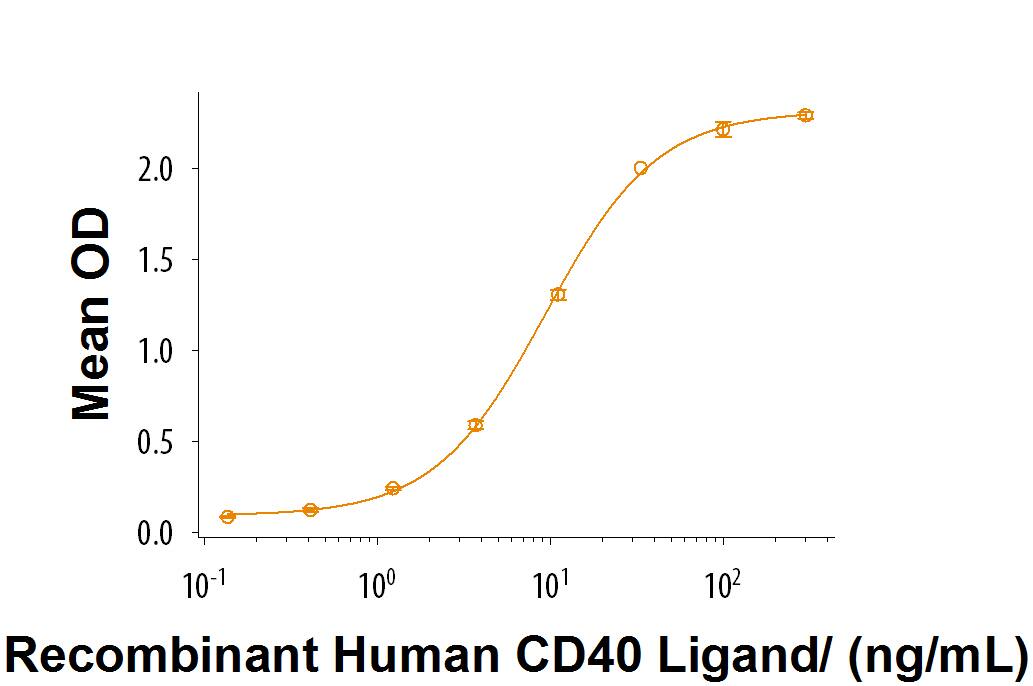
When Recombinant Human CD40/TNFRSF5 Fc Chimera is immobilized at 1 µg/mL (100 µL/well), the concentration of Recombinant Human CD40 Ligand/TNFSF5 (Catalog # 6420-CL) that produces 50% optimal binding is found to be 4-24 ng/mL.
When Recombinant Human CD40/TNFRSF5 Fc Chimera is immobilized at 1 µg/mL (100 µL/well), the concentration of Recombinant Human CD40 Ligand/TNFSF5 (Catalog # 6420-CL) that produces 50% optimal binding is found to be 4-24 ng/mL.
Scientific Data Images for Recombinant Human CD40/TNFRSF5 Fc Chimera Protein, CF
When Recombinant Human CD40/TNFRSF5 Fc Chimera (Catalog # 1493-CD) is immobilized at 1 μg/mL (100 μL/well), the concentration of Recombinant Human CD40 Ligand/TNFSF5 (Catalog # 6420-CL) that produces 50% optimal binding is found to be 4-24 ng/mL.
Formulation, Preparation and Storage
1493-CD
| Formulation | Lyophilized from a 0.2 μm filtered solution in PBS. |
| Reconstitution | Reconstitute at 100 μg/mL in sterile PBS. |
| Shipping | The product is shipped at ambient temperature. Upon receipt, store it immediately at the temperature recommended below. |
| Stability & Storage | Use a manual defrost freezer and avoid repeated freeze-thaw cycles.
|
Background: CD40/TNFRSF5
CD40, also known as TNFRSF5, is a 45-50 kDa type I transmembrane glycoprotein member of the TNF receptor superfamily (1). Mature human CD40 consists of a 173 amino acid (aa) extracellular domain, a transmembrane domain, and a 62 aa cytoplasmic domain (2). The extracellular domain of human CD40 shares 58% and 56% aa sequence identity with mouse and rat CD40, respectively. An antagonistic soluble human CD40 splice variant contains an alternate sequence within the extracellular and transmembrane domains and lacks a cytoplasmic domain (3). CD40 is expressed on the surface of B cells, dendritic cells, macrophages, monocytes and platelets, as well as endothelial and epithelial cells (4, 5). Interaction of CD40 with its ligand, CD40 Ligand, leads to the aggregation of CD40 molecules resulting in the initiation of bidirectional intracellular signaling in both CD40 and CD40 Ligand expressing cells (6). CD40 ligation by CD40 Ligand promotes B cell activation and T cell-dependent humoral responses (7, 8). CD40 serves multiple functions in both hematopoietic and epithelial cancers and is a target for tumor immunotherapy (9, 10). Dysregulation of CD40/CD40 Ligand expression and interactions contributes to the immune deficiency associated with HIV infection and AIDS (11, 12). It is also implicated in the pathology of multiple cardiovascular diseases including atherosclerosis, atherothrombosis, and restenosis (13, 14).
References
- Banchereau, J. et al. (1994) Annu. Rev. Immunol. 12:881.
- Stamenkovic, I. et al. (1989) EMBO J. 8:1403.
- Eshel, D. et al. (2008) Mol. Immunol. 46:250.
- van Kooten, C. and J. Banchereau (1997) Curr. Opin. Immunol. 9:330.
- Schonbeck, U. et al. (1997) J. Biol. Chem. 272:19569.
- Eissner, G. et al. (2004) Cytokine Growth Factor Rev. 15:353.
- Rickert, R.C. et al. (2011) Immunol. Rev. 244:115.
- Elgueta, R. et al. (2009) Immunol. Rev. 229:152.
- Loskog, A.S. and A.G. Eliopoulos (2009) Semin. Immunol. 21:301.
- Hangalapura, B.N. et al. (2012) J. Gene Med. 14:416.
- Kornbluth, R.S. (2000) J. Leukoc. Biol. 68:373.
- Chougnet, C. (2003) J. Leukoc. Biol. 74:702.
- Pamukcu, B. et al. (2011) Ann. Med. 43:331.
- Hassan, G.S. et al. (2012) Immunobiology 217:521.
Alternate Names
CD40, TNFRSF5
Gene Symbol
CD40
UniProt
Additional CD40/TNFRSF5 Products
Product Documents for Recombinant Human CD40/TNFRSF5 Fc Chimera Protein, CF
Product Specific Notices for Recombinant Human CD40/TNFRSF5 Fc Chimera Protein, CF
For research use only
Loading...
Loading...
Loading...
Loading...