
Human SPARC PE-conjugated Antibody
R&D Systems, part of Bio-Techne | Catalog # IC941P

Conjugate
Catalog #
Key Product Details
Species Reactivity
Human
Applications
Intracellular Staining by Flow Cytometry
Label
Phycoerythrin (Excitation = 488 nm, Emission = 565-605 nm)
Antibody Source
Monoclonal Mouse IgG1 Clone # 122511
Product Specifications
Immunogen
Mouse myeloma cell line NS0-derived recombinant human SPARC
Ala18-Ile303
Accession # P09486
Ala18-Ile303
Accession # P09486
Specificity
Detects human SPARC/Osteonectin in direct ELISAs and Western blots. In direct ELISAs and Western blots, no cross-reactivity with recombinant mouse SPARC/Osteonectin is observed.
Clonality
Monoclonal
Host
Mouse
Isotype
IgG1
Scientific Data Images for Human SPARC PE-conjugated Antibody
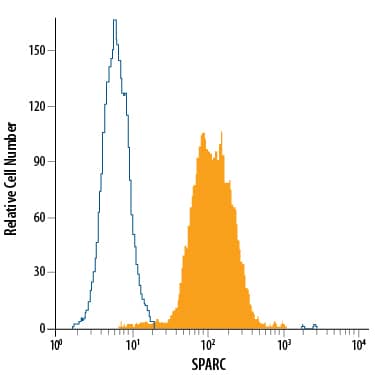
Detection of SPARC in HT1080 Human Cell Line by Flow Cytometry.
HT1080 human fibrosarcoma cell line was stained with Mouse Anti-Human SPARC PE-conjugated Monoclonal Antibody (Catalog # IC941P, filled histogram) or isotype control antibody (IC002P, open histogram). To facilitate intracellular staining, cells were fixed with Flow Cytometry Fixation Buffer (FC004) and permeabilized with Flow Cytometry Permeabilization/Wash Buffer I (FC005). View our protocol for Staining Intracellular Molecules.Applications for Human SPARC PE-conjugated Antibody
Formulation, Preparation, and Storage
Purification
Protein A or G purified from hybridoma culture supernatant
Formulation
Supplied in a saline solution containing BSA and Sodium Azide.
Shipping
The product is shipped with polar packs. Upon receipt, store it immediately at the temperature recommended below.
Stability & Storage
Protect from light. Do not freeze.
- 12 months from date of receipt, 2 to 8 °C as supplied.
Background: SPARC
SPARC, an acronym for “secreted protein, acidic and rich in cysteine”, is also known as osteonectin or BM-40 (1-5). It is the founding member of a family of secreted matricellular proteins with similar domain structure. The 286 amino acid (aa), 43 kDa protein contains an N-terminal acidic region that binds calcium, a follistatin domain that contains Kazal-like sequences, and a C-terminal extracellular calcium (EC) binding domain with two EF-hand motifs (1-5). Crystal structure modeling shows that residues implicated in cell binding, inhibition of cell spreading, and disassembly of focal adhesions cluster on one face of SPARC, while a collagen binding epitope and an N-glycosylation site are opposite this face (6). SPARC is produced by fibroblasts, capillary endothelial cells, platelets and macrophages, especially in areas of tissue morphogenesis and remodeling (3, 7). SPARC shows context-specific effects, but generally inhibits adhesion, spreading and proliferation, and promotes collagen matrix formation (3-5). For endothelial cells, SPARC disrupts focal adhesions and binds and sequesters PDGF and VEGF (3-5). SPARC is abundantly expressed in bone, where it promotes osteoblast differentiation and inhibits adipogenesis (5, 8). SPARC is potentially cleaved by metalloproteinases, producing an angiogenic peptide that includes the copper-binding sequence KGHK (7). Paradoxically, SPARC is highly expressed in many tumor types undergoing an endothelial to mesenchymal transition; its expression, however, mainly decreases the likelihood of metastasis and confers sensitivity to chemotherapy and radiation (4, 9-11). Stabilin-1, which is expressed on alternately activated macrophages, is the first SPARC receptor to be identified. It binds the SPARC EC domain and mediates endocytosis for degradation (12). Mature human SPARC shows 92%, 92%, 97%, 99%, 96% and 85% aa identity with mouse, rat, canine, bovine, porcine and chick SPARC, respectively.
References
- Lankat-Buttgereit, B. et al. (1988) FEBS Lett. 236:352.
- Sweetwyne, M. T. et al. (2004) J. Histochem. Cytochem. 52:723.
- Sage, H. et al. (1989) J. Cell Biol. 109:341.
- Framson, P. E. and E. H. Sage (2004) J. Cell. Biochem. 92:679.
- Alford, A. I. and K. D. Hankenson (2006) Bone 38:749.
- Hohenester, E et al. (1997) EMBO J. 16:3778.
- Sage, E. H. et al. (2003) J. Biol. Chem. 278:37849.
- Delany, A. M. et al. (2003) Endocrinology 144:2588.
- Robert, G. et al. (2006) Cancer Res. 66:7516.
- Koblinski, J. E. et al. (2005) Cancer Res. 65:7370.
- Tai, I. T. et al. (2005) J. Clin. Invest. 115:1492.
- Kzhyshkowska, J. et al. (2006) J. Immunol. 176:5825.
Long Name
Secreted Protein Acidic and Rich in Cysteine
Alternate Names
BM-40, Osteonectin
Gene Symbol
SPARC
UniProt
Additional SPARC Products
Product Documents for Human SPARC PE-conjugated Antibody
Product Specific Notices for Human SPARC PE-conjugated Antibody
For research use only
Loading...
Loading...
Loading...
Loading...
Loading...
Loading...