
Mouse VEGFR3/Flt-4 Antibody Best Seller
R&D Systems, part of Bio-Techne | Catalog # AF743

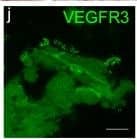

Scientific images may be resized, cropped, or adjusted for brightness or contrast for presentation purposes. These updates are limited to presentation and do not affect the underlying scientific interpretation of the data. Where available, additional source data may be provided upon request.
Conjugate
Catalog #
Key Product Details
Validated by
Biological Validation
Species Reactivity
Validated:
Mouse
Cited:
Human, Mouse, Rat, Equine, Primate - Macaca fascicularis (Crab-eating Monkey or Cynomolgus Macaque), Transgenic Mouse
Applications
Validated:
Western Blot, Flow Cytometry, CyTOF-ready
Cited:
Immunohistochemistry, Immunohistochemistry-Paraffin, Immunohistochemistry-Frozen, Western Blot, Neutralization, Flow Cytometry, Immunocytochemistry, Immunoprecipitation, ELISA Development
Label
Unconjugated
Antibody Source
Polyclonal Goat IgG
Product Specifications
Immunogen
S. frugiperda insect ovarian cell line Sf 21-derived recombinant mouse VEGFR3/Flt-4
Tyr25-Asp770
Accession # P35917
Tyr25-Asp770
Accession # P35917
Specificity
Detects mouse VEGFR3/Flt-4 in direct ELISAs and Western blots. In direct ELISAs, approximately 30% cross-reactivity with recombinant human (rh) VEGFR3 is observed and less than 5% cross-reactivity with recombinant mouse VEGFR2 is observed.
Clonality
Polyclonal
Host
Goat
Isotype
IgG
Scientific Data Images for Mouse VEGFR3/Flt-4 Antibody
Detection of VEGFR3/Flt‑4 in bEnd.3 Mouse Cell Line by Flow Cytometry.
bEnd.3 cells, a mouse endothelioma cell line, was stained with Goat Anti-Mouse VEGFR3/Flt-4 Antigen Affinity-purified Polyclonal Antibody (Catalog # AF743, filled histogram) or isotype control antibody (Catalog # AB-108-C, open histogram), followed by PE-conjugated Anti-Goat IgG Secondary Antibody (Catalog # F0107).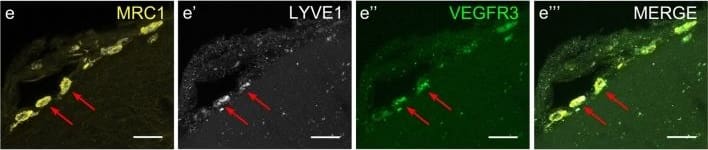
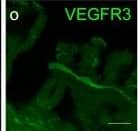
Detection of Mouse VEGFR3/Flt-4 by Immunocytochemistry/Immunofluorescence
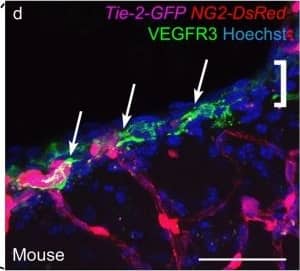
Cells with BLEC molecular markers are present within the mouse leptomeninges. a Coronal brain section of adult zebrafish brain indicating the imaging area in the dorsal optic tectum (TeO). b A 14 month old Tg(kdr-l:mCherry); Tg(flt4:mCitrine) double transgenic zebrafish has cells in the meninges (white bracket) that express flt4/vegfr3 ( alpha-GFP, green) near kdr-l positive ( alpha-RFP, red) blood vessels. DAPI (blue) labels the nuclei. Scale = 50 µm. c Coronal mouse brain section showing the imaging areas of the meninges. d As revealed by IHC, 17-week-old mouse brains express VEGFR3 (green) in the meninges (white bracket). Tie2-GFP;NG2-DsRed double reporter mice were used to distinguish arteries and veins. NG2 (red) labels pericytes and smooth muscle cells, Tie2 (magenta) labels vascular endothelial cells, and Hoechst (blue) stains nuclei. The image is rotated with the parenchyma at the bottom for ease of comparison with panel b. Scale = 50 µm. e-e′′′ As revealed by IHC, cells of the meninges co-express MRC1 (e, yellow), LYVE1 (e′, white), and VEGFR3 (e′′, green). Red arrows highlight cells expressing these three markers. The images are rotated with the parenchyma at the bottom. scale = 30 µm. f, g Quantification of the relative numbers of single and double-labelled cells in 2-month old mouse meninges. VEGFR3 and LYVE1 cell counts were from n = 2 brains, 3 coronal sections (10 area images)/brain. MRC1 and LYVE1 cell counts were from n = 3 brains, 3 coronal sections (4 area images)/brain. The mean values for each set are depicted Image collected and cropped by CiteAb from the following publication (https://pubmed.ncbi.nlm.nih.gov/31696318), licensed under a CC-BY license. Not internally tested by R&D Systems.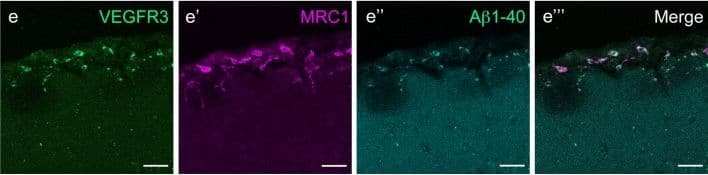
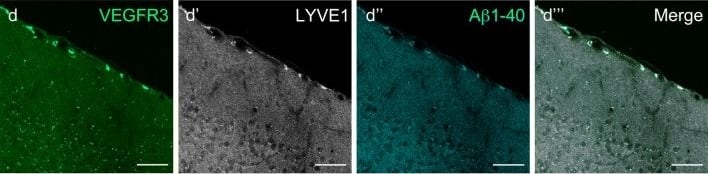
Detection of Mouse VEGFR3/Flt-4 by Immunocytochemistry/Immunofluorescence
Mouse LLECs take up A beta 1-40. a Schematic showing the site of dye and A beta1-40 perfusion into the CSF via the cisterna magna (arrow) of a 2-month old mouse. The dotted line indicates the plane of section. A anterior, P posterior, D dorsal, V ventral. b Coronal brain section indicating the areas imaged. SF4 refers to area captured in Figure S4. c The percentage of each labelled cell type that internalized perfused A beta. Cells co-expressing VEGFR3 and LYVE1 take up A beta at a higher rate than MRC1, LYVE1 double-positive cells as well as MRC1-positive, LYVE1-negative cells (p ≤ 0.05, bootstrap). VEGFR3, LYVE1 counts, n = 2 brains (3 sections/brain). MRC1, LYVE1 counts, n = 3 brains (3 sections/brain). d–d′′′ Cells of the adult mouse meninges that co-express VEGFR3 (d, green) and LYVE1 (d′, white) internalize A beta1-40 (d′′, cyan). Scale = 20 µm. e-e′′′) Cells of the adult mouse meninges that co-express VEGFR3 (e, green) and MRC1 (e′, white) internalize A beta1-40 (e′′, cyan). Scale = 40 µm. f–f′′′) Cells of the adult mouse meninges that co-express MRC1 (f, magenta) and LYVE1 (f′, white) internalize A beta1-40 (f′′, cyan). The walls of a blood vessel (white arrowhead, f′′) also accumulate A beta1-40. Scale = 60 µm Image collected and cropped by CiteAb from the following publication (https://pubmed.ncbi.nlm.nih.gov/31696318), licensed under a CC-BY license. Not internally tested by R&D Systems.
Applications for Mouse VEGFR3/Flt-4 Antibody
Application
Recommended Usage
CyTOF-ready
Ready to be labeled using established conjugation methods. No BSA or other carrier proteins that could interfere with conjugation.
Flow Cytometry
0.25 µg/106 cells
Sample: bEnd.3 mouse endothelioma cell line
Sample: bEnd.3 mouse endothelioma cell line
Western Blot
0.1 µg/mL
Sample: Recombinant Mouse VEGFR3/Flt‑4 Fc Chimera (Catalog # 743-R3)
Sample: Recombinant Mouse VEGFR3/Flt‑4 Fc Chimera (Catalog # 743-R3)
Reviewed Applications
Read 8 reviews rated 4.4 using AF743 in the following applications:
Formulation, Preparation, and Storage
Purification
Antigen Affinity-purified
Reconstitution
Reconstitute at 0.2 mg/mL in sterile PBS. For liquid material, refer to CoA for concentration.
Formulation
Lyophilized from a 0.2 μm filtered solution in PBS with Trehalose. *Small pack size (SP) is supplied either lyophilized or as a 0.2 µm filtered solution in PBS.
Shipping
Lyophilized product is shipped at ambient temperature. Liquid small pack size (-SP) is shipped with polar packs. Upon receipt, store immediately at the temperature recommended below.
Stability & Storage
Use a manual defrost freezer and avoid repeated freeze-thaw cycles.
- 12 months from date of receipt, -20 to -70 °C as supplied.
- 1 month, 2 to 8 °C under sterile conditions after reconstitution.
- 6 months, -20 to -70 °C under sterile conditions after reconstitution.
Background: VEGFR3/Flt-4
VEGFR3 (Flt-4), together with VEGFR1 (Flt-1) and VEGFR2 (KDR/Flk-1), belong to the class III subfamily of receptor tyrosine kinases (RTKs). All three receptors contain seven immunoglobulin-like repeats in their extracellular domains and kinase insert domains in their intracellular regions. The expression of these receptors is almost exclusively restricted to the endothelial cells. These receptors are likely to play essential roles in vasculogenesis and angiogenesis.
In adults, VEGFR3 expression is restricted to the endothelial cells of the lymphatic vessels. Mouse VEGFR3 cDNA encodes a 1363 amino acid (aa) residue precursor protein with a 24 aa residue signal peptide. Mature VEGFR3 has a 751 aa residue extracellular domain, a 22 aa residue hydrophobic transmembrane domain and a 565 aa residue cytoplasmic domain. The polypeptide sequences of murine Flt-4 is 88% identical to the human homologue. VEGFR3 has been reported to serve as the receptors for VEGF-C and VEGF-D.
References
- Finnerty, H. et al. (1993) Oncogene 8:2293.
- Joukov, V. et al. (1996) EMBO J. 15:290.
- Achen, M. et al. (1998) Proc. Natl. Acad. Sci. USA 95:548.
Long Name
Vascular Endothelial Growth Factor Receptor 3
Alternate Names
Flt-4, FLT4, VEGF R3
Gene Symbol
FLT4
UniProt
Additional VEGFR3/Flt-4 Products
Product Documents for Mouse VEGFR3/Flt-4 Antibody
Product Specific Notices for Mouse VEGFR3/Flt-4 Antibody
For research use only
Loading...
Loading...
Loading...
Loading...
Loading...
Loading...