
Mouse TLR2 Antibody
R&D Systems, part of Bio-Techne | Catalog # AF1530

Conjugate
Catalog #
Key Product Details
Species Reactivity
Validated:
Mouse
Cited:
Mouse, Transgenic Mouse
Applications
Validated:
Western Blot
Cited:
Immunohistochemistry-Paraffin, Western Blot, Electron Microscopy
Label
Unconjugated
Antibody Source
Polyclonal Goat IgG
Product Specifications
Immunogen
Mouse myeloma cell line NS0-derived recombinant mouse TLR2
Gln25-Leu590
Accession # Q9QUN7
Gln25-Leu590
Accession # Q9QUN7
Specificity
Detects mouse TLR2 in direct ELISAs and Western blots. In these formats, approximately 10% cross-reactivity with recombinant human (rh) TLR2 is observed and less than 2% cross-reactivity with recombinant mouse (rm) TLR1, rhTLR3, rmTLR4, and rmTLR6 is observed.
Clonality
Polyclonal
Host
Goat
Isotype
IgG
Scientific Data Images for Mouse TLR2 Antibody
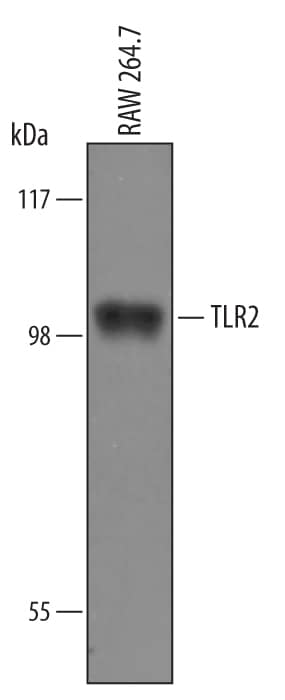
Detection of Mouse TLR2 by Western Blot.
Western blot shows lysates of RAW 264.7 mouse monocyte/macrophage cell line. PVDF Membrane was probed with 1 µg/mL of Goat Anti-Mouse TLR2 Antigen Affinity-purified Polyclonal Antibody (Catalog # AF1530) followed by HRP-conjugated Anti-Goat IgG Secondary Antibody (Catalog # HAF019). A specific band was detected for TLR2 at approximately 100 kDa (as indicated). This experiment was conducted under reducing conditions and using Immunoblot Buffer Group 1.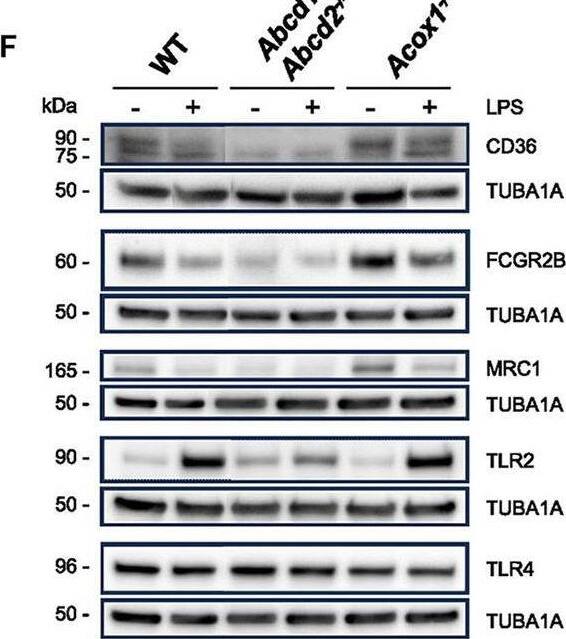
Detection of Mouse TLR2 by Western Blot
Impact of peroxisomal defect on the expression of phagocytosis-related genes in WT and mutant (Abcd1−/−Abcd2−/− and Acox1−/−) BV-2 cells. (A) Schematic representation of the main actors of phagocytosis. (B) Venn diagrams illustrating the up- and downregulated phagocytosis-related DEGs in Abcd1−/−Abcd2−/− and Acox1−/− non-stimulated BV-2 cells (DataSet GSE200022). Genes whose expression level was measured at the protein level are boxed. (C) Pie chart displaying the number of up- or downregulated phagocytosis-related DEGs after a 24-h LPS treatment (Log2FC > 1, AdjP Value < 0.05) in WT, Abcd1−/−Abcd2−/−, and Acox1−/− BV-2 cells (DataSet GSE237635). (D) Venn diagrams representing the LPS response of these DEGs (three independent batches of BV-2 cells for each genotype). (E) Heat map representing RNA-Seq gene expression of these DEGs at 24 h after LPS stimulation in WT, Abcd1−/−Abcd2−/−, and Acox1−/− BV-2 cells. (F) Representative image of Western blotting analysis (three independent experiments) of the expression levels of CD36, FCGR2B, MRC1, TLR2, and TLR4 in WT, Abcd1−/−Abcd2−/−, and Acox1−/− BV-2 cells untreated (–) or treated with LPS for 24 h (+). Expected molecular weights are indicated. Source data are available online for this figure. Image collected and cropped by CiteAb from the following open publication (https://www.frontiersin.org/articles/10.3389/fnmol.2023.1299314/full), licensed under a CC-BY license. Not internally tested by R&D Systems.Applications for Mouse TLR2 Antibody
Application
Recommended Usage
Western Blot
1 µg/mL
Sample: RAW 264.7 mouse monocyte/macrophage cell line
Sample: RAW 264.7 mouse monocyte/macrophage cell line
Reviewed Applications
Read 2 reviews rated 4 using AF1530 in the following applications:
Formulation, Preparation, and Storage
Purification
Antigen Affinity-purified
Reconstitution
Reconstitute at 0.2 mg/mL in sterile PBS. For liquid material, refer to CoA for concentration.
Formulation
Lyophilized from a 0.2 μm filtered solution in PBS with Trehalose. *Small pack size (SP) is supplied either lyophilized or as a 0.2 µm filtered solution in PBS.
Shipping
Lyophilized product is shipped at ambient temperature. Liquid small pack size (-SP) is shipped with polar packs. Upon receipt, store immediately at the temperature recommended below.
Stability & Storage
Use a manual defrost freezer and avoid repeated freeze-thaw cycles.
- 12 months from date of receipt, -20 to -70 °C as supplied.
- 1 month, 2 to 8 °C under sterile conditions after reconstitution.
- 6 months, -20 to -70 °C under sterile conditions after reconstitution.
Background: TLR2
The Toll-like family of molecules are a group of integral membrane proteins that serve as pattern recognition receptors for microbial pathogens (1‑4). To date, there are at least eleven mouse and ten human members that activate the innate immune system following exposure to a variety of microbial species (1, 3). All Toll-like receptors (TLRs) are type I transmembrane (TM) proteins that exist either in the plasma membrane or in the membranes of endosomal structures (where they bind intracellular nucleic acids) (3). All TLRs also contain a large number of extracellular leucine-rich repeats (LRRs) and a cytoplasmic tail with a Toll/IL-1 receptor (TIR) domain. Mouse Toll-like receptor-2 (TLR2) is a 97 kDa, 760 amino acid (aa) glycoprotein that contains a 563 aa extracellular region, a 21 aa TM segment, and a 176 aa cytoplasmic domain (5, 6). The extracellular region contains 16 leucine-rich repeats, while the cytoplasmic tail shows one 146 aa TIR domain. The receptor is expressed on a number of cell types including T cells ( alpha beta and gamma delta), monocytes, dendritic cells, neutrophils, B cells, endothelial cells, mast cells, NK cells, macrophages and hepatocytes (1, 4, 5, 7, 8). TLR2 functions as part of a heterodimeric complex with either TLR1 or TLR6 (1, 3, 4). These complexes recognize lipoproteins and glycolipids from gram-positive and gram-negative bacteria as well as mycoplasma and yeast. TLR2/TLR1 heterodimers recognize triacylated lipopeptides from a variety of microorganisms. The TLR2/TLR6 heterodimer preferentially recognizes diacylated lipopeptides (9). Biglycan is also known to activate TLR2, but the context is unclear (8). Notably, in human, TLR2 also dimerizes with TLR10. But the TLR10 gene in mouse (but not rat) is mutationally inactive, and thus this complex is nonfunctional (10). Upon ligand recognition, TLR2 delivers an activating signal via the associated adapter molecules, MyD88 and TIRAP (1, 11). Activation via TLR2 also results in production of a number of pro-inflammatory cytokines including TNF-alpha, IL-2, IL-6, IL-12, and MIP-2 (1, 3). The extracellular region of mouse TLR2 is 89%, 67%, 81%, and 65% aa identical to the equivalent region in rat, human, hamster and canine, respectively.
References
- Wetzler, L. (2003) Vaccine 21:S2/55.
- Netea, M. et al. (2004) J. Leukoc. Biol. 75:749.
- Dunne, A. and L. O’Neill (2005) FEBS. Lett. 579:3330.
- Hopkins, P.A. and S. Sriskandan (2005) Clin. Exp. Immunol. 140:395.
- Matsuguchi, T. et al. (2000) Blood 95:1378.
- Meng, G. et al. (2005) Immunol. Lett. 98:200.
- Flo T. et al. (2001) J. Leukoc. Biol. 69:474.
- Schaefer, L. et al. (2005) J. Clin. Invest. 115:2223.
- Akira S. (2003) Curr. Opin. Immunol. 15:5.
- Hasan, U. et al. (2005) J. Immunol. 174:2942.
- Yamamoto M. et al. (2002) Nature 420:324.
Long Name
Toll-like Receptor 2
Alternate Names
CD282
Gene Symbol
TLR2
UniProt
Additional TLR2 Products
Product Documents for Mouse TLR2 Antibody
Product Specific Notices for Mouse TLR2 Antibody
For research use only
Loading...
Loading...
Loading...
Loading...
Loading...