
Mouse/Rat Neurocan Antibody
R&D Systems, part of Bio-Techne | Catalog # AF5800

Conjugate
Catalog #
Key Product Details
Species Reactivity
Validated:
Mouse, Rat
Cited:
Human, Mouse, Transgenic Mouse
Applications
Validated:
Immunohistochemistry, Western Blot
Cited:
Immunohistochemistry, Immunohistochemistry-Paraffin, Immunohistochemistry-Frozen, Western Blot, Immunocytochemistry, ELISA Development, Immunogold Electron Microscopy
Label
Unconjugated
Antibody Source
Polyclonal Sheep IgG
Product Specifications
Immunogen
Chinese hamster ovary cell line CHO-derived recombinant mouse Neurocan
Asp23-Asp637
Accession # NP_031815
Asp23-Asp637
Accession # NP_031815
Specificity
Detects mouse and rat Neurocan in direct ELISAs and Western blots.
Clonality
Polyclonal
Host
Sheep
Isotype
IgG
Scientific Data Images for Mouse/Rat Neurocan Antibody
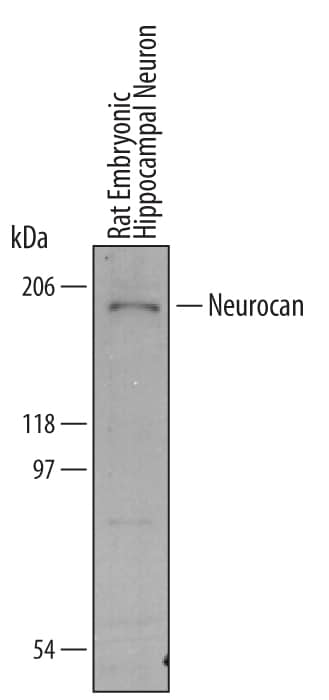
Detection of Mouse/Rat Neurocan by Western Blot.
Western blot shows lysates of rat embryonic hippocampal neurons. PVDF membrane was probed with 1 µg/mL of Mouse/Rat Neurocan Antigen Affinity-purified Polyclonal Antibody (Catalog # AF5800) followed by HRP-conjugated Anti-Sheep IgG Secondary Antibody (Catalog # HAF016). A specific band was detected for Neurocan at approximately 200 kDa (as indicated). This experiment was conducted under reducing conditions and using Immunoblot Buffer Group 8.
Neurocan in Mouse Brain.
Neurocan was detected in perfusion fixed frozen sections of mouse brain (medulla) using Mouse/Rat Neurocan Antigen Affinity-purified Polyclonal Antibody (Catalog # AF5800) at 15 µg/mL overnight at 4 °C. Tissue was stained using the Anti-Sheep HRP-DAB Cell & Tissue Staining Kit (brown; Catalog # CTS019) and counterstained with hematoxylin (blue). View our protocol for Chromogenic IHC Staining of Frozen Tissue Sections.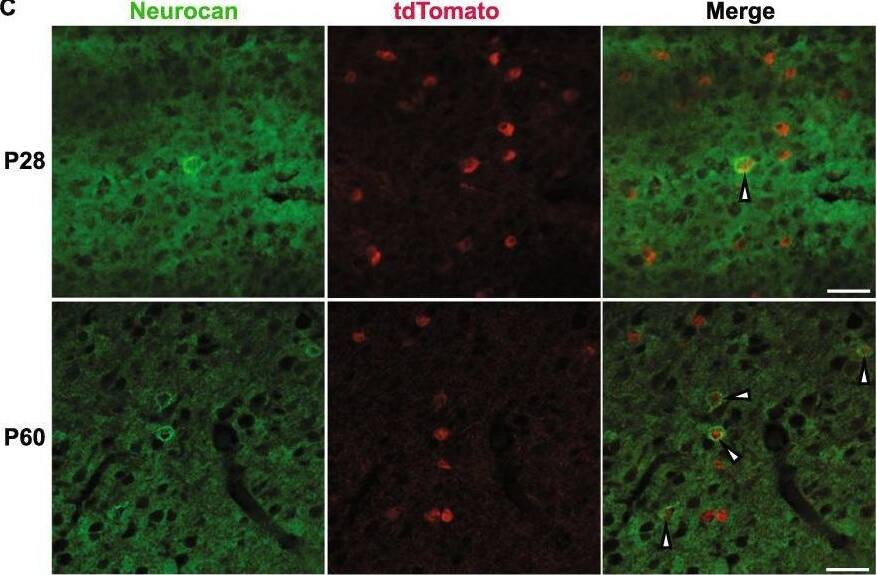
Detection of Neurocan by Immunohistochemistry
Expression of neurocan and NCAM in postnatal and adult brain. (A) Immunoblot of total brain extracts for neurocan, NCAM, PSA-NCAM, and GAPDH (loading control). (B) Co-localization of tdTomato puncta (red) with the presynaptic marker GAD65 (green) around a neuronal soma (blue). Scale bar = 5 μm. (C) Immunofluorescent staining of neurocan (green) around PV+ tdTomato-labeled interneurons (red) in mouse frontal cortex at P28 and P60. Scale bar = 50 μm. (D) Confocal images of neurocan (green) around perisomatic synaptic puncta (red) onto MATH-2 expressing pyramidal neurons (blue nucleus, outlined with white border). A magnified inset is indicated with a white box. Scale bars = 2.5 μm. (E) Electron micrograph of immunogold labeling for neurocan along the membrane of a neuronal soma (black arrows point to examples). Scale bar = 1 μm. (F) Electron micrograph of an inhibitory axon terminal onto a neuronal soma. Neurocan immunogold labeling is indicated with black arrows, and the axon terminal (AT) is labeled with a white arrowhead. Cytoplasm and nucleus of the soma are identified with text. Scale bar = 1 μm. (G) Verification of neurocan antibody specificity by immunostaining of COS7 cells transfected with Neurocan-AP (+control) or AP (−control), and a no primary antibody control. Scale bar = 50 μm.(H) Immunofluorescent localization of NCAM and neurocan in GABA+ and GABA− cortical neuron cultures. Confocal images of GABA (green), NCAM (blue), and neurocan (red) in cortical neuron cultures. White arrow indicates a GABA-negative neuron positive for NCAM and neurocan, and the green neuron represents a GABAergic interneuron. Scale bar = 10 μm. Image collected and cropped by CiteAb from the following open publication (https://pubmed.ncbi.nlm.nih.gov/29670169), licensed under a CC-BY license. Not internally tested by R&D Systems.Applications for Mouse/Rat Neurocan Antibody
Application
Recommended Usage
Immunohistochemistry
5-15 µg/mL
Sample: Perfusion fixed frozen sections of mouse brain (medulla)
Sample: Perfusion fixed frozen sections of mouse brain (medulla)
Western Blot
1 µg/mL
Sample: Rat embryonic hippocampal neurons
Sample: Rat embryonic hippocampal neurons
Formulation, Preparation, and Storage
Purification
Antigen Affinity-purified
Reconstitution
Reconstitute at 0.2 mg/mL in sterile PBS. For liquid material, refer to CoA for concentration.
Formulation
Lyophilized from a 0.2 μm filtered solution in PBS with Trehalose. *Small pack size (SP) is supplied either lyophilized or as a 0.2 µm filtered solution in PBS.
Shipping
Lyophilized product is shipped at ambient temperature. Liquid small pack size (-SP) is shipped with polar packs. Upon receipt, store immediately at the temperature recommended below.
Stability & Storage
Use a manual defrost freezer and avoid repeated freeze-thaw cycles.
- 12 months from date of receipt, -20 to -70 °C as supplied.
- 1 month, 2 to 8 °C under sterile conditions after reconstitution.
- 6 months, -20 to -70 °C under sterile conditions after reconstitution.
Background: Neurocan
References
- Inatani, M. et al. (1999) Invest. Ophthalmol. Vis. Sci. 40:2350.
- Friedlander, D.R. et al. (1994) J. Cell Biol. 125:669.
- Retzler, C. et al. (1996) J. Biol. Chem. 271:27304.
- Quaglia, X. et al. (2008) Brain 131:240.
Alternate Names
CSPG3, NCAN, NEUR
Gene Symbol
NCAN
UniProt
Additional Neurocan Products
Product Documents for Mouse/Rat Neurocan Antibody
Product Specific Notices for Mouse/Rat Neurocan Antibody
For research use only
Loading...
Loading...
Loading...
Loading...
Loading...