
Mouse G-CSF Antibody
R&D Systems, part of Bio-Techne | Catalog # MAB414


Conjugate
Catalog #
Key Product Details
Species Reactivity
Validated:
Mouse
Cited:
Mouse, Transgenic Mouse
Applications
Validated:
Western Blot, ELISA Capture (Matched Antibody Pair), Neutralization
Cited:
Immunohistochemistry, Neutralization, Flow Cytometry, ELISA Capture, ELISA Development, ELISA Development (Capture), In vivo assay, Luminex Development
Label
Unconjugated
Antibody Source
Monoclonal Rat IgG1 Clone # 67604
Product Specifications
Immunogen
E. coli-derived recombinant mouse G-CSF
Val31-Ala208
Accession # P09920
Val31-Ala208
Accession # P09920
Specificity
Detects mouse G-CSF in ELISAs and Western blots. In ELISAs, does not cross-react with recombinant human (rh) G‑CSF, rhCNTF, rmIL-6, rmLIF, or rmOSM.
Clonality
Monoclonal
Host
Rat
Isotype
IgG1
Endotoxin Level
<0.10 EU per 1 μg of the antibody by the LAL method.
Scientific Data Images for Mouse G-CSF Antibody
Cell Proliferation Induced by G-CSF and Neutralization by Mouse G-CSF Antibody.
Recombinant Mouse G-CSF (Catalog # 414-CS) stimulates proliferation in the NFS-60 mouse myeloid cells line in a dose-dependent manner (orange line). Proliferation elicited by Recombinant Mouse G-CSF (125 pg/mL) is neutralized (green line) by increasing concentrations of Mouse G-CSF Monoclonal Antibody (Catalog # MAB414). The ND50 is typically 0.01-0.03 µg/mL.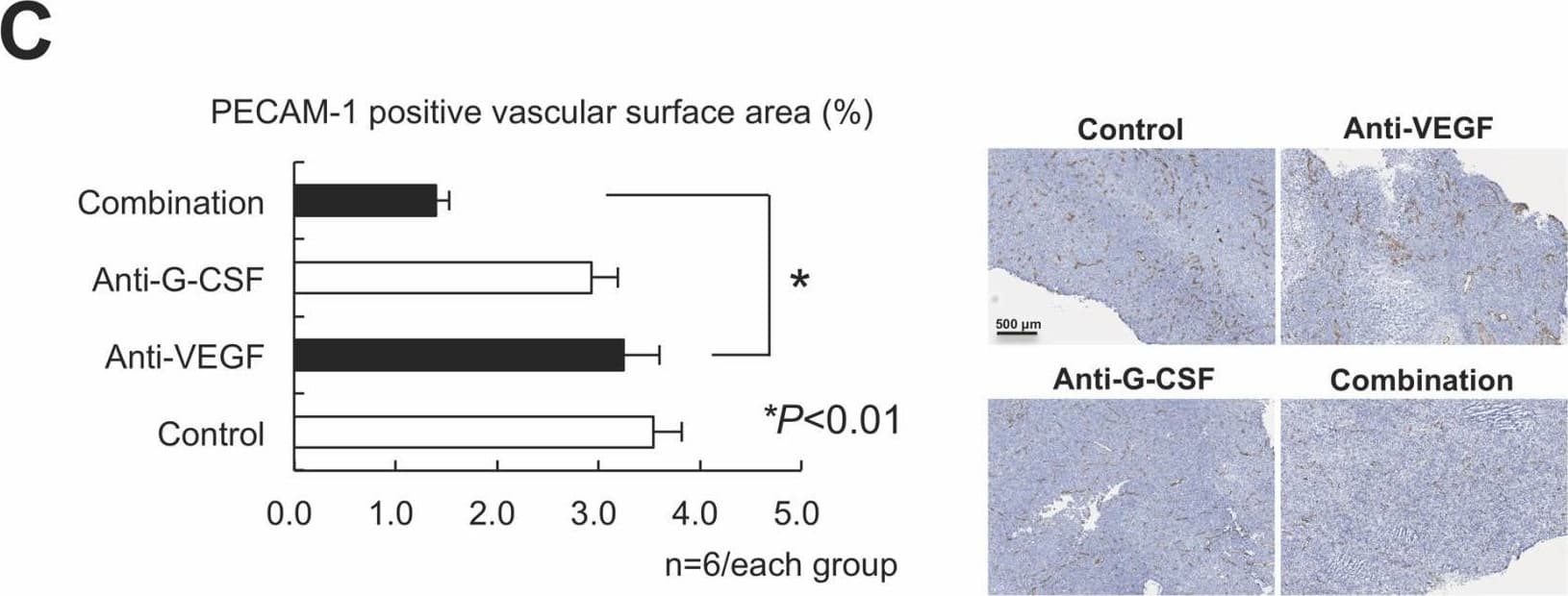
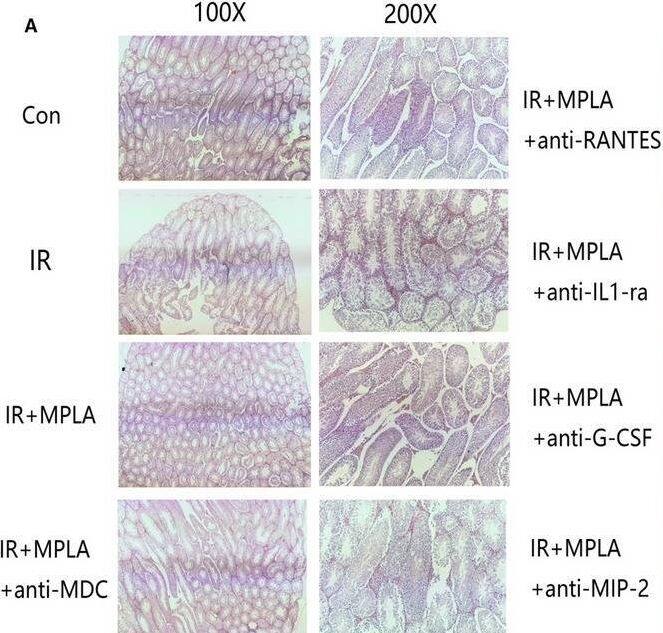
Detection of G-CSF by Immunohistochemistry
G-CSF, but neither IL-17 nor Bv8, was still essential to the intratumor recruitment of PMN-MDSCs and antitumor angiogenesis in the LLC tumor model(A) Confirmation that G-CSF, but not IL-17, was involved in anti-VEGF-mediated upregulation in LLC tumor lysate assessed by ELISA assay. (n = 6/group). (B) Neither anti-VEGF nor capecitabine affected Bv8 expression as assessed by ELISA. (n = 6/group). (C) Effects of anti-VEGF, anti-G-CSF, and their combination on LLC tumor angiogenesis. The PECAM-1-positive vascular surface area was identified by immunohistochemistry. Only the combination, but not either sole therapy, could reduce the tumor angiogenesis. (n = 6/group). (D) Effects of anti-VEGF, capecitabine, and their combination on LLC tumor angiogenesis. The PECAM-1-positive vascular surface area was identified by immunohistochemistry. Note that only the combination, but not either sole therapy, could reduce the tumor angiogenesis, similarly to the findings to shown in panel (C). Data are mean ± SEM. N.S.: not significant, *P < 0.01, and #P < 0.05. (n = 5–6/group). Image collected and cropped by CiteAb from the following open publication (https://pubmed.ncbi.nlm.nih.gov/29707135), licensed under a CC-BY license. Not internally tested by R&D Systems.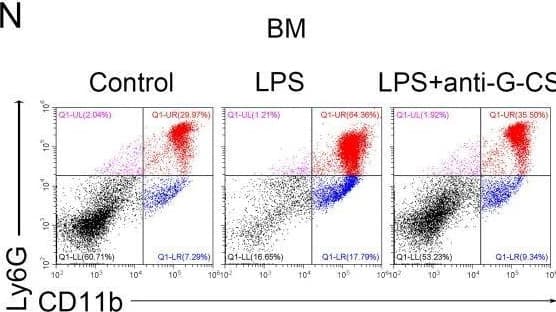
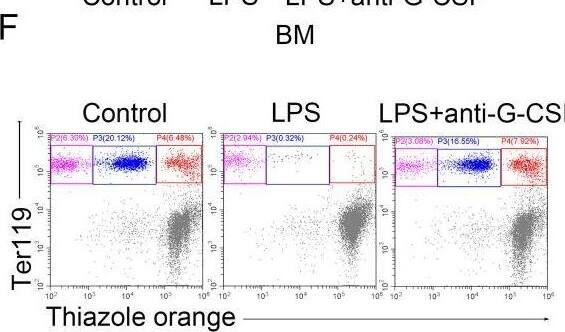
Detection of G-CSF by Flow Cytometry
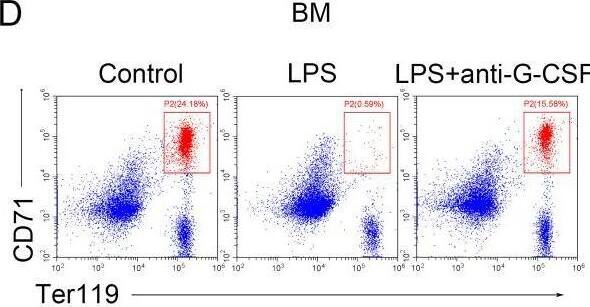
G-CSF neutralization decreases BM granulopoiesis, restores BM erythropoiesis, and suppresses splenic erythropoiesis in LPS-treated mice.(N) Representative flow cytometric plots of CD11b+Ly6G+ cells in the BMs of control mice, LPS-treated mice, and LPS-treated mice with anti–G-CSF treatment. Image collected and cropped by CiteAb from the following open publication (https://pubmed.ncbi.nlm.nih.gov/33234677), licensed under a CC-BY license. Not internally tested by R&D Systems.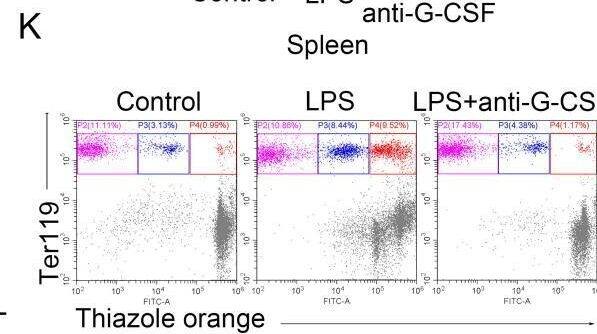
Applications for Mouse G-CSF Antibody
Application
Recommended Usage
Western Blot
1 µg/mL
Sample: Recombinant Mouse G-CSF (Catalog # 414-CS)
Sample: Recombinant Mouse G-CSF (Catalog # 414-CS)
Neutralization
Measured by its ability to neutralize G‑CSF-induced proliferation in the NFS‑60 mouse myeloid cells line. Shirafuji, N. et al. (1989) Exp. Hematol. 17:116. The Neutralization Dose (ND50) is typically 0.01-0.03 µg/mL in the presence of 0.125 ng/mL Recombinant Mouse G‑CSF.
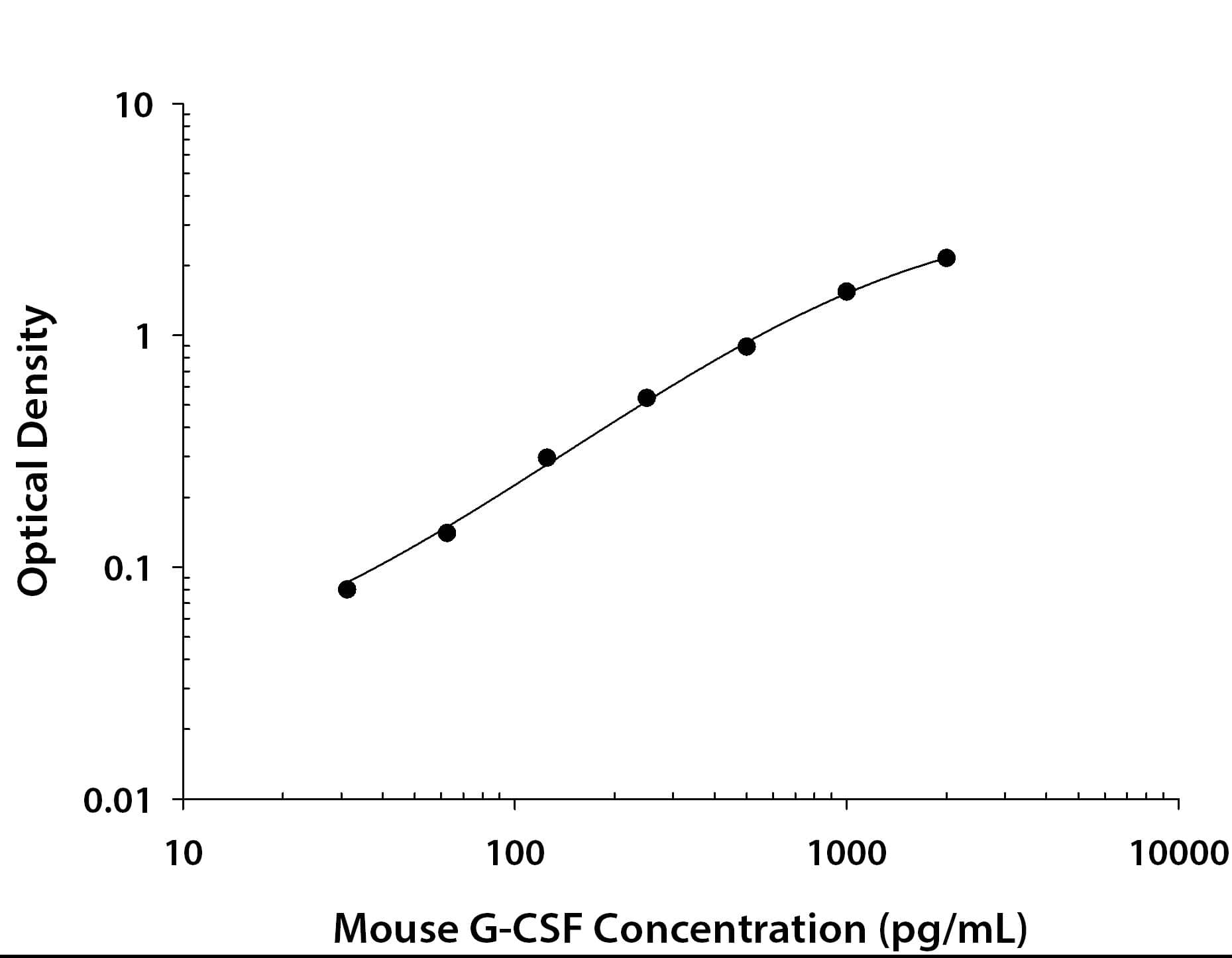
Mouse G-CSF Sandwich Immunoassay
Please Note: Optimal dilutions of this antibody should be experimentally determined.
Reviewed Applications
Read 3 reviews rated 4 using MAB414 in the following applications:
Formulation, Preparation, and Storage
Purification
Protein A or G purified from hybridoma culture supernatant
Reconstitution
Reconstitute at 0.5 mg/mL in sterile PBS. For liquid material, refer to CoA for concentration.
Formulation
Lyophilized from a 0.2 μm filtered solution in PBS with Trehalose. See Certificate of Analysis for details.
*Small pack size (-SP) is supplied either lyophilized or as a 0.2 µm filtered solution in PBS.
*Small pack size (-SP) is supplied either lyophilized or as a 0.2 µm filtered solution in PBS.
Shipping
Lyophilized product is shipped at ambient temperature. Liquid small pack size (-SP) is shipped with polar packs. Upon receipt, store immediately at the temperature recommended below.
Stability & Storage
Use a manual defrost freezer and avoid repeated freeze-thaw cycles.
- 12 months from date of receipt, -20 to -70 °C as supplied.
- 1 month, 2 to 8 °C under sterile conditions after reconstitution.
- 6 months, -20 to -70 °C under sterile conditions after reconstitution.
Background: G-CSF
G-CSF is a pleiotropic cytokine best known for its specific effects on the proliferation, differentiation, and activation of hematopoietic cells of the neutrophilic granulocyte lineage. It is produced mainly by monocytes and macrophages upon activation by endotoxin, TNF-alpha and IFN-gamma. Other cell types including fibroblasts, endothelial cells, astrocytes and bone marrow stromal cells can also secrete G-CSF after LPS, IL-1, or TNF-alpha activation. In addition, various carcinoma cell lines and myeloblastic leukemia cells can express G-CSF constitutively.
The murine G-CSF cDNA encodes a 208 amino acid (aa) residue precursor protein containing a 30 aa residue signal peptide that is proteolytically cleaved to generate the 178 aa residue mature protein. Human G-CSF is 73% identical at the amino acid level to murine G-CSF and the two proteins show species cross-reactivity.
In vitro, G-CSF stimulates growth, differentiation and functions of cells from the neutrophil lineage. It also has blast cell growth factor activity and can synergize with IL-3 to shorten the Go period of early hematopoietic progenitors. Consistent with its in vitro functions, G-CSF has been found to play important roles in defense against infection, in inflammation and repair, and in the maintenance of steady state hematopoiesis. Recombinant human G-CSF has been approved for the amelioration of chemotherapy induced neutropenia as well as for severe chronic neutropenia following marrow transplant.
Long Name
Granulocyte Colony Stimulating Factor
Alternate Names
C17orf33, CSF3, CSF3OS, Filgrastim, GCSF, Lenograstim, Pluripoietin
Gene Symbol
CSF3
UniProt
Additional G-CSF Products
Product Documents for Mouse G-CSF Antibody
Product Specific Notices for Mouse G-CSF Antibody
For research use only
Loading...
Loading...
Loading...
Loading...
Loading...