
Mouse Dkk-3 Antibody
R&D Systems, part of Bio-Techne | Catalog # AF948

Conjugate
Catalog #
Key Product Details
Species Reactivity
Validated:
Mouse
Cited:
Mouse
Applications
Validated:
Western Blot
Cited:
Immunohistochemistry, Western Blot
Label
Unconjugated
Antibody Source
Polyclonal Goat IgG
Product Specifications
Immunogen
Mouse myeloma cell line NS0-derived recombinant mouse Dkk-3
Met1-Ile349
Accession # Q9QUN9
Met1-Ile349
Accession # Q9QUN9
Specificity
Detects mouse Dkk-3 in direct ELISAs and Western blots. In direct ELISAs, approximately 20% cross-reactivity with recombinant human (rh) Dkk‑3 is observed and less than 1% cross-reactivity with rhDkk-1 is observed.
Clonality
Polyclonal
Host
Goat
Isotype
IgG
Scientific Data Images for Mouse Dkk-3 Antibody
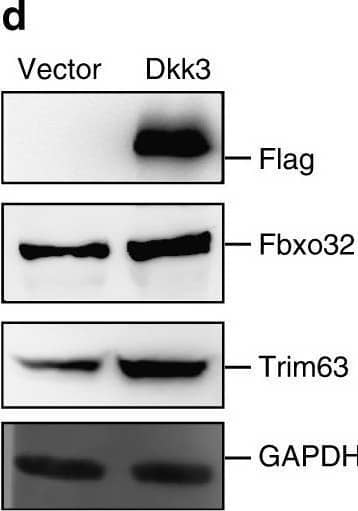
Detection of Mouse Dkk-3 by Western Blot
Over-expression of Dkk3-induced atrophy in cultured myotubes. a Representative images of myotubes over-expressing Dkk3. Primary myotubes were infected by adenovirus-encoding Dkk3 or control vector. Seventy two hours after infection, the myotubes over-expressing Dkk3 were significantly thinner than those infected by control vector. Green indicated myosin heavy chain (MYHC) immunofluorescent staining. Blue indicated DAPI staining of nuclei; Merge indicated merged images of MYHC and DAPI. Scale bars, 50 μm. b Quantification of the average diameters of the myotubes over-expressing Dkk3 or vector control. Error bars indicated s.d. and were based on three independent experiments. The diameters of 900 myotubes were measured in each experiment. ** indicated p < 0.01. cFbxo32 and Trim63 expression levels increased after Dkk3 over-expression. Vector indicated myotubes infected with adenovirus-encoding vector control. Dkk3 indicated myotubes infected with adenovirus-encoding Dkk3. Error bars indicated s.d. and were based on three independent experiments. ** indicated p < 0.01. d Over-expression of Dkk3 increased the protein levels of Fbxo32 and Trim63. Immunoblotting assays were performed with whole-cell extracts from myotubes over-expressing Dkk3 or vector control. Dkk3 was tagged with Flag tag. GAPDH served as internal control. All p-values were based on two-tailed t-test Image collected and cropped by CiteAb from the following open publication (https://pubmed.ncbi.nlm.nih.gov/29717119), licensed under a CC-BY license. Not internally tested by R&D Systems.Applications for Mouse Dkk-3 Antibody
Application
Recommended Usage
Western Blot
0.1 µg/mL
Sample: Recombinant Mouse Dkk-3
Sample: Recombinant Mouse Dkk-3
Formulation, Preparation, and Storage
Purification
Antigen Affinity-purified
Reconstitution
Reconstitute at 0.2 mg/mL in sterile PBS. For liquid material, refer to CoA for concentration.
Formulation
Lyophilized from a 0.2 μm filtered solution in PBS with Trehalose. *Small pack size (SP) is supplied either lyophilized or as a 0.2 µm filtered solution in PBS.
Shipping
Lyophilized product is shipped at ambient temperature. Liquid small pack size (-SP) is shipped with polar packs. Upon receipt, store immediately at the temperature recommended below.
Stability & Storage
Use a manual defrost freezer and avoid repeated freeze-thaw cycles.
- 12 months from date of receipt, -20 to -70 °C as supplied.
- 1 month, 2 to 8 °C under sterile conditions after reconstitution.
- 6 months, -20 to -70 °C under sterile conditions after reconstitution.
Background: Dkk-3
Dkk-3 (Dickkopf-related protein 3; also REIC) is a 65-70 kDa secreted glycoprotein member of the Dickkopf family of molecules. It is expressed by multiple cell types, including neurons, endothelial cells, keratinocytes and zona glomerulosa cells of the adrenal. Dkk-3 is reported to be a positive regulator of Wnt signaling. It is suggested to bind exclusively to Wnt-inhibiting Kremen proteins, thereby blocking their expression on the cell surface. This makes LRP available for Wnt binding and signaling. Dkk-3 is also reported to induce the development of DC from monocytes. Mature mouse Dkk-3 is 328 amino acids (aa) in length (aa 22-349). It contains one coiled-coil region (aa 39-84), two consecutive Dkk-type Cys-rich regions (aa 147-195 and 208-284), and one phosphoserine site at Ser298. Over aa 22-349, mouse shares 83% and 92% aa identity with human and rat Dkk-3, respectively.
Long Name
Dickkopf-3
Alternate Names
Dkk3, REIC
Gene Symbol
DKK3
UniProt
Additional Dkk-3 Products
Product Documents for Mouse Dkk-3 Antibody
Product Specific Notices for Mouse Dkk-3 Antibody
For research use only
Loading...
Loading...
Loading...
Loading...
Loading...