
LC3B Antibody - BSA Free Best Seller
Novus Biologicals, part of Bio-Techne | Catalog # NB100-2220



Conjugate
Catalog #
Key Product Details
Validated by
Knockout/Knockdown, Biological Validation
Species Reactivity
Validated:
Human, Mouse, Rat, Porcine, Alligator, Avian, Bacteria, Bovine, Canine, Chicken, Chinese Hamster, Golden Syrian Hamster, Guinea Pig, Hamster, Invertebrate, Monkey, Primate, Rabbit, Zebrafish
Cited:
Human, Mouse, Rat, Porcine, Alligator, Avian, Avian - Chicken, Bacteria, Bovine, Canine, Fish - Danio rerio (Zebrafish), Golden Syrian Hamster, Guinea Pig, Hamster, Insect - Drosophila melanogaster, Invertebrate, Nematode - Caenorhabditis elegans, Primate, Primate - Macaca mulatta (Rhesus Macaque), Rabbit
Applications
Validated:
Knockout Validated, Immunohistochemistry, Immunohistochemistry-Paraffin, Immunohistochemistry-Frozen, Western Blot, Immunoblotting, ELISA, Flow Cytometry, Immunocytochemistry/ Immunofluorescence, Simple Western, Immunoprecipitation, Chromatin Immunoprecipitation (ChIP), Proximity Ligation Assay, Knockdown Validated, SDS-PAGE
Cited:
Knockout Validated, Immunohistochemistry, Immunohistochemistry-Paraffin, Immunohistochemistry-Frozen, Western Blot, Immunoblotting, ELISA, Block/Neutralize, Flow Cytometry, Immunocytochemistry, Immunocytochemistry/ Immunofluorescence, Simple Western, Immunoprecipitation, Chemotaxis, Proximity Ligation Assay, IF/IHC, Electron Microscopy, Knockdown Validated, SDS-PAGE
Label
Unconjugated
Antibody Source
Polyclonal Rabbit IgG
Format
BSA Free
Concentration
1.0 mg/ml
Product Specifications
Immunogen
Polyclonal LC3B Antibody was made to a synthetic peptide made to an N-terminal portion of the human LC3B protein sequence (between residues 1-100). [UniProt# Q9GZQ8]
Reactivity Notes
Use in Rat reported in scientific literature (PMID:34622072). Use in Chinese Hamster reported in scientific literature (PMID:34332287). Mouse reactivity reported in scientific literature (PMID:32814898). Bovine reactivity reported in scientific literature (PMID: 24895572). Primate reactivity reported in scientific literature (PMID: 25142602). Canine reactivity reported in scientific literature (PMID: 25839646). Avian reactivity reported in scientific literature (PMID: 29546310). Hamster reactivity reported in scientific literature (PMID: 26423766). Rabbit reactivity reported in scientific literature (PMID: 26497211). The mouse detection has been reported to be weaker than the human. Immunogen displays the following percentage of sequence identity for non-tested species: Xenopus 84%. Invertebrate reactivity reported in scientific literature (PMID: 26716072 ). Monkey reactivity reported in scientific literature (PMID: 30324853). Guinea pig reactivity reported from a verified customer review. Rat reactivity reported in scientific literature (PMID: 30744518). Bacteria reactivity reported in scientific literature (PMID: 28783414). Chicken reactivity reported in scientific literature (PMID: 30649814). Porcine reactivity reported in scientific literature (PMID: 30789643). Golden Syrian hamster reactivity reported in scientific literature (PMID: 23180219). Zebrafish reactivity reported in scientific literature (PMID: 29185873). Human reactivity reported in scientific literature (PMID:33086573). Use in Alligator reported in scientific literature (PMID:32061056).
Localization
Type I form of LC3B is cytoplasmic, whereas the type II form of LC3B binds to the autophagic membranes.
Marker
Autophagosome Marker
Clonality
Polyclonal
Host
Rabbit
Isotype
IgG
Theoretical MW
14.688 kDa.
Disclaimer note: The observed molecular weight of the protein may vary from the listed predicted molecular weight due to post translational modifications, post translation cleavages, relative charges, and other experimental factors.
Disclaimer note: The observed molecular weight of the protein may vary from the listed predicted molecular weight due to post translational modifications, post translation cleavages, relative charges, and other experimental factors.
Scientific Data Images for LC3B Antibody - BSA Free
Knockout Validation of LC3B Antibody in HeLa and LC3B Knockout HeLa Cells in Western Blot
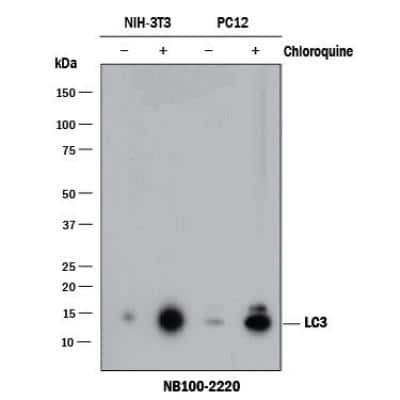
Lysates of HeLa parental cell line and LC3B knockout HeLa cell line (KO) untreated (-) or treated (+) with 50 uM CQ for 18 hours. PVDF (Polyvinylidene difluoride) membrane was probed with 0.5 ug/mL of Rabbit Anti-LC3B Polyclonal Antibody (Catalog # NB100-2220) followed by HRP-conjugated Anti-Rabbit IgG Secondary Antibody (Catalog# HAF008). A specific band was detected for LC3B at a molecular weight of approximately 15 kDa (as indicated) in the parental HeLa cell line, but is not detectable in the knockout HeLa cell line. GAPDH is shown as a loading control. This experiment was conducted under reducing conditions.
Knockout Validation of LC3B Antibody in HeLa and LC3B Knockout HeLa Cells in Immunocytochemistry/Immunofluorescence
LC3B was detected in immersion fixed CQ treated HeLa cells (left) but was not detected in LC3B knockout HeLa cells (right) using rabbit anti-human LC3B polyclonal antibody (Catalog #NB100-2220) at 0.3 ug/mL for 3 hours at room temperature. Cells were stained using the NorthernLights(TM) 557-conjugated anti-Rabbit IgG Secondary Antibody (red; Catalog # NL004) and counterstained with DAPI (blue). Specific staining was localized to cytoplasm.




























Applications for LC3B Antibody - BSA Free
Application
Recommended Usage
Immunocytochemistry/ Immunofluorescence
1:200
Immunohistochemistry
1:200 - 1:400
Immunohistochemistry-Paraffin
1:200 - 1:400
Immunoprecipitation
20 ug/500 ug of protein
Simple Western
1:50
Western Blot
0.5 - 2.0 ug/mL
Application Notes
Use in SDS-PAGE reported in scientific literature (PMID:34315875).
Reviewed Applications
Read 51 reviews rated 4.6 using NB100-2220 in the following applications:
- Immunocytochemistry (2 Reviews)
- Immunocytochemistry/Immunofluorescence (1 Review)
- Immunofluorescence (1 Review)
- Immunohistochemistry (1 Review)
- Immunohistochemistry-Frozen (1 Review)
- Immunohistochemistry-Paraffin (1 Review)
- Immunoprecipitation (1 Review)
- Simple Western (3 Reviews)
- Western Blot (40 Reviews)
Formulation, Preparation, and Storage
Purification
Immunogen affinity purified
Formulation
PBS
Format
BSA Free
Preservative
0.02% Sodium Azide
Concentration
1.0 mg/ml
Shipping
The product is shipped with polar packs. Upon receipt, store it immediately at the temperature recommended below.
Stability & Storage
Store at -20C.
Background: LC3B
Autophagic flux is supported by autophagy-related proteins (Atgs) initially identified in yeast (6,7). The core autophagy machinery is comprised of 17 Atg proteins that play specific roles in autophagosome formation. Among these Atg proteins, Atg8 is not only involved in autophagosome formation but also functions in cargo selection. In mammals, several Atg8 homologues have been identified including microtubule-associated protein 1 light chain 3 alpha, beta and gamma - LC3A, LC3B, and LC3C (8) respectively, as well as GABA type A receptor-associated protein (GABARAP), GABARAP-Like1, and GABARAP-Like2 (9). LC3 (predicted molecular weight 14kD) is ubiquitously expressed and undergoes posttranslational processing after synthesis. First, the cysteine protease Atg4 cleaves a carboxy terminal sequence to generate the cytosolic form LC3-I. Next, E1-like (Atg7) and E2-like (Atg3) enzymes conjugate phosphatidylethanolamine to the newly exposed carboxyterminal glycine, generating LC3-II. Finally, the Atg12-Atg5-Atg16L1 complex participates in LC3 lipidation and autophagosome formation (10). LC3B-I to LC3B-II conversion correlates with autophagosome number and is considered the best marker to monitor autophagy.
References
1. Yu, L., Chen, Y., & Tooze, S. A. (2018). Autophagy pathway: Cellular and molecular mechanisms. Autophagy. https://doi.org/10.1080/15548627.2017.1378838
2. Forrester, A., De Leonibus, C., Grumati, P., Fasana, E., Piemontese, M., Staiano, L., ... Settembre, C. (2019). A selective ER -phagy exerts procollagen quality control via a Calnexin- FAM 134B complex. The EMBO Journal. https://doi.org/10.15252/embj.201899847
3. He, X., Zhu, Y., Zhang, Y., Geng, Y., Gong, J., Geng, J., ... Zhong, H. (2019). RNF34 functions in immunity and selective mitophagy by targeting MAVS for autophagic degradation. The EMBO Journal. https://doi.org/10.15252/embj.2018100978
4. Mathai, B., Meijer, A., & Simonsen, A. (2017). Studying Autophagy in Zebrafish. Cells. https://doi.org/10.3390/cells6030021
5. Losier, T. T., Akuma, M., McKee-Muir, O. C., LeBlond, N. D., Suk, Y., Alsaadi, R. M., ... Russell, R. C. (2019). AMPK Promotes Xenophagy through Priming of Autophagic Kinases upon Detection of Bacterial Outer Membrane Vesicles. Cell Reports. https://doi.org/10.1016/j.celrep.2019.01.062
6. Nakatogawa, H., Suzuki, K., Kamada, Y., & Ohsumi, Y. (2009). Dynamics and diversity in autophagy mechanisms: Lessons from yeast. Nature Reviews Molecular Cell Biology. https://doi.org/10.1038/nrm2708
7. Tsukada, M., & Ohsumi, Y. (1993). Isolation and characterization of autophagy-defective mutants of Saccharomyces cerevisiae. FEBS Letters. https://doi.org/10.1016/0014-5793(93)80398-E
8. Wild, P., McEwan, D. G., & Dikic, I. (2014). The LC3 interactome at a glance. Journal of Cell Science. https://doi.org/10.1242/jcs.140426
9. Igloi, G. L. (2001). Cloning, expression patterns, and chromosome localization of three human and two mouse homologues of GABAA receptor-associated protein. Genomics. https://doi.org/10.1006/geno.2001.6555
10. Glick, D., Barth, S., & Macleod, K. F. (2010). Autophagy: Cellular and molecular mechanisms. Journal of Pathology. https://doi.org/10.1002/path.2697
Long Name
Microtubule-associated Protein 1 Light Chain 3 beta
Alternate Names
Apg8b, ATG8F, LC3II, MAP1LC3B, anti-LC3B, atg8f antibody, LC3B ihc, LC3B immunohistochemistry, LC3B immunoprecipitation, LC3B western blot
Gene Symbol
MAP1LC3B
Additional LC3B Products
Product Documents for LC3B Antibody - BSA Free
Product Specific Notices for LC3B Antibody - BSA Free
This product is for research use only and is not approved for use in humans or in clinical diagnosis. Primary Antibodies are guaranteed for 1 year from date of receipt.
Loading...
Loading...
Loading...
Loading...
Loading...
Loading...