
Human TTK Antibody
R&D Systems, part of Bio-Techne | Catalog # AF6028

Conjugate
Catalog #
Key Product Details
Species Reactivity
Human
Applications
Immunohistochemistry, Western Blot
Label
Unconjugated
Antibody Source
Polyclonal Sheep IgG
Product Specifications
Immunogen
E. coli-derived recombinant human TTK
Ser281-Leu481
Accession # P33981
Ser281-Leu481
Accession # P33981
Specificity
Detects human TTK in Western blots.
Clonality
Polyclonal
Host
Sheep
Isotype
IgG
Scientific Data Images for Human TTK Antibody
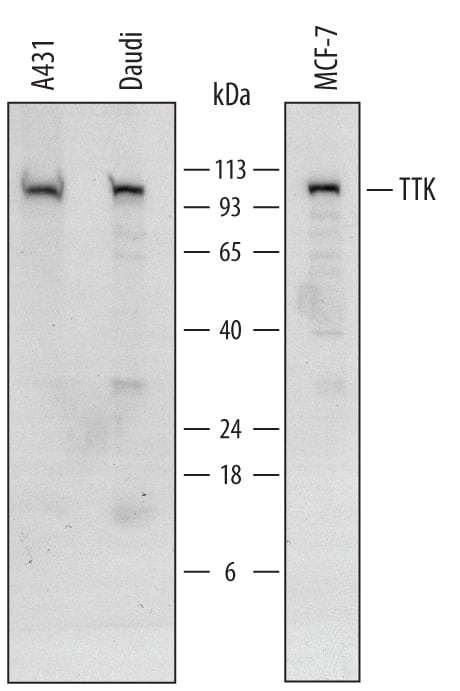
Detection of Human TTK by Western Blot.
Western blot shows lysates of A431 human epithelial carcinoma cell line, Daudi human Burkitt's lymphoma cell line, and MCF-7 human breast cancer cell line. PVDF Membrane was probed with 0.5 µg/mL of Sheep Anti-Human TTK Antigen Affinity-purified Polyclonal Antibody (Catalog # AF6028) followed by HRP-conjugated Anti-Sheep IgG Secondary Antibody (Catalog # HAF016). A specific band was detected for TTK at approximately 100 kDa (as indicated). This experiment was conducted under reducing conditions and using Immunoblot Buffer Group 1.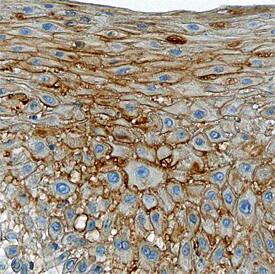
TTK in Human Squamous Cell Carcinoma.
TTK was detected in immersion fixed paraffin-embedded sections of human squamous cell carcinoma using Sheep Anti-Human TTK Antigen Affinity-purified Polyclonal Antibody (Catalog # AF6028) at 15 µg/mL overnight at 4 °C. Tissue was stained using the Anti-Sheep HRP-DAB Cell & Tissue Staining Kit (brown; Catalog # CTS019) and counterstained with hematoxylin (blue). Specific staining was localized to plasma membranes of epithelial cells. View our protocol for Chromogenic IHC Staining of Paraffin-embedded Tissue Sections.Applications for Human TTK Antibody
Application
Recommended Usage
Immunohistochemistry
5-15 µg/mL
Sample: Immersion fixed paraffin-embedded sections of human squamous cell carcinoma
Sample: Immersion fixed paraffin-embedded sections of human squamous cell carcinoma
Western Blot
0.5 µg/mL
Sample: A431 human epithelial carcinoma cell line, Daudi human Burkitt's lymphoma cell line, and MCF‑7 human breast cancer cell line
Sample: A431 human epithelial carcinoma cell line, Daudi human Burkitt's lymphoma cell line, and MCF‑7 human breast cancer cell line
Formulation, Preparation, and Storage
Purification
Antigen Affinity-purified
Reconstitution
Reconstitute at 0.2 mg/mL in sterile PBS. For liquid material, refer to CoA for concentration.
Formulation
Lyophilized from a 0.2 μm filtered solution in PBS with Trehalose. *Small pack size (SP) is supplied either lyophilized or as a 0.2 µm filtered solution in PBS.
Shipping
Lyophilized product is shipped at ambient temperature. Liquid small pack size (-SP) is shipped with polar packs. Upon receipt, store immediately at the temperature recommended below.
Stability & Storage
Use a manual defrost freezer and avoid repeated freeze-thaw cycles.
- 12 months from date of receipt, -20 to -70 °C as supplied.
- 1 month, 2 to 8 °C under sterile conditions after reconstitution.
- 6 months, -20 to -70 °C under sterile conditions after reconstitution.
Background: TTK
TTK (Dual specificity Thr/Tyr kinase; also PYT and hMps1) is a 97-105 kDa member of the Ser/Thr protein kinase family of enzymes. It is expressed in rapidly proliferating tissues and cell lines, and participates in cell cycle regulation. In particular, it directs chromosome alignment, centrosome duplication, and spindle assembly checkpoint formation. Via phosphorylation, TTK is known to regulate p53, CDCA8 and TACC2. Human TTK is 857 amino acids (aa) in length and contains one protein kinase domain (aa 525-791). Activation occurs following homodimerization and autophosphorylation on Thr675, Thr676 and Thr686.
Long Name
TTK Protein Kinase
Alternate Names
Mps1, MPS1L1, PYT
Gene Symbol
TTK
UniProt
Additional TTK Products
Product Documents for Human TTK Antibody
Product Specific Notices for Human TTK Antibody
For research use only
Loading...
Loading...
Loading...
Loading...
Loading...