
Human TNF RI/TNFRSF1A Antibody
R&D Systems, part of Bio-Techne | Catalog # AF225



Conjugate
Catalog #
Key Product Details
Species Reactivity
Validated:
Human
Cited:
Human, Mouse, Porcine
Applications
Validated:
Western Blot, Flow Cytometry, Immunocytochemistry, Agonist Activity, CyTOF-ready
Cited:
Immunohistochemistry, Immunohistochemistry-Paraffin, Immunohistochemistry-Frozen, Western Blot, Neutralization, Flow Cytometry, Immunocytochemistry, Immunoprecipitation, ELISA Development, Functional Assay
Label
Unconjugated
Antibody Source
Polyclonal Goat IgG
Product Specifications
Immunogen
E. coli-derived recombinant human sTNF RI/TNFRSF1A
Accession # NP_001056
Accession # NP_001056
Specificity
Detects human sTNF RI/TNFRSF1A in direct ELISAs and Western blots. In direct ELISAs, less than 20% cross-reactivity with recombinant mouse TNF sRI and recombinant rat TNF sRI is observed. This anti-human TNF RI antibody can interact with the cell surface 55 kDa human TNF RI and exhibits TNF agonist activities on the A549 human lung carcinoma cell line. This antibody also exhibits TNF agonist activities on the L‑929 mouse fibroblast cell line, suggesting that it has cross-species activity with mouse cell surface TNF RI.
Clonality
Polyclonal
Host
Goat
Isotype
IgG
Endotoxin Level
<0.10 EU per 1 μg of the antibody by the LAL method.
Scientific Data Images for Human TNF RI/TNFRSF1A Antibody
TNF RI/TNFRSF1A in Human Peripheral Blood Lymphocytes.
TNF RI/TNFRSF1A was detected in immersion fixed human peripheral blood lymphocytes using 5 µg/mL Human TNF RI/TNFRSF1A Antigen Affinity-purified Polyclonal Antibody (Catalog # AF225) for 3 hours at room temperature. Cells were stained (red) and counterstained (green). View our protocol for Fluorescent ICC Staining of Non-adherent Cells.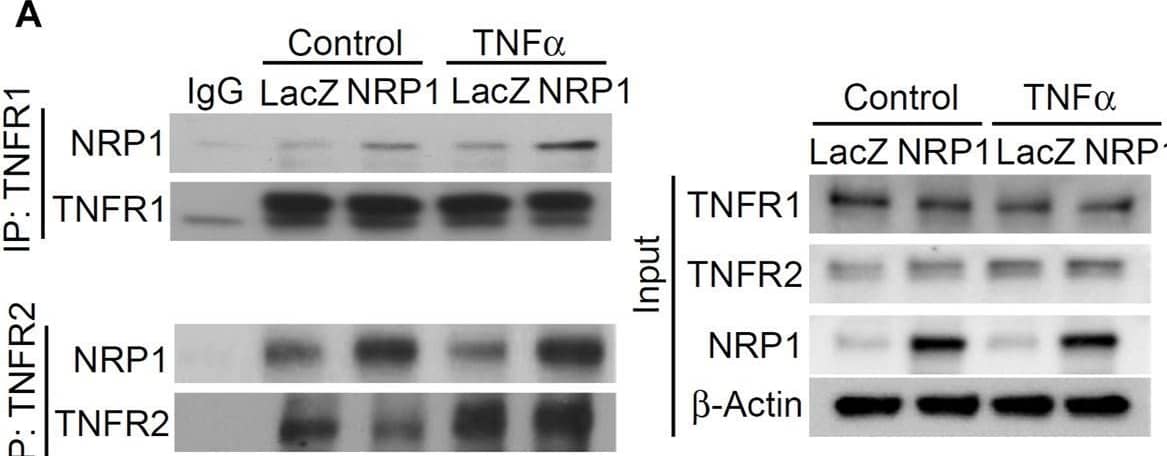
Detection of Human TNF RI/TNFRSF1A by Western Blot
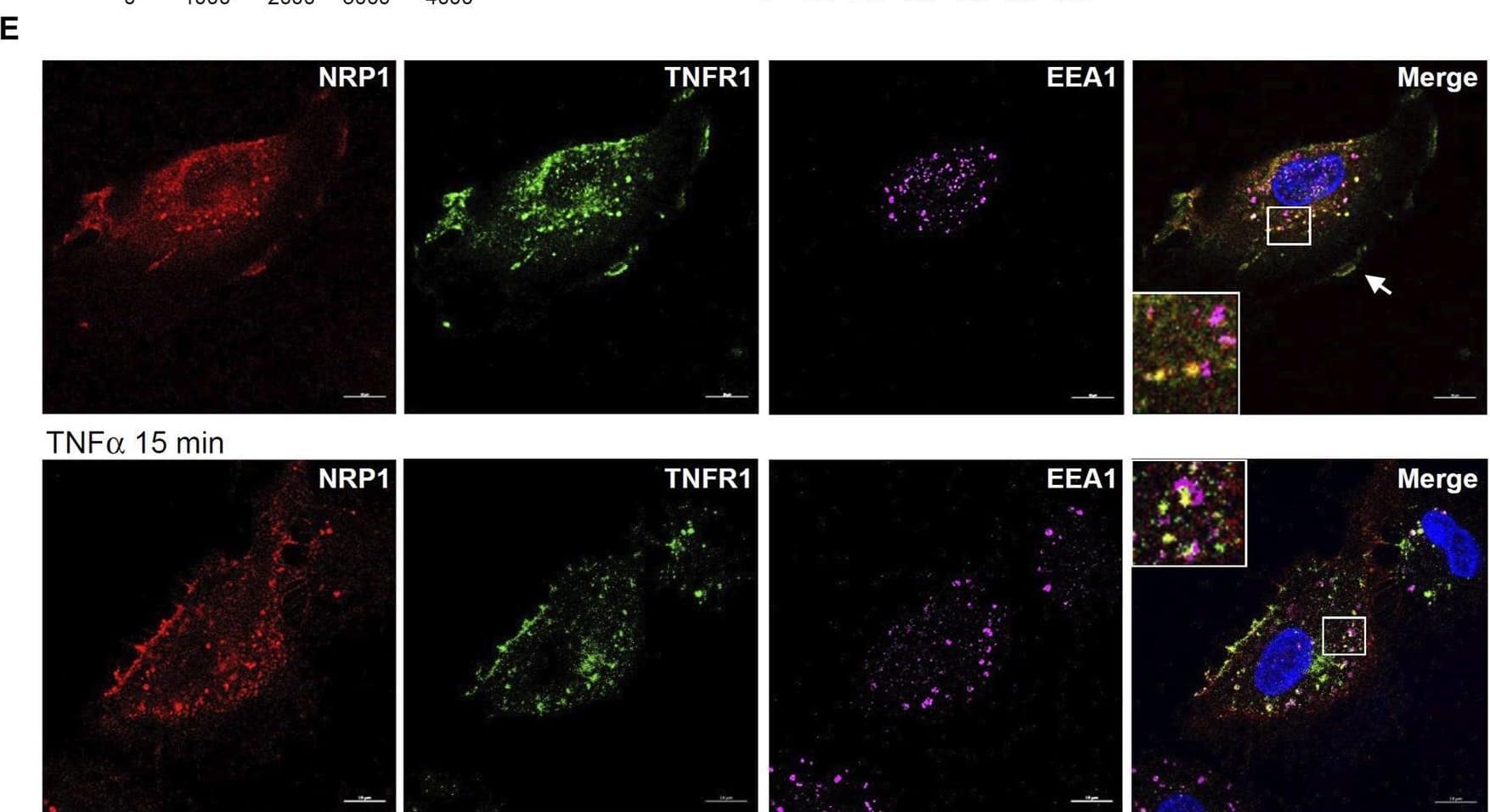
NRP1 and TNFRs are in the same protein complexes. (A) HUVECs were infected with retrovirus expressing NRP1 or LacZ as a control, and then stimulated with TNF alpha (5 ng/mL, 15 min). Cell lysates were immunoprecipated with anti-TNFR1 or TNFR2 antibodies and immunoprecipates were analyzed for the presence of the TNFRs and NRP1 by Western blotting (left panels). Cell lysates were immunoblotted as load control (right panel). (B) HUVECs were infected lentivirus expressing control-shRNA and NRP1-shRNA, respectively, selected with puromycin for 48 h, stimulated with TNF alpha and then subjected to Western blotting. (C, D) HUVECs (5*104/well) were plated into a 24-well plate. Half of the wells were pre-incubated with an excess of “non-GpL” TNF alpha (2 μg/mL) to determine the non-specific binding of Gaussia. princeps luciferase TNF alpha (GpL-TNF alpha). Then all the wells were incubated with GpL-TNF alpha at different concentrations for 30 min at 37°C. The non-specific binding values of the “non-GpL” TNF alpha groups were subtracted from the corresponding total binding values. The data were analyzed by a non-linear regression to a single site using the GraphPad Prism 5 software. The experiments were performed in duplicates and independently repeated for 3 times. (E) HUVECs were stimulated with TNF alpha (5 ng/mL) for 15 min and then subjected to immunofluorescent staining with the indicated antibodies. Nuclei were counterstained with DAPI. Co-localization of NRP1 and TNFR1 in both plasmal membrane (arrow) and cytoplasm were observed. Scale bar, 10 μm. Image collected and cropped by CiteAb from the following open publication (https://www.frontiersin.org/articles/10.3389/fcell.2024.1210944/full), licensed under a CC-BY license. Not internally tested by R&D Systems.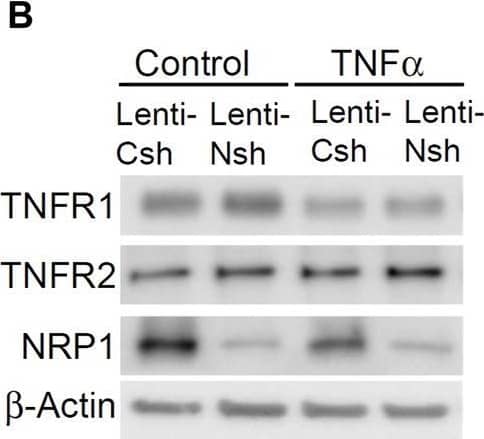
Detection of Human TNF RI/TNFRSF1A by Western Blot
NRP1 and TNFRs are in the same protein complexes. (A) HUVECs were infected with retrovirus expressing NRP1 or LacZ as a control, and then stimulated with TNF alpha (5 ng/mL, 15 min). Cell lysates were immunoprecipated with anti-TNFR1 or TNFR2 antibodies and immunoprecipates were analyzed for the presence of the TNFRs and NRP1 by Western blotting (left panels). Cell lysates were immunoblotted as load control (right panel). (B) HUVECs were infected lentivirus expressing control-shRNA and NRP1-shRNA, respectively, selected with puromycin for 48 h, stimulated with TNF alpha and then subjected to Western blotting. (C, D) HUVECs (5*104/well) were plated into a 24-well plate. Half of the wells were pre-incubated with an excess of “non-GpL” TNF alpha (2 μg/mL) to determine the non-specific binding of Gaussia. princeps luciferase TNF alpha (GpL-TNF alpha). Then all the wells were incubated with GpL-TNF alpha at different concentrations for 30 min at 37°C. The non-specific binding values of the “non-GpL” TNF alpha groups were subtracted from the corresponding total binding values. The data were analyzed by a non-linear regression to a single site using the GraphPad Prism 5 software. The experiments were performed in duplicates and independently repeated for 3 times. (E) HUVECs were stimulated with TNF alpha (5 ng/mL) for 15 min and then subjected to immunofluorescent staining with the indicated antibodies. Nuclei were counterstained with DAPI. Co-localization of NRP1 and TNFR1 in both plasmal membrane (arrow) and cytoplasm were observed. Scale bar, 10 μm. Image collected and cropped by CiteAb from the following open publication (https://www.frontiersin.org/articles/10.3389/fcell.2024.1210944/full), licensed under a CC-BY license. Not internally tested by R&D Systems.Applications for Human TNF RI/TNFRSF1A Antibody
Application
Recommended Usage
Agonist Activity
Measured in a cytotoxicity assay using L-929 mouse fibrosarcoma cells in the presence of the metabolic inhibitor actinomycin D.
The ED50 for this effect is typically 1-6 μg/mL.
The ED50 for this effect is typically 1-6 μg/mL.
CyTOF-ready
Ready to be labeled using established conjugation methods. No BSA or other carrier proteins that could interfere with conjugation.
Flow Cytometry
2.5 µg/106 cells
Sample: Human blood-derived monocytes
Sample: Human blood-derived monocytes
Immunocytochemistry
5-15 µg/mL
Sample: Immersion fixed human peripheral blood lymphocytes
Sample: Immersion fixed human peripheral blood lymphocytes
Western Blot
0.1 µg/mL
Sample: Recombinant Human TNF RI/TNFRSF1A (Catalog # 636-R1)
Sample: Recombinant Human TNF RI/TNFRSF1A (Catalog # 636-R1)
Formulation, Preparation, and Storage
Purification
Antigen Affinity-purified
Reconstitution
Reconstitute at 0.2 mg/mL in sterile PBS. For liquid material, refer to CoA for concentration.
Formulation
Lyophilized from a 0.2 μm filtered solution in PBS with Trehalose. *Small pack size (SP) is supplied either lyophilized or as a 0.2 µm filtered solution in PBS.
Shipping
Lyophilized product is shipped at ambient temperature. Liquid small pack size (-SP) is shipped with polar packs. Upon receipt, store immediately at the temperature recommended below.
Stability & Storage
Use a manual defrost freezer and avoid repeated freeze-thaw cycles.
- 12 months from date of receipt, -20 to -70 °C as supplied.
- 1 month, 2 to 8 °C under sterile conditions after reconstitution.
- 6 months, -20 to -70 °C under sterile conditions after reconstitution.
Background: TNF RI/TNFRSF1A
TNF RI occurs both in membrane bound and soluble forms and functions as a receptor for TNF-alpha and TNF-beta. In the superfamily nomenclature, it is designated TNFRSF1A.
Long Name
Tumor Necrosis Factor Receptor I
Alternate Names
CD120a, TNFRI, TNFRSF1A
Gene Symbol
TNFRSF1A
UniProt
Additional TNF RI/TNFRSF1A Products
Product Documents for Human TNF RI/TNFRSF1A Antibody
Product Specific Notices for Human TNF RI/TNFRSF1A Antibody
For research use only
Loading...
Loading...
Loading...
Loading...
Loading...
Loading...