
Human SLC1A5 Antibody
R&D Systems, part of Bio-Techne | Catalog # MAB11603

Conjugate
Catalog #
Key Product Details
Species Reactivity
Human
Applications
Immunohistochemistry, Western Blot, Immunocytochemistry
Label
Unconjugated
Antibody Source
Monoclonal Mouse IgG2B Clone # 1085750
Product Specifications
Immunogen
Synthetic Peptide
Accession # Q15758
Accession # Q15758
Specificity
Detects a synthetic peptide corresponding to residues near amino acid 500 of human SLC1A5 protein by Direct ELISA.
Clonality
Monoclonal
Host
Mouse
Isotype
IgG2B
Scientific Data Images for Human SLC1A5 Antibody
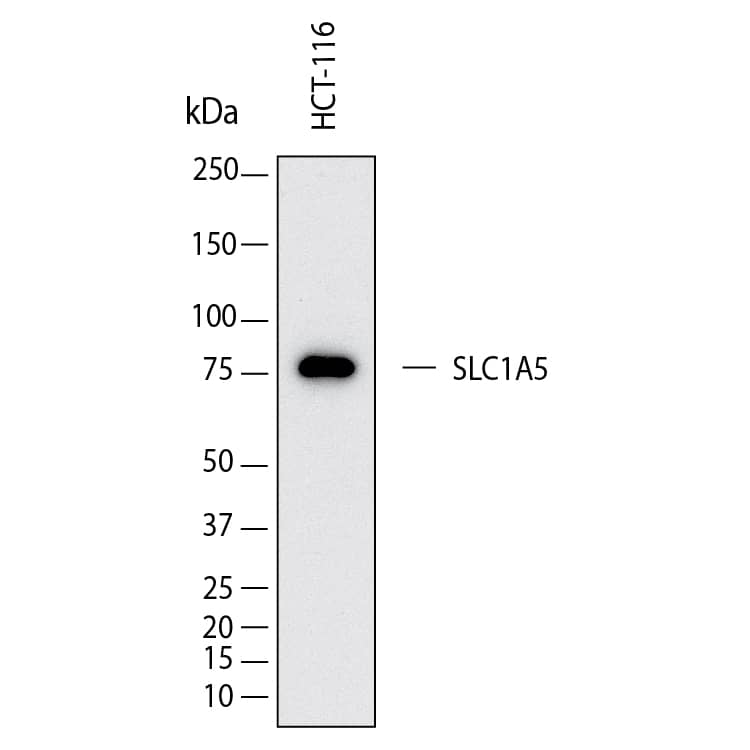
Detection of Human SLC1A5 by Western Blot.
Western Blot shows lysates of HCT-116 human colorectal carcinoma cell line. PVDF membrane was probed with 2 µg/ml of Mouse Anti-Human SLC1A5 Monoclonal Antibody (Catalog # MAB11603) followed by HRP-conjugated Anti-Mouse IgG Secondary Antibody (Catalog # HAF018). A specific band was detected for SLC1A5 at approximately 80 kDa (as indicated). This experiment was conducted under reducing conditions and using Western Blot Buffer Group 1.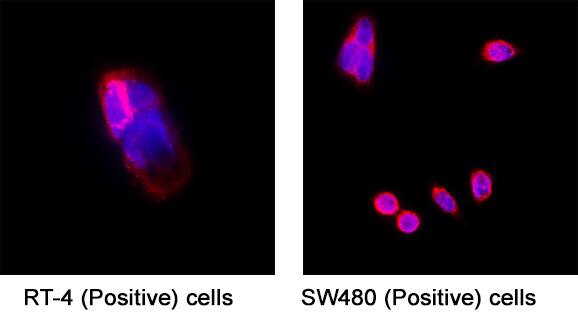
Detection of SLC1A5 in RT-4 cells and SW480 cells.
SLC1A5 was detected in immersion fixed RT-4 human bladder carcinoma cell line (Positive) and SW480 human colorectal adenocarcinoma cell line (Positive) using Mouse Anti-Human SLC1A5 Monoclonal Antibody (Catalog # mab11603) at 8 µg/ml for 3 hours at room temperature. Cells were stained using the NorthernLights™ 557-conjugated Anti-Mouse IgG Secondary Antibody (red; Catalog # NL007) and counterstained with DAPI (blue). Specific staining was localized to the cell surface. View our protocol for Fluorescent ICC Staining of Cells on Coverslips.
Detection of SLC1A5 in Human Prostate.
SLC1A5 was detected in immersion fixed paraffin-embedded sections of human prostate using Mouse Anti-Human SLC1A5 Monoclonal Antibody (Catalog # mab11603) at 0.1 µg/ml for 1 hour at room temperature followed by incubation with the Anti-Mouse IgG VisUCyte™ HRP Polymer Antibody (Catalog # VC001). Before incubation with the primary antibody, tissue was subjected to heat-induced epitope retrieval using VisUCyte Antigen Retrieval Reagent-Basic (Catalog # VCTS021). Tissue was stained using DAB (brown) and counterstained with hematoxylin (blue). Specific staining was localized to the cell membrane of glandular cells. View our protocol for IHC Staining with VisUCyte HRP Polymer Detection Reagents.Applications for Human SLC1A5 Antibody
Application
Recommended Usage
Immunocytochemistry
3-25 µg/mL
Sample: Immersion fixed RT-4 human bladder carcinoma cell line and SW480 human colorectal adenocarcinoma cell line
Sample: Immersion fixed RT-4 human bladder carcinoma cell line and SW480 human colorectal adenocarcinoma cell line
Immunohistochemistry
0.1-10 µg/mL
Sample: Immersion fixed paraffin-embedded sections of human prostate
Sample: Immersion fixed paraffin-embedded sections of human prostate
Western Blot
2 µg/mL
Sample: HCT-116 human colorectal carcinoma cell line
Sample: HCT-116 human colorectal carcinoma cell line
Formulation, Preparation, and Storage
Purification
Protein A or G purified from hybridoma culture supernatant
Reconstitution
Reconstitute lyophilized material at 0.2 mg/ml in sterile PBS. For liquid material, refer to CoA for concentration.
Formulation
Lyophilized from a 0.2 μm filtered solution in PBS with Trehalose.
Shipping
Lyophilized product is shipped at ambient temperature. Liquid small pack size (-SP) is shipped with polar packs. Upon receipt, store immediately at the temperature recommended below.
Stability & Storage
Use a manual defrost freezer and avoid repeated freeze-thaw cycles.
- 12 months from date of receipt, -20 to -70 °C as supplied.
- 1 month, 2 to 8 °C under sterile conditions after reconstitution.
- 6 months, -20 to -70 °C under sterile conditions after reconstitution.
Background: SLC1A5
References
- Nachef M, Ali AK, Almutairi SM, Lee SH. Targeting SLC1A5 and SLC3A2/SLC7A5 as a Potential Strategy to Strengthen Anti-Tumor Immunity in the Tumor Microenvironment. Front Immunol. 2021 Apr 19;12:624324. doi: 10.3389/fimmu.2021.624324. PMID: 33953707; PMCID: PMC8089370.
- Chen P, Jiang Y, Liang J, Cai J, Zhuo Y, Fan H, Yuan R, Cheng S, Zhang Y. SLC1A5 is a novel biomarker associated with ferroptosis and the tumor microenvironment: a pancancer analysis. Aging (Albany NY). 2023 Aug 10;15(15):7451-7475. doi: 10.18632/aging.204911. Epub 2023 Aug 10. PMID: 37566748; PMCID: PMC10457057.
Long Name
SLC1A5
Alternate Names
AAAT, ASCT2, ATBO, baboon M7 virus receptor, M7V1, M7VS1, R16, RD114 virus receptor, RDRC
Gene Symbol
Q15758
UniProt
Additional SLC1A5 Products
Product Documents for Human SLC1A5 Antibody
Product Specific Notices for Human SLC1A5 Antibody
For research use only
Loading...
Loading...
Loading...
Loading...
Loading...