
Human Purine Nucleoside Phosphorylase/PNP Antibody
R&D Systems, part of Bio-Techne | Catalog # AF6486

Conjugate
Catalog #
Key Product Details
Species Reactivity
Human
Applications
Western Blot, Simple Western
Label
Unconjugated
Antibody Source
Polyclonal Sheep IgG
Product Specifications
Immunogen
E. coli-derived recombinant human Purine Nucleoside Phosphorylase/PNP
Met1-Ser289
Accession # P00491
Met1-Ser289
Accession # P00491
Specificity
Detects human Purine Nucleoside Phosphorylase/PNP in direct ELISAs and Western blots.
Clonality
Polyclonal
Host
Sheep
Isotype
IgG
Scientific Data Images for Human Purine Nucleoside Phosphorylase/PNP Antibody
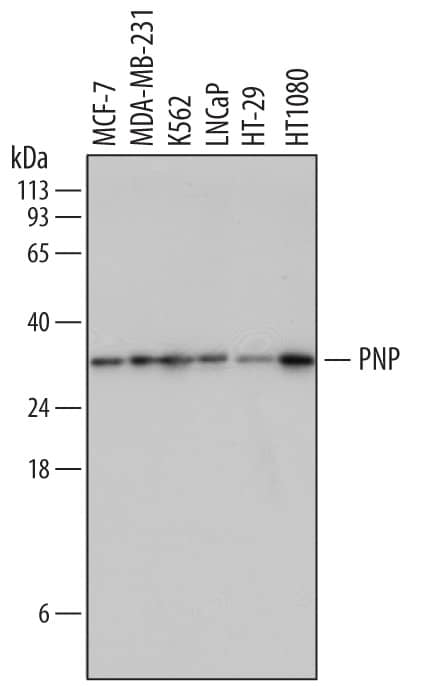
Detection of Human Purine Nucleoside Phosphorylase/ PNP by Western Blot.
Western blot shows lysates of MCF-7 human breast cancer cell line, MDA-MB-231 human breast cancer cell line, K562 human chronic myelogenous leukemia cell line, LNCaP human prostate cancer cell line, HT-29 human colon adenocarcinoma cell line, and HT1080 human fibrosarcoma cell line. PVDF membrane was probed with 1 µg/mL of Sheep Anti-Human Purine Nucleoside Phosphorylase/PNP Antigen Affinity-purified Polyclonal Antibody (Catalog # AF6486) followed by HRP-conjugated Anti-Sheep IgG Secondary Antibody (Catalog # HAF016). A specific band was detected for Purine Nucleoside Phosphorylase/PNP at approximately 32 kDa (as indicated). This experiment was conducted under reducing conditions and using Immunoblot Buffer Group 1.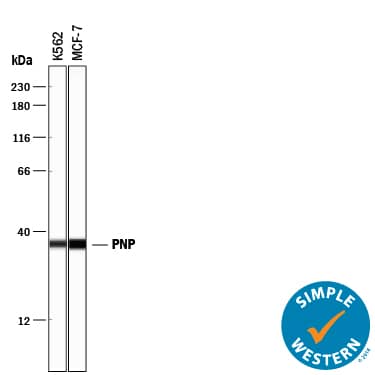
Detection of Human Purine Nucleoside Phosphorylase/PNP by Simple WesternTM.
Simple Western lane view shows lysates of K562 human chronic myelogenous leukemia cell line and MCF-7 human breast cancer cell line, loaded at 0.2 mg/mL. A specific band was detected for Purine Nucleoside Phosphorylase/PNP at approximately 36 kDa (as indicated) using 50 µg/mL of Sheep Anti-Human Purine Nucleoside Phosphorylase/PNP Antigen Affinity-purified Polyclonal Antibody (Catalog # AF6486) followed by 1:50 dilution of HRP-conjugated Anti-Sheep IgG Secondary Antibody (Catalog # HAF016). This experiment was conducted under reducing conditions and using the 12-230 kDa separation system.Applications for Human Purine Nucleoside Phosphorylase/PNP Antibody
Application
Recommended Usage
Simple Western
50 µg/mL
Sample: K562 human chronic myelogenous leukemia cell line and MCF‑7 human breast cancer cell line
Sample: K562 human chronic myelogenous leukemia cell line and MCF‑7 human breast cancer cell line
Western Blot
1 µg/mL
Sample: MCF‑7 human breast cancer cell line, MDA‑MB‑231 human breast cancer cell line, K562 human chronic myelogenous leukemia cell line, LNCaP human prostate cancer cell line, HT‑29 human colon adenocarcinoma cell line, and HT1080 human fibrosarcoma cell line
Sample: MCF‑7 human breast cancer cell line, MDA‑MB‑231 human breast cancer cell line, K562 human chronic myelogenous leukemia cell line, LNCaP human prostate cancer cell line, HT‑29 human colon adenocarcinoma cell line, and HT1080 human fibrosarcoma cell line
Formulation, Preparation, and Storage
Purification
Antigen Affinity-purified
Reconstitution
Sterile PBS to a final concentration of 0.2 mg/mL. For liquid material, refer to CoA for concentration.
Formulation
Lyophilized from a 0.2 μm filtered solution in PBS with Trehalose. *Small pack size (SP) is supplied either lyophilized or as a 0.2 µm filtered solution in PBS.
Shipping
Lyophilized product is shipped at ambient temperature. Liquid small pack size (-SP) is shipped with polar packs. Upon receipt, store immediately at the temperature recommended below.
Stability & Storage
Use a manual defrost freezer and avoid repeated freeze-thaw cycles.
- 12 months from date of receipt, -20 to -70 °C as supplied.
- 1 month, 2 to 8 °C under sterile conditions after reconstitution.
- 6 months, -20 to -70 °C under sterile conditions after reconstitution.
Background: Purine Nucleoside Phosphorylase/PNP
Purine Nucleoside Phosphorylase (PNP) catalyzes the phophorolysis of N-ribosidic bonds of purine nucleosides and deoxynucleosides. Physiological substrates of PNP include inosine, guanosine, and 2'-deoxyguanosine, but not adenosine (1). PNP is expressed in most tissues, with markedly greater expression in lymphoid tissues. Genetic deficiencies of PNP result in severely compromised T‑lymphocyte function and neurologic dysfunction (2, 3). PNP is used in assays for the measurement of inorganic phosphate (4).
References
- Schramm, V.L. (1998) Annu. Rev. Biochem. 67:693.
- Stoop, W. et al. (1977) N. Eng. J. Med. 296:651.
- Markert, M.L. (1991) Immunodefic. Rev. 3:45.
- Webb, M.R. (1992) Proc. Natl. Acad. Sci. USA. 89:4884.
Alternate Names
Inosine phosphorylase, PUNP
Entrez Gene IDs
4860 (Human)
Gene Symbol
PNP
UniProt
Additional Purine Nucleoside Phosphorylase/PNP Products
Product Documents for Human Purine Nucleoside Phosphorylase/PNP Antibody
Product Specific Notices for Human Purine Nucleoside Phosphorylase/PNP Antibody
For research use only
Loading...
Loading...
Loading...
Loading...
Loading...